
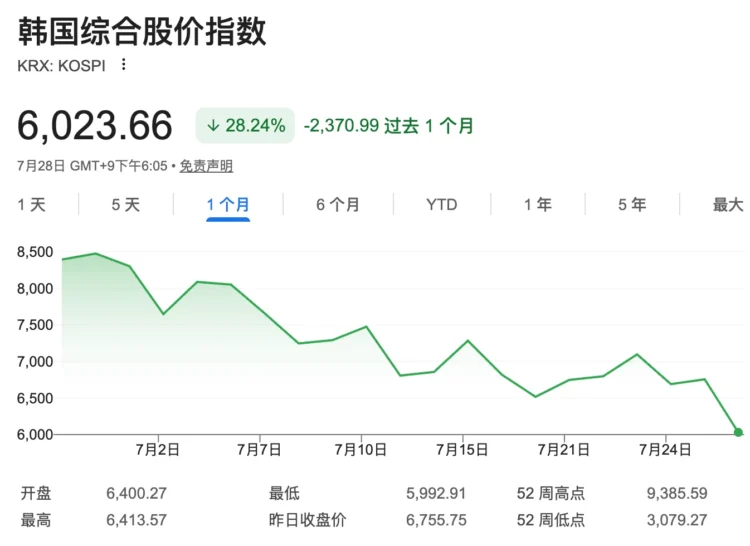
South Korea’s stock market tripped another circuit breaker on July 28 after the KOSPI fell more than 11% intraday. The index dropped below 6,000 for the first time since April 14 and is now down more than 35% from its June high. It was the eighth circuit breaker in the Korean market this year.
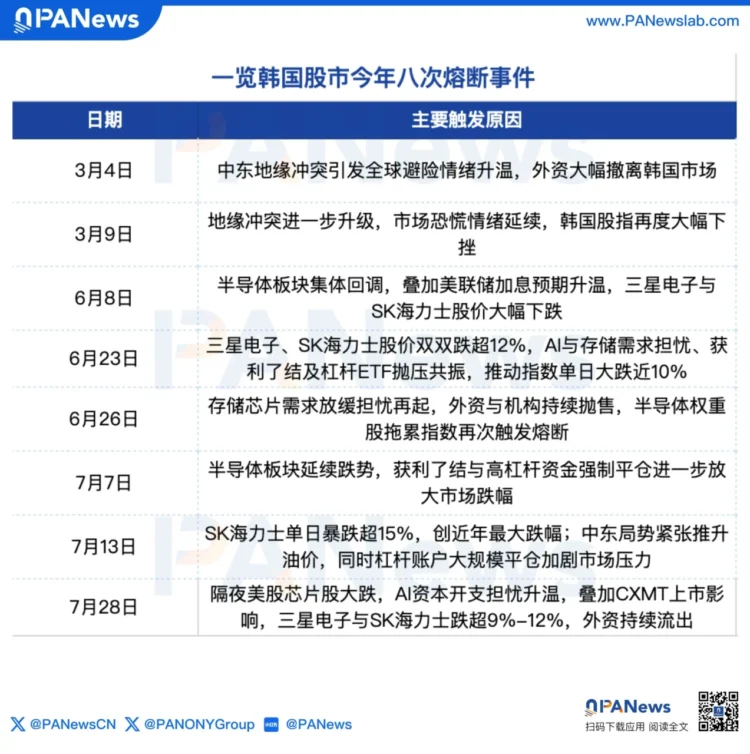
Of those, six have come in the past two months. The report says the two circuit breakers seen in March were largely tied to escalating geopolitical tensions in the Middle East and a broader flight to safety, while the six episodes since June have exposed structural risks building inside the Korean market itself.
Semiconductor weakness became the main drag
The rally in Korean equities had been powered in large part by enthusiasm around AI. That same theme is now working in reverse as investors reassess the durability of AI capital spending, the growth outlook for high-end memory chip demand, and future supply pressure.
Samsung Electronics and SK Hynix have been at the center of that reversal. The two chipmakers once accounted for more than 60% of the KOSPI’s weight, driving much of the market’s earlier advance and helping Korea rank among the world’s strongest-performing equity markets. The concentration also made the market more fragile.
Over the past month, Samsung Electronics has fallen about 31.2%, while SK Hynix has lost more than 14.8%. SK Hynix ADRs also slipped below their issue price less than a month after listing.
SKHX perpetual on Hyperliquid saw a sharp price spike down
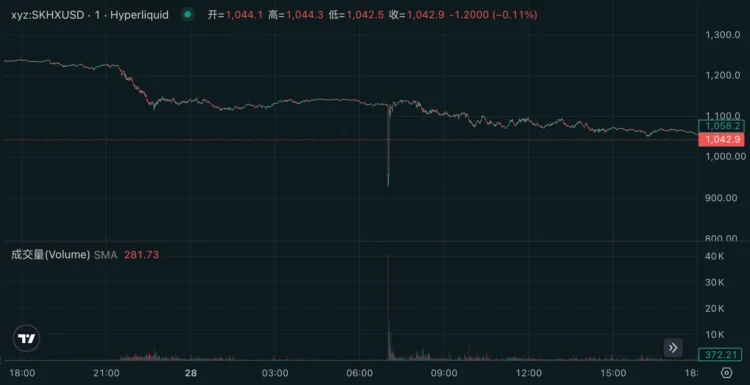
Volatility in the cash market spilled into on-chain perpetuals. According to HyperInsight, the SKHX perpetual contract on Hyperliquid fell from $1,128.2 to $927 at 7 a.m. Beijing time, a brief 17.9% drop that forced liquidations across heavily leveraged long positions.
Open interest by notional value dropped from about $508 million to $388 million. Long liquidations over four hours came close to $80 million, exceeding those in Binance over the same period, according to the report.
The direct trigger was described as an abnormal order worth only about $867 in South Korea’s NXT pre-market session. Because pre-market liquidity was thin, that small trade, though fully compliant with exchange rules, became an important external price input and was picked up by the Trade.XYZ oracle system.
Hyperliquid’s SK Hynix perpetual then adjusted its mark price accordingly. In a highly leveraged derivatives market, even a brief deviation in the mark price can trigger forced liquidations. As long positions were closed out, selling pressure intensified and turned the move into a chain reaction.
Binance was affected to a lesser extent. Before South Korea’s main market opened, Binance was still relying primarily on an internal pricing mechanism rather than switching immediately to external quotes, which helped it avoid liquidations on a similar scale. Still, arbitrage flows between venues pulled SK Hynix perpetual prices lower there as well.
The report says the incident was not market manipulation. It describes the move as a butterfly effect created by a combination of low liquidity, external price feeds and high leverage. In a mature spot market, a trade worth less than $1,000 would usually have little visible impact. In an on-chain derivatives market that depends on external price inputs, a small trade can move the mark price through oracle design and then spread into a much larger leveraged book.
Hyperliquid comments on the HIP-3 mechanism
After the event, Hyperliquid said the SKHYNIX perpetual contract was deployed and operated by the Trade.xyz team. That team is investigating the cause and will share an update after the analysis is complete.
Hyperliquid also explained the HIP-3 market structure. Under that framework, deployers are responsible for pushing mark prices, oracle inputs and external price feeds for their markets. They can use a mark-price method similar to validator-run perpetuals, where the protocol contributes one of three median components and the deployer supplies the other two, which can influence the final mark price. Hyperliquid gave this example: if the median of the latest on-chain trade, best bid and best ask is 100, and the deployer submits 150 and 151, the resulting mark price would be 150.
The liquidation chain triggered by a small trade has put the focus back on several issues in on-chain derivatives: the stability of price sources, oracle design, and the strength of liquidation protections during extreme market conditions.
Regulators move to tighten leverage rules
July’s market rout has also hit investor confidence in Korea, prompting a faster policy response. The report points to the country’s long-standing retail appetite for leveraged trading as a major amplifier of volatility.
Official data previously disclosed in Korea showed that as of July 13, cumulative forced liquidations for the month had reached KRW 344.2 billion. More than 1.2 million leveraged retail accounts had hit margin-call thresholds, and around 320,000 to 360,000 of those accounts had already been forcibly liquidated by brokerages. Some investors were left owing money to their brokers.
People Power Party lawmaker Kim Eun-hye is said to be discussing whether to pursue a state compensation lawsuit over investor losses. Another lawmaker from the same party, Na Kyung-won, has publicly called for a full investigation into public losses and for active consideration of state compensation, including a parliamentary probe and special counsel review into what she described as a “hasty introduction” by the Blue House and financial authorities.
At the same time, the Financial Services Commission, or FSC, has started tightening oversight of single-stock leveraged products. Under new rules, starting July 31, 2026, the basic margin threshold for ordinary individual investors in those products will rise from KRW 10 million to KRW 30 million. The rules will also refine margin calculations to reduce the impact of momentum-driven leveraged retail trading. Regulators said investment thresholds could be raised again later and personal investment caps may also be introduced.
The report adds that risk is not limited to leveraged ETFs. Retail borrowing to chase equities has also added strain. As stocks climbed earlier, many investors used loans to pursue returns, and Korean banks reportedly saw lending limits come under pressure around mid-year. Some investors with weaker credit profiles moved to illegal private lending, with the number of people in that group rising from 59,000 last year to 119,000.
To reduce financial risk, Korean banks have recently tightened unsecured lending policies. Financial regulators are also considering limits on using borrowed funds to buy high-risk financial products, including a rule that would allow no more than 20% of funds used for financial investments to be allocated to leveraged products tied to a single stock.
Foreign outflows rise as local investors return to U.S. stocks
Foreign capital has been pulling out as volatility worsens. A recent Korea equity strategy report from JPMorgan said net foreign outflows from Korean stocks this year have exceeded $110 billion, the largest on record for a single Asian market. About 90% of that amount was concentrated in Samsung Electronics and SK Hynix.
Fading confidence has also pushed Korean investors back into overseas markets. According to the Seoul Economic Daily, net buying of U.S. stocks by Korean investors topped KRW 5 trillion this month. Data from Seibro, the securities information portal operated by Korea Securities Depository, showed that domestic Korean investors were net buyers of nearly $3.59 billion in U.S. equities from the first to the 27th of the month, about 5.5 times the total for all of June. Most of the money went into semiconductor and technology names.
From a global standout powered by the AI cycle to a market facing repeated circuit breakers, leverage unwinds and foreign capital flight, Korean equities are now going through a harsh repricing phase.