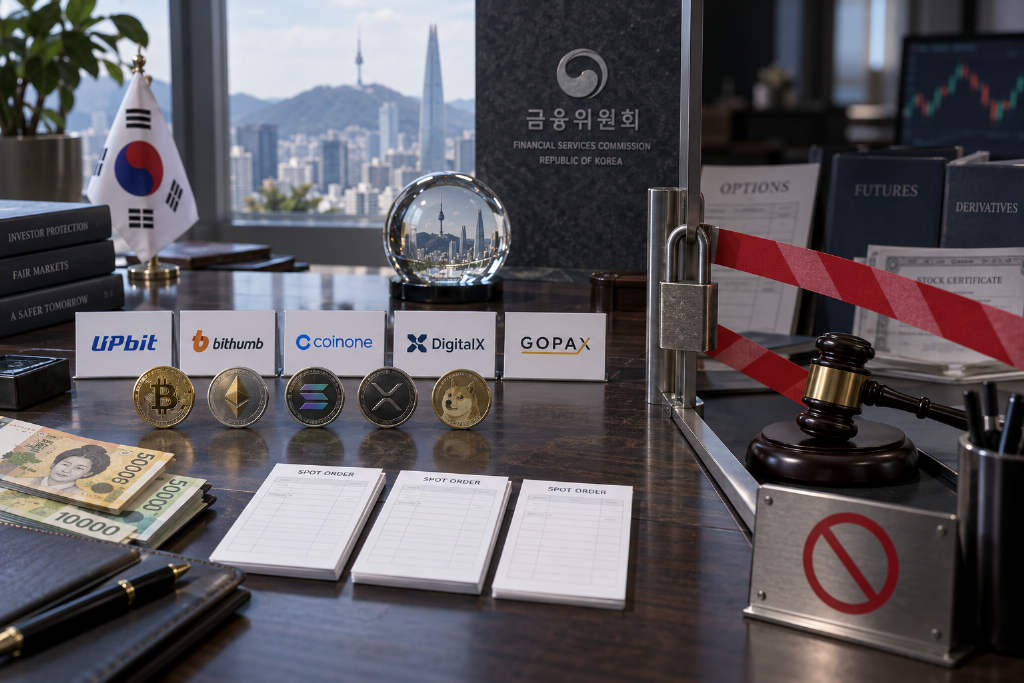
South Korean crypto exchanges are still restricted to spot trading while major global platforms expand into perpetual futures, options, and even stock-related products, according to Daum. CoinGecko data showed that combined spot trading volume at the five largest won-denominated exchanges — Upbit, Bithumb, Coinone, DigitalX, formerly Korbit, and GOPAX — reached about $146.7 billion in the second quarter of 2026, down 33.0% from $218.8 billion in the first quarter. The report contrasted that decline with moves by overseas exchanges to broaden their product lines. Coinbase completed its integration with derivatives exchange Deribit this month and plans to launch a unified platform covering spot, derivatives, and stocks. Binance is also expanding perpetual contracts tied to precious metals, stocks, and indexes. Under current Korean rules, local institutions are barred from running crypto derivatives businesses. The country’s upcoming virtual asset tax law covers spot gains only, while profits from overseas derivatives trading still lack a clear taxation framework. Industry participants are concerned about weakening competitiveness for domestic exchanges and unequal taxation. Korean financial regulators have not provided a specific timetable for allowing crypto derivatives trading.
South Korean crypto exchanges remain confined to spot trading as global platforms push deeper into perpetual futures, options, and traditional stock-related products, according to Daum.
CoinGecko data showed that combined spot trading volume at the five largest won-denominated exchanges — Upbit, Bithumb, Coinone, DigitalX, formerly Korbit, and GOPAX — totaled about $146.7 billion in the second quarter of 2026. That was down 33.0% from $218.8 billion in the first quarter.
Overseas exchanges, by contrast, are continuing to widen their product offerings. Coinbase completed its integration with derivatives exchange Deribit this month and plans to roll out a unified platform covering spot, derivatives, and stocks. Binance is expanding perpetual contracts linked to precious metals, stocks, and indexes.
The report said current South Korean rules prohibit local institutions from operating crypto derivatives businesses. The country’s upcoming virtual asset tax law covers gains from spot trading only, while profits from overseas derivatives trading still do not have a clear taxation mechanism. Industry participants are concerned that domestic exchanges could lose competitiveness and that the gap could create unequal taxation.
South Korea’s financial regulators have not yet presented a specific timetable for introducing crypto derivatives trading.
This article was originally published by Bit.Fan. For more cryptocurrency news and market insights, visit www.bit.fan. Disclaimer:
The market information, project data, and third-party content displayed on this platform are for industry information sharing only and do not constitute any form of investment advice or return commitment.
Cryptocurrency trading carries high risks. Users should fully assess their risk tolerance and make independent decisions. All profits, losses, and legal responsibilities are borne by the users themselves.