
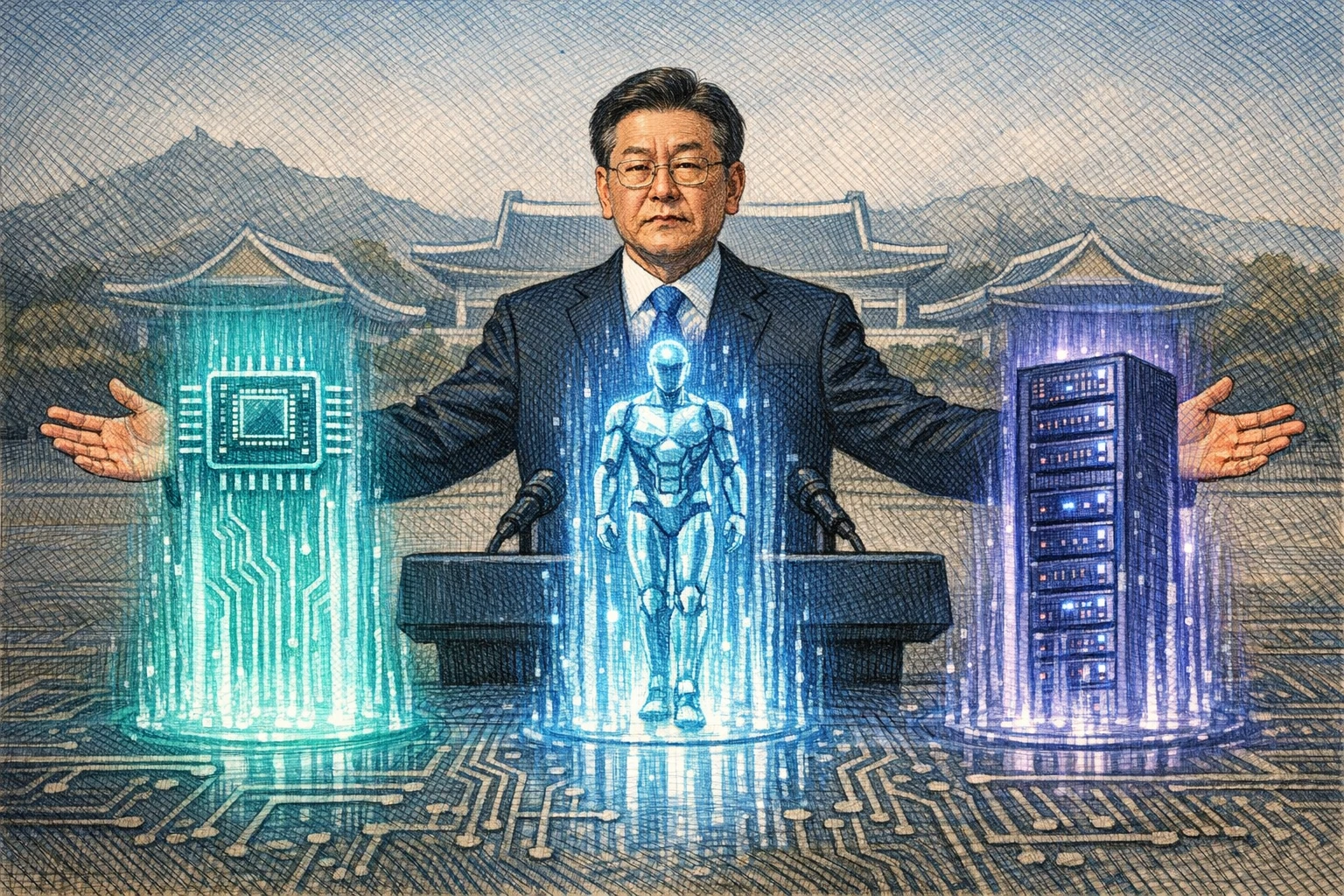
South Korean President Lee Jae-myung on June 29 unveiled a national AI strategy at the Blue House, naming semiconductors, physical AI, and data centers as its three main pillars. Under the plan, major Korean companies led by Samsung Electronics and SK Hynix will invest at least 1,350 trillion won, or about $880 billion, into chips and data centers, while the government will commit more than 200 trillion won in R&D funding by 2030.
A three-pillar plan built around Korea’s existing chip strengths
The strategy is designed to carry South Korea’s memory-chip advantage into the AI era. Lee described it as a “great leap forward,” with the state aiming to secure chip leadership upstream, expand AI into real-world devices, and build enough data-center capacity to support national computing demand. In this framework, physical AI refers to AI systems embedded in robots, vehicles, and factories rather than limited to cloud-based services.
The broader goal is to extend Korea’s role beyond supplying chips. The plan links wafer fabrication, computing infrastructure, and downstream industrial use cases into a single national buildout, giving the AI push a full supply-chain shape.
Four fabs planned and data-center capacity targeted at 18.4GW
Samsung Electronics and SK Hynix are set to spend 800 trillion won to build four fabrication plants in the country’s southwest, two each. Samsung has already selected Gwangju as the site for a new semiconductor cluster. On the infrastructure side, SK Group, GS Group, and Naver will invest 550 trillion won with the aim of lifting national data-center capacity to 18.4GW by 2035.
South Korea has also approved a five-year national science and technology blueprint. That roadmap includes more than 200 trillion won in state-backed research spending before 2030. Physical AI has been designated a national strategic industry, with Seoul targeting a top-three global position in AI robotics by the end of the decade.
NVIDIA to supply 260,000 high-end GPUs before 2030
The compute layer has already been outlined as well. NVIDIA has agreed to provide 260,000 high-end GPUs to the South Korean government and four major conglomerates before 2030, in a deal worth up to 14 trillion won, or roughly $9.8 billion. According to the report, the arrangement was originally reached during Jensen Huang’s October 2025 visit to Korea and has now been folded into the larger national program.
The listed recipients are the Ministry of Science and ICT, Samsung Electronics, Hyundai Motor, SK Group, and Naver. Hyundai Motor Group is set to receive about 50,000 Blackwell GPUs for mobility, smart factories, and automotive semiconductors. SK Group plans to build an AI factory equipped with more than 50,000 NVIDIA GPUs and launch what the report describes as Asia’s first industrial AI cloud. Naver Cloud will expand its installed base by more than 60,000 GPUs.
With US export controls blocking the most advanced GPUs from reaching China, South Korea’s access to large-scale priority supply also gives the program a clear geopolitical dimension.