
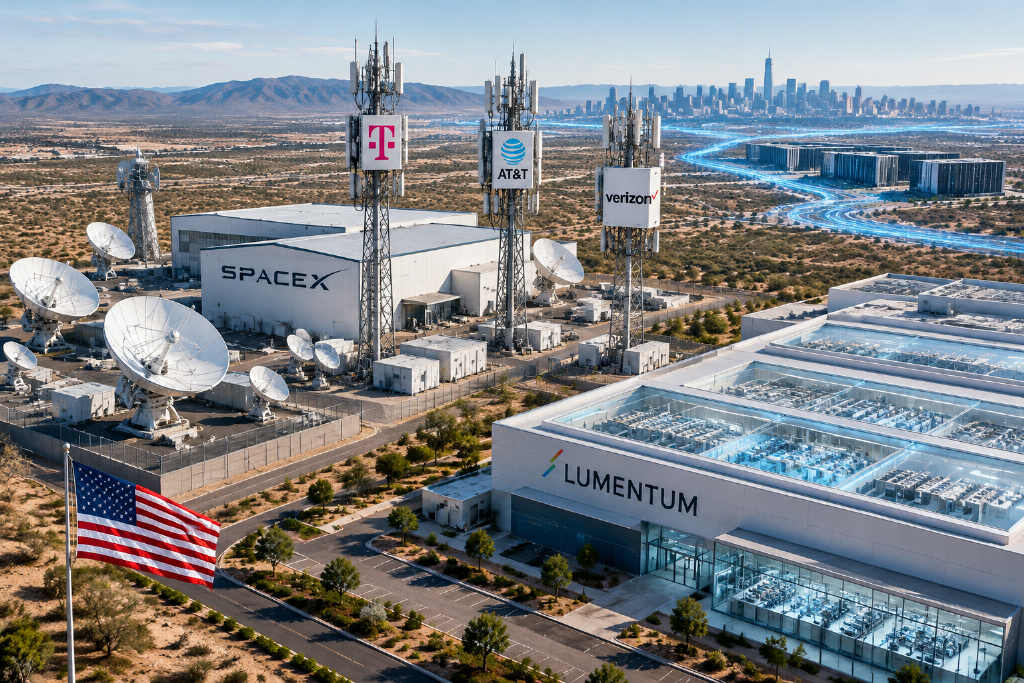
U.S. stocks finished higher Friday, with the S&P 500 up 0.59% at 7811.54, the Nasdaq Composite up 0.64% at 27366.17, and the Dow Jones Industrial Average up 0.83% at 51654.95. For the week, the three indexes gained 1.15%, 0.93%, and 0.64%, respectively. Communications was the day’s most volatile group after SpaceX agreed to acquire nationwide low-band spectrum, sending T-Mobile, AT&T and Verizon lower while tower stocks jumped. Lumentum also moved higher after saying some optical component capacity has been booked through early 2029. Even with a rebound in parts of big tech, the Philadelphia Semiconductor Index still closed in the red, showing that investors are still favoring AI supply-chain segments where demand signals look more concrete.

Major indexes rose, but semiconductors lagged
The S&P 500, Dow and Nasdaq all ended the session higher, and all three posted weekly gains. The VIX fell 3.70% to 14.84.
Nine of the S&P 500’s 11 sectors advanced. Real estate rose 1.88%, consumer discretionary gained 1.69%, and health care added 1.58%. Communication services fell 0.40%, while energy slipped 0.18%. Advancers outnumbered decliners on both the NYSE and Nasdaq, a sign that Friday’s rebound was not driven only by a small group of megacap tech stocks.
The "Magnificent Seven" turned in a mixed performance. Amazon rose 3.29%, Microsoft gained 2.38%, Tesla added 2.05%, and Alphabet Class A climbed 0.97%. Meta fell 0.31%, Nvidia slipped 0.52%, and Apple lost 1.11%. The Philadelphia Semiconductor Index fell 0.41% to 12572.4. The Nasdaq Golden Dragon China Index rose 2.69% to 5753.78.
In other markets, Treasury yields moved slightly higher, with the 2-year yield around 4.79% late in the session and the 10-year yield around 5.24%. WTI crude settled at $91.85 a barrel, up 0.39%, and Brent settled at $104.72, up 0.42%. December COMEX gold settled at $4216.30 an ounce, up about 1.4%.
SpaceX spectrum purchase triggered a broad repricing in telecom
SpaceX agreed to buy nationwide 800 MHz low-band spectrum licenses from Grain Management in a transaction reportedly valued at about $8 billion. Compared with higher-frequency bands, low-band signals travel farther and penetrate buildings more effectively. SpaceX plans to use the spectrum for Starlink Mobile, combining satellite connectivity with terrestrial communications infrastructure to serve mobile phone users.
The market quickly reassessed how much competitive pressure traditional wireless carriers could face. T-Mobile fell about 13.3%, AT&T dropped about 9.8%, and Verizon lost about 8.8%. The concern was that if SpaceX can gradually improve indoor coverage, competition may not stay limited to remote-area users and could extend into the core mobile customer base of incumbent carriers.
Tower companies moved the other way. Crown Castle rose about 15.6%, American Tower gained about 9.3%, and SBA Communications advanced about 7.3%. The report said that even if SpaceX relies mainly on satellite networks, improving urban and indoor coverage could still require towers, rooftop antennas, and other ground-based assets.
The spectrum deal still needs regulatory approval, and any network buildout will take time. Friday’s stock moves reflected a market repricing of the future competitive setup, not the completion of a nationwide mobile network by SpaceX.
Lumentum says part of its capacity is sold through early 2029
Lumentum’s chief executive said some of the company’s optical component capacity has already been sold through early 2029. For certain products, about 70% of demand could still go unmet next year. As AI data centers keep expanding, customers need more high-speed optical interconnect equipment and are locking in supply years in advance. Lumentum shares rose 5.23% on Friday.
That strength did not lift the broader chip sector. The SOX index still fell 0.41%, and Nvidia also finished slightly lower. Microsoft and Amazon gained, showing the rebound in tech was uneven. Investors are drawing a line between companies already showing order visibility and capacity strain, and those that still need demand to materialize.
OpenAI’s revenue figures, which had stirred AI-related stocks a day earlier, also got further clarification. According to the report, the company’s annualized revenue was about $50 billion as of the end of September. The widely cited $70 billion figure referred to a target the company hopes to reach or exceed by year-end. The two numbers point to different dates and should not be treated as the same thing.
Consumer sentiment weakened, while Apple order signals stayed mixed
The University of Michigan’s preliminary October consumer sentiment index fell to 46.3 from 48.1 in September. The current economic conditions component dropped to 44.7, while one-year inflation expectations rose to 4.7% from 4.6%. The data showed weaker consumer assessments of current conditions and little relief in concerns about rising prices.
Apple fell 1.11% on Friday. One report said the company asked some suppliers to cut production of components for the iPhone 18 Pro series. A person at a supply-chain company said Pro orders had declined while Pro Max orders had increased, leaving total order volume roughly unchanged for now. What can be confirmed at this stage is that some orders have been adjusted. Whether demand for the whole lineup is actually slowing will need more sales data.