
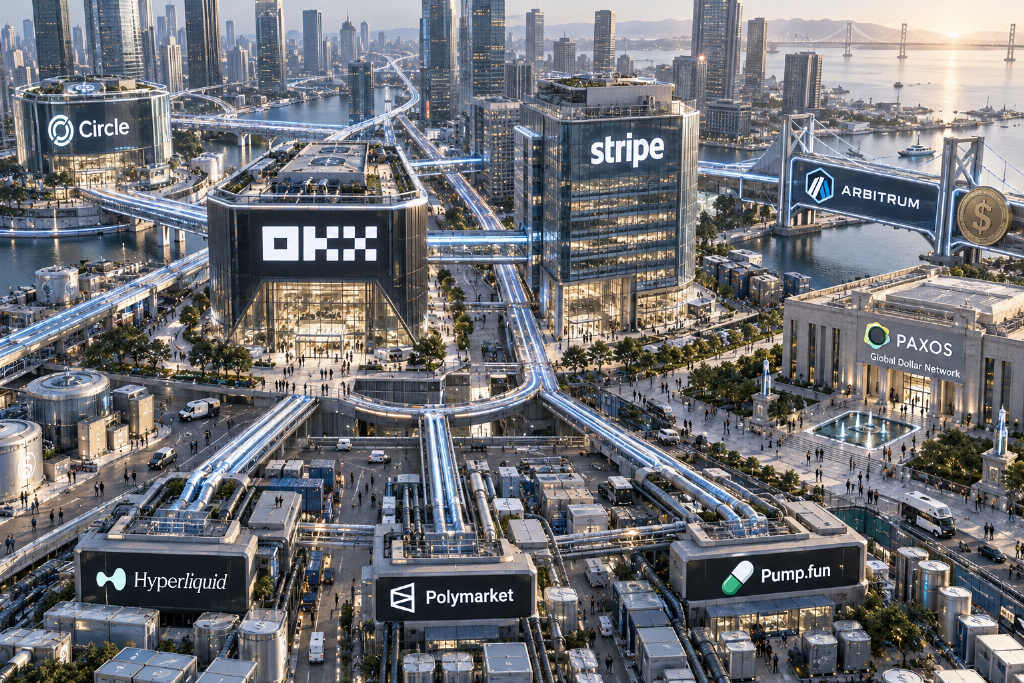
For years, the assumption in crypto was simple: the company that prints the stablecoin captures the value. By October 2026, that logic was starting to look incomplete. The issuers are now paying tolls to the platforms that control the roads.

Three developments on Oct. 6 captured that shift.
Arbitrum One launched native USDG and joined the Global Dollar Network led by Paxos. At the same time, ArbitrumDAO put forward a governance proposal to add another 100 million ARB to the USDG incentive program, with voting still underway. Arbitrum holds about $3.78 billion in stablecoins on-chain. The interest generated by those balances had historically flowed to issuers such as Circle and Tether. Global Dollar Network states its pitch in blunt terms: 「Stop funding their profits」. Arbitrum’s move was not just about adding another stablecoin. It was an attempt to turn stablecoin float on its chain into a revenue source for the ecosystem itself.
On the same day, OKX said it had completed a new strategic financing round at a $25 billion pre-money valuation. The investor list included Circle, QRT, Ripple and SC Ventures, the venture arm of Standard Chartered. OKX said it was not raising money out of necessity and was instead looking for long-term partners. In the context of stablecoin competition, the message was hard to miss: issuers and issuer-linked institutions are willing to pay for distribution, and they do not want their tokens pushed down the order book on a major exchange.
Stripe’s stablecoin lead Henri Stern also said the company plans to roll out stablecoin cards to more than 100 countries by the end of the year, letting users spend stablecoins from their wallets across Visa’s 175 million merchants. The card processed $1.2 billion in spending last month, up 3x year over year. Stripe does not issue a stablecoin itself. Its role is to move stablecoins to places where they can actually be spent.
A chain, an exchange and a payments company all moved in the same direction on the same day. The rules of the stablecoin market are changing.
The most profitable issuer still wins on distribution
Tether remains the most profitable stablecoin issuer in crypto.
In 2025, Tether posted more than $10 billion in net profit with roughly 300 employees, or about $33 million in profit per employee, nearly 100 times Goldman Sachs on that measure. The business model is straightforward. A user deposits $1 to mint 1 USDT. Tether then invests that dollar in assets such as U.S. Treasuries and earns roughly 5% annual yield, while token holders receive none of that interest. The spread belongs to Tether.
By the end of 2025, Tether directly held more than $122 billion in U.S. Treasuries. Including indirect exposure through repos and money market funds, its total Treasury position was about $141.6 billion. If Tether were treated as a country, it would rank close to the world’s 18th-largest holder of U.S. government debt. It also held 127.5 tons of gold and 96,185 BTC. At year-end market prices, those gold reserves were worth about $17 billion and the bitcoin holdings about $8.4 billion, with roughly $3.5 billion in unrealized gains on BTC.
According to DeFiLlama’s protocol revenue tracking, Tether generated about $510 million in 30-day revenue, the highest in the sector. Circle was second at about $210 million, less than half of Tether’s figure. Hyperliquid and Pump.fun were each below one-eighth of Tether.
Tether’s edge is not just that it issues USDT. It is that USDT is distributed almost everywhere. In convenience stores across Central America, village markets in Africa and phone top-up shops in Southeast Asia, users may not have access to Coinbase or Circle’s compliance-heavy channels, but they can still find USDT. Research published in 2026 showed that about 93% of USDT on Tron sat in ordinary wallets rather than exchanges. Andersen Institute estimated the share outside centralized exchanges at roughly 95%. The strength here is not a slogan about decentralization. It is the fact that distribution is fragmented across users, use cases and liquidity pools, with no single gatekeeper able to choke it off or demand a large share of the economics.
Circle makes money, but keeps less of it
Circle is profitable at the revenue line too. In fiscal 2025, total revenue reached $2.747 billion, up 64% year over year. The problem is not that Circle earns too little. The problem is that it retains less of what it earns.
One of Circle’s key profitability metrics is RLDC Margin, the share of revenue left after distribution costs. For full-year 2025, that figure was about 39%. That means more than 60% of revenue was paid out to the channels that helped distribute USDC.
Circle’s distribution, transaction and other costs reached $1.664 billion in 2025, also up about 64% from a year earlier. Of that, roughly $1.4 billion went to Coinbase alone, up about 51%. Under the companies’ agreement, Coinbase takes the larger share of reserve interest generated by USDC on its platform, leaving Circle with the smaller portion. Distribution has become more expensive, not less.
Interest rates add another layer of pressure. More than 90% of Circle’s revenue comes from reserve income, so each Federal Reserve rate cut hits the business. The second quarter of 2026 made that clear. USDC on-chain transaction volume jumped 151% year over year, but reserve revenue rose only 5%. Average circulation increased 25%, while reserve yield fell by 66 basis points. The important point is not the surge in transaction volume. It is that transaction activity and reserve income are no longer moving together. Circle earns on dollars that stay parked in the system, not on how many times those dollars change hands.
The longer rate-cut cycle matters as well. In 2025, after the Fed entered an easing path, Circle reported adjusted EBITDA of $582 million for the year, but posted a net loss of $70.1 million because of $424 million in IPO-related stock compensation expense. Public markets were also focused on competition. On Sept. 1, Goldman Sachs, Citigroup, Bank of America and 18 other major global financial institutions said they would form a joint venture to issue a stablecoin, and Circle shares fell 6% that day. On June 30, Stripe, Visa, Mastercard, BlackRock and Google joined the OpenUSD effort, and Circle stock dropped about 17% in a single session. On Aug. 3, Morgan Stanley cut its price target to $38 from $106, citing slower USDC growth, pressure from OpenUSD and the fragility of the reserve-income model.
Circle’s weakness is not poor compliance or opaque reserves. It is dependence on third parties to get the token into users’ hands. Once those channels raise the price, Circle has limited leverage.
The last mile is where stablecoins still struggle
In stablecoins, the “last mile” is not about moving value on-chain. It is about turning on-chain settlement into real commercial payment.
A transfer from Venezuela to Vietnam can clear on-chain in seconds. The hard part is converting that USDT into Vietnamese dong under local rules, sending it to the correct bank account and reconciling the payment properly.
That last mile has four steps. Cross-border transfer is largely solved. Foreign exchange is increasingly manageable. The real bottlenecks are local payment rail access and compliance reconciliation. A provider serving 10 markets may need to maintain dozens of separate bank and mobile payment integrations. Each interface can fail on its own. Each country has different KYC fields and reporting requirements.
Off-ramping is not the only problem. On-ramping is messy too. A user may send the right dollar amount on the wrong chain, transfer USDT when the merchant accepts USDC, or forget to include a memo. Binance disclosed in 2023 that it handled about 4,000 deposit recovery requests per month and had recovered 7 million USDT in total. Kraken has charged as much as $200 per mistaken token recovery.
The raw transfer numbers also overstate real-world use. BCG and Allium cleaned up $62 trillion in public blockchain stablecoin transfers, removing bot activity, internal shuffling and speculative trading, and concluded that genuine economic activity was about $4.2 trillion. Of that, only $350 billion to $550 billion could be identified as payments for goods and services, less than 2% of the total. A European Central Bank survey found that only 0.2% of online merchants in the euro area accept crypto assets, while physical retail acceptance has stayed below 1% for two years. Mastercard’s chief product officer said about 90% of stablecoin volume is tied to crypto trading and that stablecoins “lack a clear value proposition” in ordinary consumer-to-merchant payments. Field research in Yiwu was even more direct: most merchants had never heard of stablecoins, and some of those who had tried them found that traditional settlement preserved export tax rebates of 6% to 13%, while using USDT meant losing that benefit. Blockchains solve how money moves. They do not solve how goods are delivered and settled in the real economy.
A number of companies trying to fix that last mile have already run into trouble. BitPay’s card stopped accepting new users in June 2023 and had still not reopened three years later. Its Trustpilot score stood at 1.2 out of 5, customer support was limited to email tickets, and weekend service hours had been cut to four hours. From 2025 to 2026, Dupay shut down because “compliance issues and barriers to fund circulation could not be fundamentally resolved,” OneKey U Card was suspended, Binance ended card services in Europe and Latin America, and Paris-based Kulipa collapsed overnight, affecting more than 20 wallet clients including Solflare and Ready. Its issuer, Monavate, was fined €270,000 by the Bank of Lithuania. Once the license was halted, the product died immediately. Cambodia-based Huione Pay saw its on-chain balance drained to just 990,000 USDT, and its license had already been revoked a year earlier. In January 2026, Polish regulators revoked Quicko’s license. On Feb. 3, cards from CEX.IO, Trustee Plus and IN1 all stopped working at the same time.
The immediate causes differed, but the structural weakness was the same. Front-end brands own the user relationship, while the back-end issuer, license, settlement and compliance nodes determine whether the product survives. Most crypto card programs are not Visa Principal Members. They rely on BIN sponsorship, effectively renting bank membership. The sponsor handles compliance and settlement, while the crypto brand handles customer acquisition and branding. Cardholder agreements often barely mention the sponsor, but if the sponsor fails, the card stops working. Wirecard’s collapse in 2020 took down the first-generation Visa cards from Crypto.com and Binance. Metropolitan Bank’s exit from crypto in 2023 also cut off BitPay.
Visa is often described as a toll collector, but that misses what it actually sells. The company provides the infrastructure: transaction authorization, network routing, rule systems, fraud controls, inter-institution clearing, chargeback handling and a global acceptance network. On a $100 purchase, the merchant discount goes to the acquirer, the issuer takes most of the interchange, and Visa’s network fee is only a small slice. It earns that slice because it spent decades building a trust system that lets billions of cards and tens of millions of merchants transact every day.
Visa is now extending that system into stablecoins. By September 2026, more than 160 stablecoin-linked card programs were running on the Visa network. Annualized stablecoin settlement run-rate had passed $20 billion, up more than 15x year over year. Visa’s CFO did not break out the figure on the earnings call because it still represented only 0.12% of Visa’s annual volume, which is measured in the tens of trillions of dollars. But the direction is clear. Crypto has not displaced Visa. It is paying to use a new stablecoin highway that Visa is building.
The last mile is not mainly a technical problem. It is a problem of institutions, infrastructure and trust. Blockchains solve distance. Delivery still requires local banking relationships, FX liquidity, compliance capability and dispute resolution. Visa and banks spent 50 years building those systems. Crypto has not found a cheap way to replicate them. Whoever fixes that mile becomes the real road builder. That is why platforms that already control part of the route can now demand a larger share from issuers.
Platforms are pushing back
Hyperliquid was one of the clearest examples.
In September 2025, Hyperliquid did something unusual: it put the issuance rights for its ecosystem stablecoin, USDH, out to public tender. Paxos, Frax, Ethena, Sky and Agora all bid. Native Markets won. At the time, Hyperliquid’s monthly trading volume was close to $400 billion, and the chain held $5.7 billion in stablecoins. Those balances generated hundreds of millions of dollars in annual interest that had previously gone to Circle and Tether. Dragonfly partner Haseeb Qureshi publicly argued that the bidding process looked compromised and that Native Markets appeared preselected. But the larger point was not the process. It was the posture: if this much money moves through the platform every day, the platform decides who gets to issue the settlement asset.
USDH ran for eight months and peaked at only $100 million in circulation. Against more than $5 billion of USDC on Hyperliquid, it was marginal. Users did not adopt it. On May 14, 2026, Hyperliquid, Circle, Coinbase and Native Markets jointly announced that USDH would be discontinued and USDC would return as the platform’s sole settlement asset. Native Markets transferred the purchase rights to the USDH brand assets to Coinbase and exited.
At first glance, that looked like a win for Circle. The terms of the new AQAv2 agreement tell a different story. First, about 90% of cost-adjusted USDC reserve income flows to the Hyperliquid ecosystem, higher than the 50% Native Markets had promised under USDH. Second, Circle and Coinbase each staked 500,000 HYPE, and those tokens can be slashed if revenue fails to cover costs. Third, Coinbase handles treasury deployment while Circle handles technical deployment and cross-chain support. Both do the work, while the platform keeps most of the economics. Revenue started accruing on Aug. 26, and the first payment arrived on Oct. 3 for $14.58 million.
The key point is not that Hyperliquid failed to launch its own stablecoin. It used USDH to create competitive pressure, then forced Circle and Coinbase to pay to remain in the distribution channel. They posted real HYPE collateral and gave up 90% of the economics. Hyperliquid did not win the war to issue its own stablecoin. It won the war over whether any issuer can stay on the platform without paying rent.
Polymarket took a different route. It did not negotiate revenue sharing with issuers. It pulled the settlement layer inside its own stack. In April 2026, Polymarket upgraded its collateral model and replaced USDC.e with its own pUSD. pUSD is backed 1:1 by USDC and enforced by smart contracts. On the surface, it looks like a wrapped token. Structurally, it does much more.
Users can deposit more than 20 tokens, including ETH, DAI and WBTC on Ethereum, USDT and WETH on Polygon, SOL and USDe on Solana, and even USDT on Bitcoin and Tron. The system automatically bridges and converts those assets into pUSD, which becomes the internal settlement unit. Users still see dollars. Polymarket gains control over the settlement layer inside the platform, while the underlying reserves remain anchored to USDC. It can earn interest on those reserve assets, bringing in at least $50 million a year. It did not replace the issuer. It turned the issuer into a base asset and made its own settlement layer the main point of value capture.
The same logic is spreading beyond exchanges and prediction markets. Meme platforms are moving in the same direction. Pump.fun has built a treasury of nearly $2 billion. Co-founder Noah Tweedale said publicly in September 2026 that the team was discussing a native stablecoin and that decentralization was not the key issue. Control of end users was. Pump.fun first switched trading pairs from SOL to USDC to fix revenue settlement. The next step would be issuing its own token and keeping reserve income inside the platform.
On BNB Chain, Four.Meme did not wait to issue one itself. It designated UXUY’s UUSD as the official launch token and hardwired UUSD as the default quote asset in the launch flow. On Solana, LetsBonk partnered with Trump family-linked World Liberty Financial. WLFI offered direct incentives, paying developers to launch tokens paired with USD1. On Jan. 3, 2026, LetsBonk hit 8,800 token creations in a single day, and its market share jumped from 3% to 30%. Even meme launchpads have figured out that the platform that embeds the stablecoin into its own use case controls the faucet.
Three generations of stablecoin evolution
Viewed over time, stablecoins have already gone through three generations.
The first was issuer-owned. Tether and Circle are the clearest examples. The issuer controlled the brand, minting rights, reserve income and distribution relationships, while channels acted as delivery partners and collected fees. In that phase, issuance itself was a privilege. Whoever secured the regulatory footing could sit on Treasury yield. Tether used first-mover advantage and low-cost transfers on Tron to spread through emerging markets. Circle used Coinbase and compliance status to lock in U.S. institutional demand. Channels had little say.
The second was issuer-as-infrastructure. Paxos is the clearest example here. It issued BUSD for Binance, PYUSD for PayPal and now USDG for the Global Dollar Network. Paxos has effectively split its business into two lines: White Label Stablecoins for branded partners, and the GDN/USDG model that shares reserve income with network participants. In this phase, the issuer keeps the license, custody, minting technology, compliance stack and APIs. The brand belongs to someone else. The users belong to someone else. With USDG, even control over revenue sharing is increasingly outside the issuer’s hands. The issuer becomes a compliance outsourcer. Paxos is not retreating because it cannot survive. It is adapting to a world where licenses matter less than user access.
The third is platform-owned settlement. That is the phase now taking shape. OpenUSD has brought in more than 140 institutions. The ledger and reserves are shared at the base layer, while Visa, Stripe and Shopify each manage their own use cases. Revenue is split according to traffic contribution, and equity is also allocated to partners that help grow the network. PayPal has gone further with PYUSDx, a platform that lets companies issue their own branded stablecoins without touching reserves or managing compliance. PayPal and MoonPay have turned issuance into a configurable service accessible through an API. In this phase, platforms control user access, quote assets, scenario-specific settlement, routing and reserve-income sharing. The stablecoin itself starts to look like a commodity layer.
That does not mean issuers have simply lost and platforms have simply won. Issuers are integrating vertically as well. Circle is pushing Arc chain in an effort to own more of the rails. Stripe is building on both ends, with Bridge for stablecoin conversion, the Privy wallet acquisition and a growing stablecoin card footprint. Visa has launched its Stablecoin Platform to bring stablecoin settlement into its global network. Tether is expanding into payments, its own public chain, wallets and physical infrastructure. Everyone is building roads. No one wants to be pushed back into the role of a contract manufacturer that only prints dollars.
At bottom, the three generations point to one conclusion: issuing money is getting easier, while building the roads is getting harder.
The power now sits at the interface
USDT and USDC still account for more than 80% of the market combined, but market share alone says less than it used to.
Issuance rights are being commoditized. Distribution rights are becoming more valuable. Cross-chain bridges and smart routing are making conversion between stablecoins close to frictionless. Whether a user holds USDT, USDC or pUSD matters less than who gets to own the channel through which that user spends, trades, settles or moves funds across borders.
Tether’s moat is not just the size of its Treasury book. It is the fact that it already sits in millions of wallets and offline touchpoints across emerging markets, with no single gatekeeper able to replace it. That is the deepest difference between Tether and Circle. Circle’s investments in OKX, its willingness to give up 90% of economics on Hyperliquid and its push to build Arc all reflect the same realization: compliance and reserves are not enough. If the token does not reach the user, it is just paper.
The future may not belong to one universal stablecoin. It may belong to many settlement coins tied to specific contexts: one for exchanges, one for prediction markets, one for meme launchpads, one for banks and one for card networks. They may share the same reserve and compliance base underneath while distributing through separate channels on the surface, with economics split according to traffic contribution.
a16z has argued that the real opportunity for stablecoins is not to displace Visa’s 150 million merchants, but to serve merchants Visa never reached in the first place: individual developers and small software vendors with no website, no legal entity and no credit history. They cannot qualify for card acceptance, but they can receive USDT at a wallet address. Machine-to-machine payments among AI agents make the point even more sharply. The x402 protocol embeds stablecoin payments into HTTP requests, turning card fees into a tax that software can optimize away.
Those are the new roads.
The war is shifting from who owns the dollar to who controls the interface through which dollars enter the real economy. Issuers are starting to look more like upstream suppliers of raw monetary material. The actors that control the interface hold the stronger position. Whoever gets the token into users’ hands and fixes the last mile writes the next set of rules. Market share describes the past. Interface networks point to what comes next.
