

The $1.25 billion figure does not cover all potential BTC sales
Strategy disclosed on July 7 that it sold 3,588 BTC worth about $216 million between June 29 and July 5. The company said the proceeds were used to pay STRC dividends and replenish the USD Reserve.
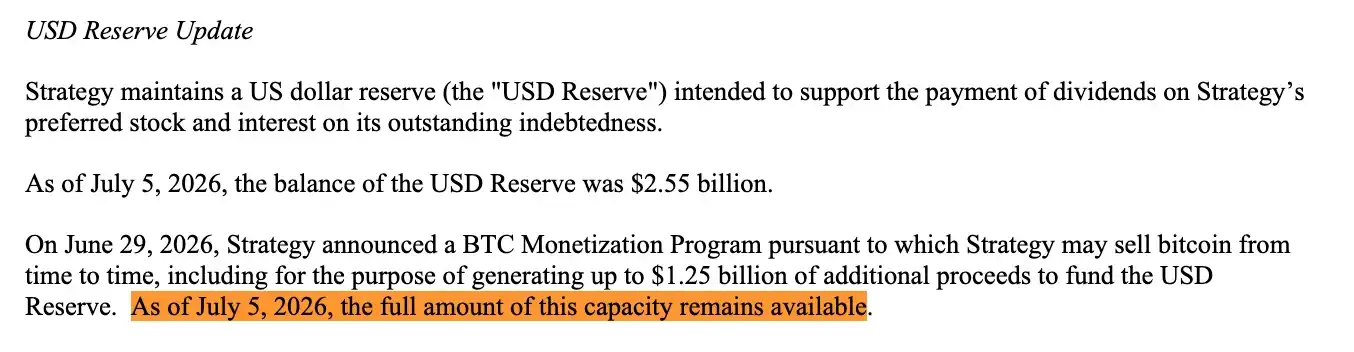
Despite completing that sale, Strategy also said its full $1.25 billion reserve-building capacity remains available.
That is the key point highlighted in the Bankless analysis cited in the report. The market has largely treated $1.25 billion as the headline number, but that cap applies only to BTC sales used to build the USD Reserve. It does not represent the company’s total BTC sale limit under the current framework.
The latest $216 million sale fell into another category: replenishing the reserve. In other words, it did not consume any of the previously disclosed reserve-building capacity.
Three buckets sit inside the monetization plan
On June 29, after weeks of pressure on MSTR and STRC, Strategy introduced the BTC Monetization Program as part of a broader Digital Credit Capital Framework. The plan laid out three main uses for BTC sales.
- Build the reserve: sell up to $1.25 billion in BTC to establish the USD Reserve.
- Cover preferreds and debt costs: sell BTC to meet fixed dividend and interest obligations tied to preferred shares and debt. If management believes selling BTC is more favorable than issuing common stock, BTC can also be sold to replenish reserves previously used for those obligations.
- Fund buybacks: sell BTC to repurchase up to $1 billion of preferred shares and up to $1 billion of MSTR common stock. Proceeds may also be used to cover taxes, fees, and other related costs.
Market attention has centered on the first bucket. But the third one alone adds another $2 billion. Based only on the portions with explicit caps, Strategy’s planned BTC sale capacity already exceeds $3 billion.
That total still excludes the bucket tied to dividend payments, interest costs, and reserve replenishment, where no specific ceiling has been disclosed.
Building and replenishing lead to the same destination
The more subtle issue is the distinction between building the reserve and replenishing it.
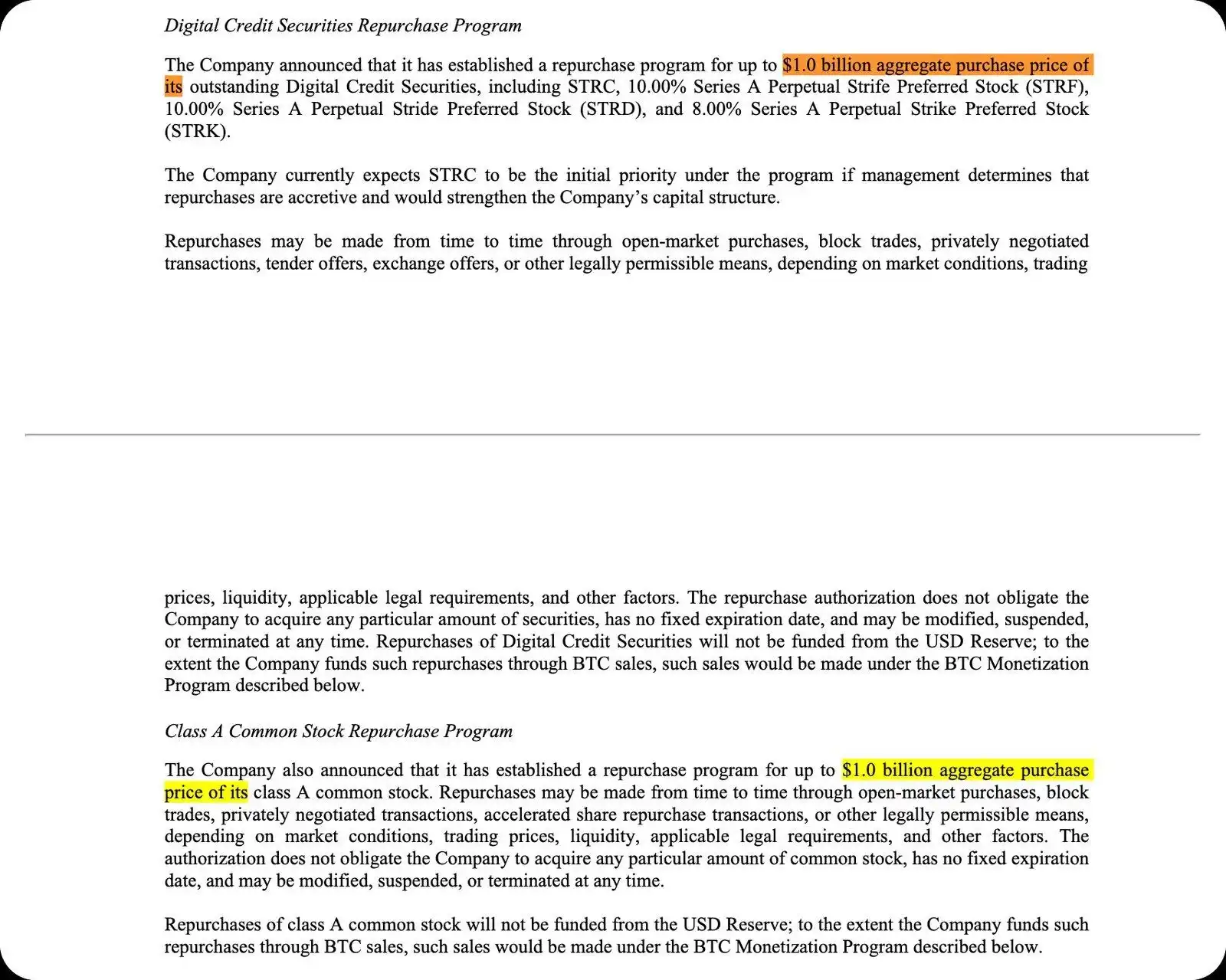
The USD Reserve exists to cover preferred share dividends and debt interest. Under the current policy framework, it cannot be used for stock buybacks.
As of June 28, Strategy’s USD Reserve stood at $2.55 billion. According to the report, that was enough to cover about $1.76 billion in annual debt and preferred payment obligations, or roughly 17 months of coverage. The board’s minimum requirement is 12 months unless it approves a lower threshold.
Within that structure, the company draws a line between two paths:
- Selling BTC before paying dividends and adding the cash to the reserve is classified as building.
- Using the reserve to pay dividends first, then selling BTC to restore the reserve, is classified as replenishing.
Those are different accounting labels, but they produce the same economic result: converting BTC into cash to cover dividend and interest obligations.
That is why the latest sale made the distinction stand out. Strategy sold $216 million in BTC, used the proceeds for dividends and reserve replenishment, and still said the entire $1.25 billion reserve-building amount remained untouched.
From accumulation story to active capital management
In the June 29 announcement, Michael Saylor said the framework reflects Strategy’s need for liquidity, discipline, and active capital management.
CEO Phong Le put it more plainly: “Strategy is transitioning from a one-way capital issuance model to an active capital management model.”
Castle Island’s Matt Walsh and Jeff Dorman said on a podcast last week that Strategy has gradually become an actively managed hedge fund.
That marks a shift from the company’s earlier playbook: sell MSTR shares, buy Bitcoin, and offer investors leveraged BTC exposure through the stock. The current setup is different. Strategy is now trading among the moving parts of its own capital structure, managing pressure across MSTR common shares, preferred shares, the reserve, and BTC holdings.
The tradeoffs are becoming harder to ignore
Walsh and Dorman pointed to a set of tensions inside that model.
- Selling common stock can support preferred dividends, but it can also compress MSTR’s premium to the value of the BTC it holds.
- Selling Bitcoin can extend cash-flow duration, but it weakens the company’s long-running “never sell” narrative.
- Supporting the preferred structure can help preserve market confidence, but it draws down cash reserves.
- Cutting preferred dividends can protect liquidity, but it may send preferred share prices sharply lower.
The analysis argues that the so-called reserve loophole is one expression of this broader change. Bitcoin is no longer just an asset Strategy keeps accumulating. It is also becoming a balance-sheet lever used to keep the preferred structure functioning.
What investors are being asked to evaluate now
The report’s central takeaway after the July 6 filing is that Strategy may have more room to maneuver than the market has assumed. Investors should no longer treat the $1.25 billion figure as the total cap on potential BTC sales.
What matters now is whether Saylor can operate a system in which each move inside the capital structure may support one side while putting stress on another. The language inside the framework matters more than before: build, replenish, issue, repurchase, and defend all carry implications for how much BTC Strategy may still be able to sell.
The plan gives the company more flexibility. It does not remove the underlying tensions. The old idea of a simple leveraged Bitcoin vehicle no longer captures what Strategy has become. The debate is shifting toward its ability to manage capital actively without breaking another part of the structure in the process.