


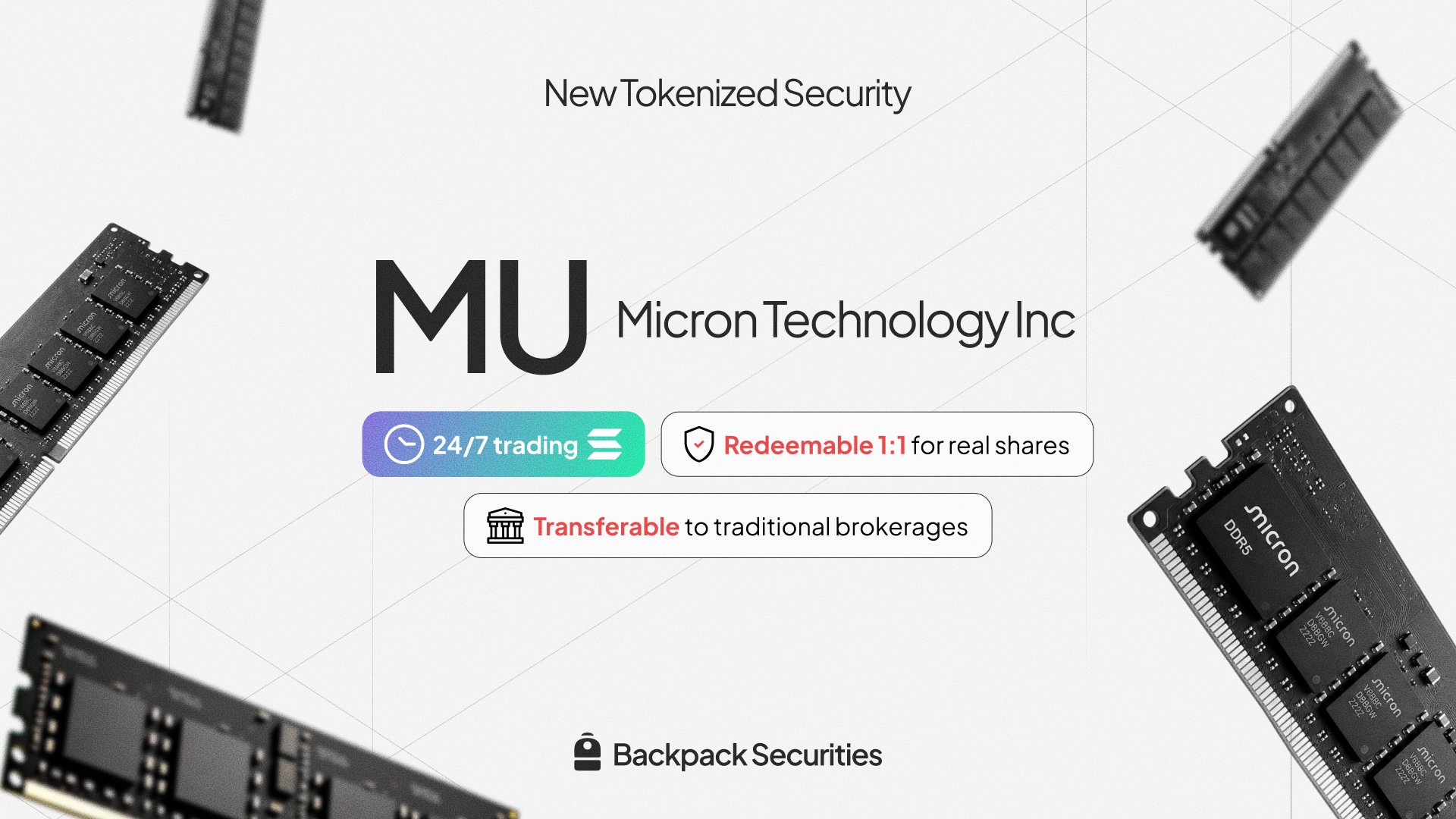
On June 22, Backpack Securities announced via social media the launch of tokenized Micron Technology stock ($MU) on the Solana blockchain, in collaboration with Sunrise DeFi. Issued by Backpack Securities, the token represents ownership of Micron common stock and is designed to bridge traditional equities with on-chain trading.
According to the announcement, $MU tokens trade 24/7 on Solana, allowing investors to buy and sell at any time, unrestricted by traditional market hours. Each token is pegged 1:1 to Micron common stock, and holders can redeem tokens for actual shares or transfer them to conventional brokerage accounts through compliant channels. This mechanism effectively bridges crypto with traditional securities, offering global investors greater flexibility.
Micron Earnings to Test AI Memory Boom
Micron Technology is set to report its latest quarterly results after the US market close on Wednesday. The earnings are widely seen as a critical test of the AI memory boom. As one of the world's top three memory chipmakers, Micron's high-bandwidth memory (HBM) and NAND flash products are integral to AI training, inference, and data centers. With rising demand for HBM and DDR5 driven by artificial intelligence, Micron's performance will serve as a key indicator for the entire chip industry's health.
The on-chain, real-time trading nature of $MU allows investors to react immediately to the earnings announcement, bypassing the wait for the next traditional market open. This immediacy provides a unique tool for capturing short-term volatility post-earnings and is drawing more traders to the advantages of tokenized assets.
Redemption and Trading Mechanics
Backpack Securities emphasized that $MU tokens maintain a strict 1:1 peg with Micron common stock. Holders can redeem tokens for physical shares and transfer them to traditional brokerage accounts. Currently, users can buy and sell $MU via the Backpack wallet or any Solana-compatible decentralized exchange. In this partnership, Sunrise DeFi provided the underlying technical integration; as a DeFi protocol within the Solana ecosystem, it focuses on yield optimization and cross-chain interoperability.
Another key feature of tokenized stocks is the ability to trade fractional shares, lowering the investment barrier. $MU tokens can be traded in units smaller than the price of one full share, enabling more investors to gain exposure to Micron without purchasing a whole share.
Real-World Assets on Solana Gain Momentum
Tokenization of real-world assets (RWA) is a defining trend in crypto. The Backpack–Sunrise collaboration adds a significant stock token to the Solana ecosystem. Similar initiatives, such as Ondo Finance and BlackRock's BUIDL, have launched tokenized assets on other chains. Solana, with its low fees and high throughput, is emerging as a preferred platform for tokenized asset issuance. The listing of $MU further enriches Solana's RWA landscape and offers a new model for traditional financial institutions exploring on-chain securities.