
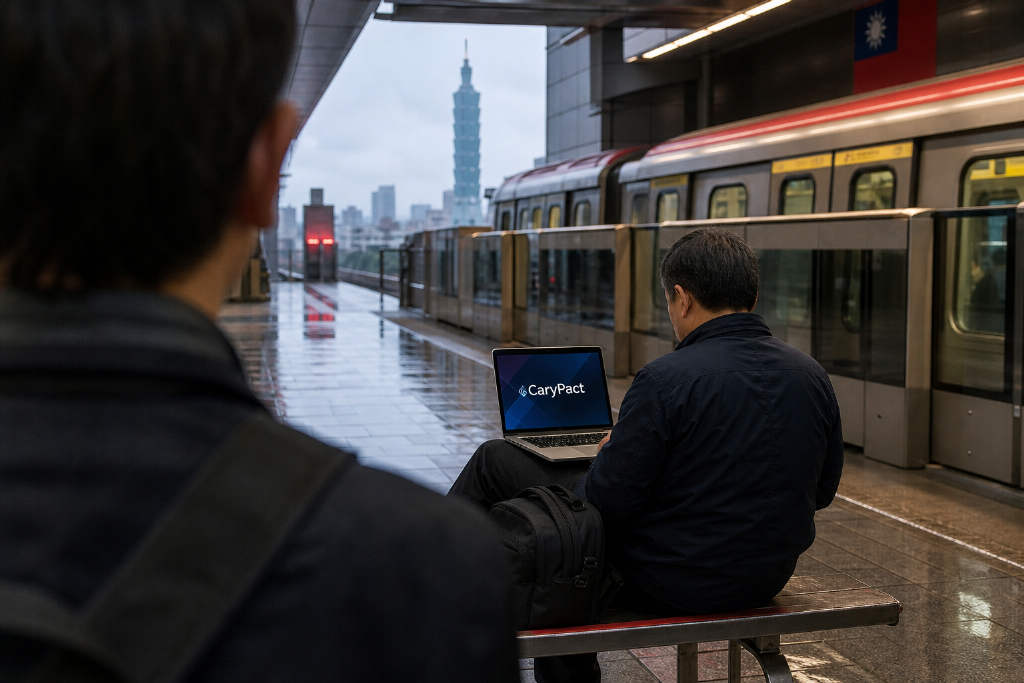
A Taipei Metro incident that briefly triggered online speculation over possible Chinese intelligence activity has now led to a different set of questions, this time around a crypto investment project called CaryPact.
The case began when a 48-year-old man surnamed Kao was seen using a laptop on a Taipei MRT platform. Text visible on the screen included “Zone 2 Photosynthesis System,” prompting some social media users to suspect the display was tied to intelligence gathering. Police later located Kao and confirmed he was simply listening to an online investment and wealth-management course. The lesson was even discussing “compound interest,” turning the earlier espionage narrative into a false alarm.
That left another question: what kind of financial course divides participants into “zones” and uses a label such as “photosynthesis system”?
Manhsiu Hsu, founder of blockchain media outlet Blocktrend, said he followed clues left in the news coverage, including simplified Chinese text, “zones,” “photosynthesis system,” and “compound interest.” His review found that those elements closely overlap with a cryptocurrency investment project known as CaryPact.
Keyword overlap appears in CaryPact’s public network
There is no evidence at this stage directly proving that Kao is a CaryPact investor or member. Still, based on public community channels and course materials, CaryPact’s promotional network does appear to feature the same terms: “zones,” “photosynthesis system,” and “compound interest.”
CaryPact presents itself as a project built on a blockchain called BOT Chain. Its pitch centers on turning AI computing power into an investment product. Participants are told they can buy so-called “computing power servers” and provide that capacity to consumers with AI processing needs in exchange for continuing returns. In simple terms, the model is framed like buying an AI computer that keeps generating rental income.
The open question is whether the returns truly come from external demand for GPU or other computing resources. If they do, there should in theory be verifiable real-world operating data: what server specifications investors are buying, which data center the hardware is deployed in, how heavily the equipment is being used, how much customers are paying for computing power, and how revenue is split between the platform and investors.
Those details are central to assessing whether a computing service provider’s income is actually tied to AI demand. By contrast, CaryPact’s public-facing information puts far more emphasis on BOT Chain, PoS staking, the CA token, and community and organizational expansion. That shifts attention to a more basic issue: are investor returns mainly coming from genuine customers paying for computing rentals, or from funds contributed by later participants and from the project’s token economy? Without verifiable operating data, that remains unclear.
Questions around the USDT used on BOT Chain
Hsu also highlighted another issue involving the USDT used in the CaryPact ecosystem.
Public CaryPact tutorials show users converting CA tokens into a token on BOT Chain labeled USDT, then bridging those assets to BNB Chain through BOT Bridge. Related materials also list a token contract on BOT Chain with both the name and ticker shown as USDT.
Tether’s official list of supported USD₮ protocols does not currently include BOT Chain. On any blockchain that allows token issuance, it is possible to create a token named “USDT.” Matching name and ticker alone do not mean the token was issued by Tether, nor do they mean holders can redeem it directly with Tether at a 1:1 U.S. dollar value.
Public groups showed “zones,” “photosynthesis system,” and “compound interest ×3”
After examining public Telegram communities, Hsu found that CaryPact’s Chinese-language groups had used a structure divided into “zones,” including invitations for a “Zone 7” lecturer to share with members. Related messages also referred to a “photosynthesis system” completing large volumes of “server group purchases.”
In CaryPact communities operating in other languages, Hsu also found a course directly titled “Network Plan and Compound Interest ×3,” tying an organizational system to “triple compound interest.”
That means several of the key terms confirmed by police from Kao’s laptop screen and course content — “zones,” “photosynthesis system,” “investment,” and “compound interest” — can also be found in CaryPact’s public promotional structure.
Focus shifts from espionage suspicion to financial risk
The incident first gained traction because the phrase “Zone 2” was read by some online users as a possible national security matter. After police checked the case, they concluded that Kao had simply purchased an online investment course and that the initial espionage speculation was unfounded.
But if “zones” refer not to military units but to the structure of an investment community, the risk changes shape. The concern moves away from national security and toward financial exposure.
There has been no judicial investigation or ruling that would allow the public to directly characterize CaryPact as fraud. There is also no direct evidence linking Kao himself to CaryPact. Even so, the overlap in publicly available material has raised clear questions.