
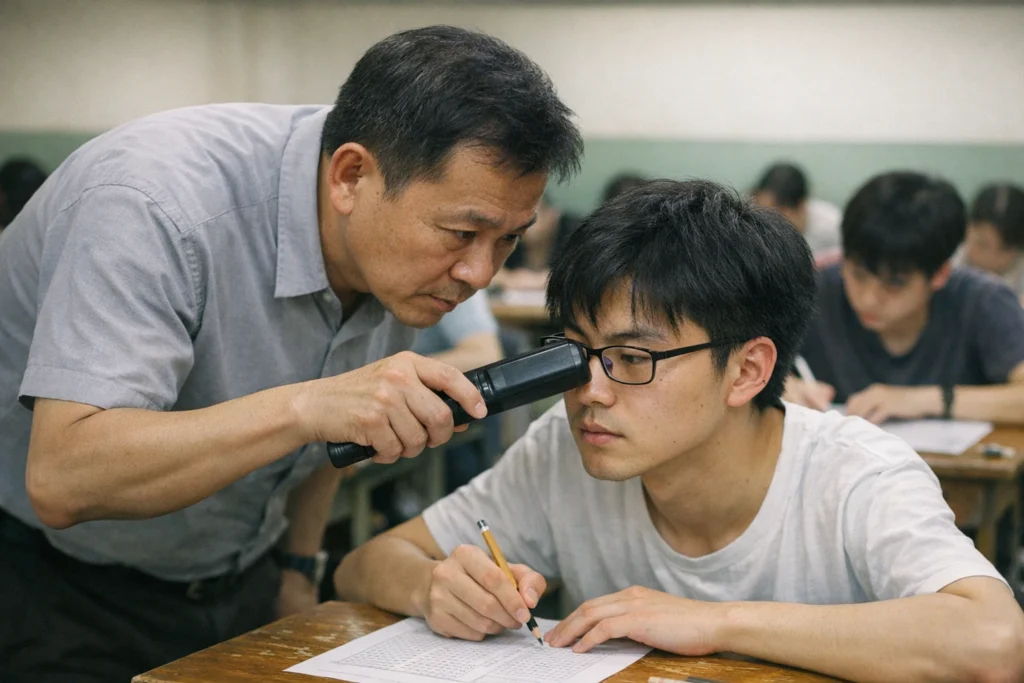
Taiwan will tighten its exam rules after two confirmed cases this year involving AI smart glasses, including one discovered during the July 115 academic year subject test after metal detectors were deployed for the first time.
According to the source article, the College Entrance Examination Center has decided that, starting in the 116 academic year, smart glasses will be listed separately from other wearable devices. Bringing or wearing them into an exam venue will count as cheating. A violator will receive a zero for that subject, and serious cases may lead to cancellation of all scores.
How the glasses are used in exam settings
The report says the process does not require manual operation. A camera built into the frame scans the questions, sends the images to a large language model for processing, and then projects the answers onto the inside of the lens. From the outside, there may be no obvious movement such as looking down or reaching for a device.
In a recent South Korean test demonstration cited in the article, AI glasses completed a mock College Scholastic Ability Test in 18 minutes and scored 96 points.
Two confirmed cases in Taiwan
Taiwan has already recorded two cheating cases involving AI smart glasses this year.
- The first was in June. A candidate retaking exams for National Taiwan University’s medicine and dentistry programs was caught wearing AI smart glasses during a biology exam. The article says the glasses could scan questions in real time and display answers. It was described as Taiwan’s first confirmed AI-glasses cheating case.
- The second came in July during the 115 academic year subject test. On the first day, during the physics exam, a candidate was caught wearing AI glasses and was immediately disqualified. The key tool in that case was a metal detector used by the exam authority for the first time.
The College Entrance Examination Center currently bans smart glasses, smartwatches, and smart bands from exam rooms, and it has also suggested installing signal blockers in classrooms to cut device connectivity.
The article also points to a simpler weakness: these glasses can heat up during continuous processing. How often a candidate touches the glasses, and the temperature of the frame, are now details invigilators have been told to watch.
South Korea saw earlier and denser cases
The report says South Korea saw earlier and more concentrated incidents. The first known cases appeared in May. Two candidates were caught wearing AI smart glasses during TOEIC exams on May 10 and May 31. In the same month, three more people were caught in electrical and fire safety technician certification exams.
Public attention intensified after the mock-test result of 96 points in 18 minutes. The article says the AI performance outscored most students who had devoted themselves to the exam.
South Korea’s Ministry of Education has recently instructed regional education offices to put AI glasses on lists of banned exam items. At the university level, however, the article says discussion has largely been absent so far. Seoul National University, Korea University, Ewha Womans University, and Sungkyunkwan University had not yet discussed smart-glasses cheating or set response guidelines, according to the report.
CNN reported confirmed cases across Asia
CNN reported in June that confirmed cases in this wave of tech-enabled cheating had appeared in South Korea, Taiwan, and China. The source article describes Asia, where exam pressure is high, as the center of the surge.
Stricter rules will start next year in Taiwan
Taiwan’s next anti-cheating step has already been settled. From the 116 academic year, smart glasses will be separated from devices such as smartwatches and smart bands in exam rules, with tougher penalties attached. Bringing or wearing them will itself constitute cheating. The penalty will be a zero for that subject, while serious cases may result in cancellation of all scores.
The source article says the exam authority is taking a zero-tolerance approach to smart glasses. It also highlights the word “bringing” in the new rule. The line is being moved forward from proving actual use during the exam to whether the device is on the candidate at entry.
The article adds that as cheating tools become harder to distinguish from ordinary eyewear, the challenge facing exam administration will continue to grow.