
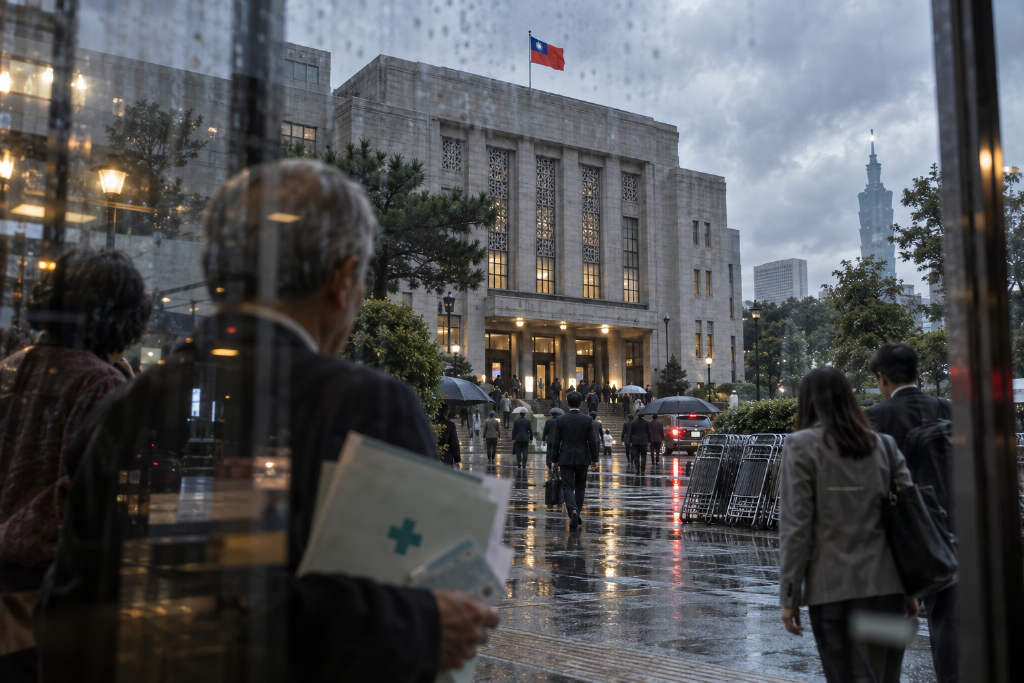
Taiwan’s legislature on Oct. 16 approved a third reading of an amendment to Article 22 of the Senior Citizens Welfare Act, clearing the way for the central government to fully subsidize National Health Insurance premiums for eligible residents aged 65 and older. The measure passed 60-39.
The vote came after an overnight push by the Taiwan People’s Party caucus, which kept watch outside the legislative chamber ahead of the session. On the day of the vote, a revised amendment jointly advanced by the Kuomintang caucus and the Taiwan People’s Party caucus was put to a ballot. Of 99 lawmakers present, 60 voted in favor and 39 voted against. Cross-party negotiations convened by Legislative Speaker Han Kuo-yu did not produce a consensus, and the Democratic Progressive Party caucus opposed the bill.
Under the new language, the subsidy applies to people aged 65 and above whose total consolidated income in the most recent year did not reach the filing threshold, or whose consolidated income tax rate was below 20%. For those who qualify, health insurance premiums will be fully covered by the central competent authority. The law leaves the detailed rules on eligible beneficiaries, covered items, and standards to be set separately by the central authority.
According to October data from Taiwan’s Department of Household Registration under the Ministry of the Interior, the 65-and-over population stood at 4,806,053. The article says about 4.03 million people are expected to benefit. That works out to roughly 84% of the elderly population, or about five out of every six seniors.
Health officials and medical groups warn over funding and system strain
Health Minister Shih Chung-liang publicly raised concerns as the proposal moved forward, and seven major medical groups also voiced opposition. The report says Lin Ya-hui, executive director of the Taiwan Healthcare Reform Foundation, issued a strong condemnation. Teng Hsi-hua, spokesperson for the Civil Alliance for Monitoring National Health Insurance, called on the Executive Yuan not to countersign the bill. Wang Wan-yu, chair of the New Power Party, criticized the move as one that would "hollow out the next generation."
Shih laid out three possible consequences. One is higher premiums, which he said would create intergenerational unfairness. Another is squeezing the growth room of the National Health Insurance global budget. A third is using tax revenue, which could crowd out other welfare programs.
He said that "if these costs are shifted to payers aged 15 to 64, the main health insurance contributors, each person would pay more than 3,000 a year." The article notes that the calculation behind that estimate has not been made public, and it remains unclear whether the final funding source would be premiums, the insurance budget, or tax revenue.
A contrast with the 2025 supplemental premium proposal
The report compares the latest amendment with a 2025 draft annual settlement plan for second-generation National Health Insurance supplemental premiums. On Nov. 5, 2025, the Ministry of Health and Welfare proposed charging a 2.11% supplemental premium on annual interest, dividend, and rental income above NT$20,000. The measure was expected to affect about 4.8 million people and bring in NT$10 billion to NT$20 billion a year for the health insurance system, with implementation as early as Year 116 of the Republic of China calendar.
That plan was halted almost immediately. On the evening of Nov. 6, Executive Yuan spokesperson Lee Hui-chih said Premier Cho Jung-tai had instructed officials to "broadly listen to opinions from all sectors, suspend controversial plans, and strengthen social communication." The draft was paused the night after it was proposed.
The article argues that the supplemental premium draft made it easy for affected people to calculate whether they would have to pay more and by how much. In contrast, the new elderly premium subsidy may involve a larger bill overall, but the public does not yet know exactly which group will end up paying, which may help explain the weaker social backlash so far.
On the size of the financial burden, Shih said, "Today it may look like 30 billion, 40 billion, 50 billion, but this is destructive to the whole system, and that deeply worries me." Chiu Hui-ju cited NT$38.8 billion in elderly health insurance benefit spending. The article notes that both figures are above the NT$10 billion to NT$20 billion in added revenue estimated under the earlier supplemental premium draft.
The dispute centers on who ultimately bears the cost
One of the main issues is where the burden ends up. If the government raises premiums, insured contributors would pay directly. If the system absorbs the cost within the global budget, hospitals, clinics, and doctors would feel the pressure because that budget is the source of payments to medical institutions. If tax revenue is used, the burden moves into the state budget and competes with other welfare items.
The article also references The Logic of Collective Action by U.S. economist Mancur Olson. The point drawn from the book is that groups with concentrated gains or losses are easier to organize, while large groups whose members each bear only a small share of the cost often struggle to mobilize.
The political trail goes back to late 2024
The report says this was not the first time the proposal became a political flashpoint. On Dec. 31, 2024, the Kuomintang caucus had planned to handle the same bill, but younger party lawmakers Liao Wei-hsiang and Niu Hsu-ting strongly objected during a caucus meeting, arguing that it would create "social confrontation between the young and the elderly." The caucus later announced a pause. That earlier original proposal had come from lawmakers including Chang Chia-chun, with the threshold also set at 20%. Su Ching-chuan had proposed lowering it to 5%.
At the time, Premier Cho Jung-tai said the proposal would increase central government spending by about NT$38.4 billion and was not something the Executive Yuan could absorb. He also said the amendment did not explain where the money would come from. Deputy Health Minister Lu Chien-te had also said then that "the median income for young people is 37,500."
In the current round, the bill that passed came from a revised motion by the Kuomintang and Taiwan People’s Party caucuses, while the Democratic Progressive Party caucus voted against it. The report also notes that some Kuomintang figures had opposed the same bill in 2024, Taiwan People’s Party lawmakers said the amendment would ease pressure on the "sandwich generation," and the health minister himself has continued to warn about the policy.
Beneficiaries and payers can overlap within the same family
Chiu Hui-ju said the amendment would mean the sandwich generation no longer has to shoulder health insurance premiums for their parents, easing household financial pressure. The report points out that in the same family, one side of the equation could be parents no longer paying premiums while younger working-age members still do not know where or how they may end up paying more.
On funding, Chiu asked, "Does the government really have to be so stingy in caring for the elderly?" She cited a central government budget of about NT$3.9 trillion for next year and NT$38.8 billion in elderly health insurance benefit spending. The report converts that to about 1% of the total budget, meaning roughly NT$1 out of every NT$100 in central spending would go to this item.
Ko Chih-en, the Kuomintang’s Kaohsiung mayoral candidate, said uniform application nationwide would be "a major step in realizing medical equality" and should not be judged only against patchwork local subsidies. She also said 16 cities and counties across Taiwan already provide different levels of assistance for elderly health insurance premiums. Elderly advocacy groups welcomed a unified national approach and stressed that the amendment still includes a means test.
An aging society is already putting pressure on health spending
The article places the dispute in the context of demographic change and medical spending. Taiwan’s National Health Insurance global budget now exceeds NT$1 trillion. People classified as elderly account for about 20% of the population but use more than 42% of health insurance spending. In simple terms, one out of every five people is elderly, yet more than two-fifths of health insurance outlays go to that group.
Long-term care spending has also grown from less than NT$5 billion in 2015 to more than NT$110 billion this year. Medical spending for those aged 65 and above is 3.3 times that of people under 65 and 5.1 times that of people under 20.
Wang Wan-yu estimated that related spending would come to nearly NT$40 billion this year and reach NT$63.25 billion by 2049. Lin Ya-hui said the amendment would deepen intergenerational confrontation, undermine the principle of ability-to-pay burden sharing, and erode the sustainability of National Health Insurance. In that framework, people with higher income are supposed to contribute more.
Shih said, "Elections are temporary, but National Health Insurance is something the public relies on. It needs a stable system, and it needs support that can be sustained." What worries him, according to the article, is that similar amendments may keep resurfacing.
What exactly passed
As summarized in the report’s Q&A section, the legislature’s Oct. 16 third reading of Article 22 means that people aged 65 and older whose income is below the filing threshold, or whose consolidated income tax rate is below 20%, will have their health insurance premiums fully subsidized by the central government. About 4.03 million people are expected to benefit.
Is the extra NT$3,000 a year for working-age payers settled?
No. The article says that figure came from a hypothetical scenario outlined by Shih Chung-liang: if the cost is shifted to payers aged 15 to 64, each would pay more than NT$3,000 a year. The formula has not been disclosed, and the funding path has not yet been determined.