
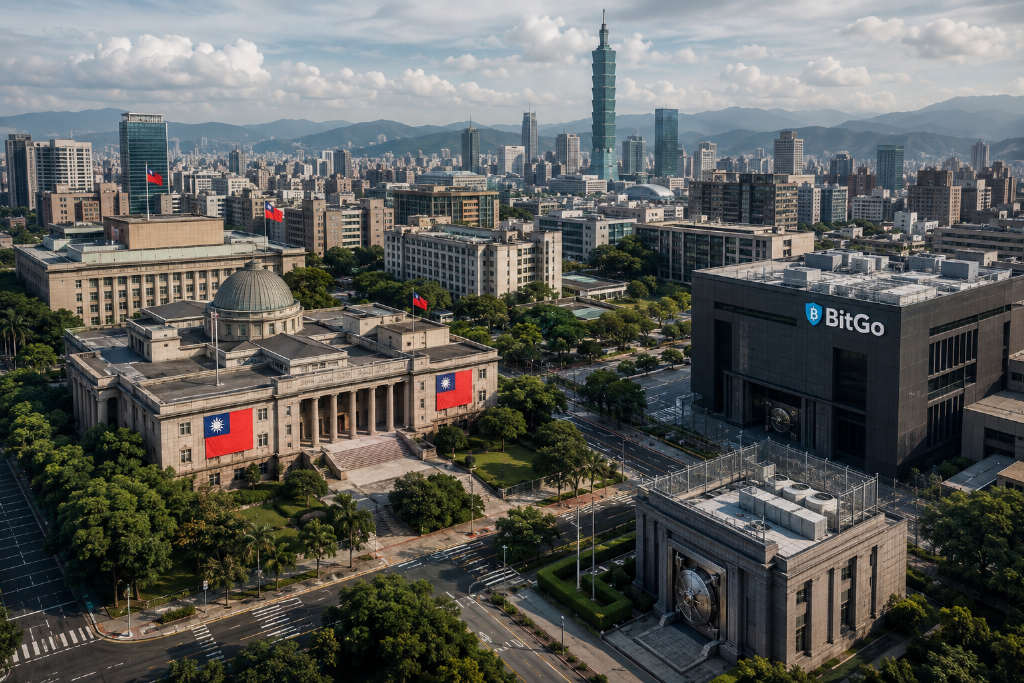
Taiwan’s legislature passed the Virtual Asset Service Act on June 30, putting the local crypto industry on a formal licensing track after years in what the report described as a period where registration alone was enough to operate.
Eight days before the vote, BlockTempo interviewed two market participants: Denny Yang, co-founder of Red Capital and TAAS, and Ivan, BitGo’s head of Asia-Pacific. Yang was described as part of Taiwan’s first blockchain venture capital firm and now involved in building what he said would be Taiwan’s first Bitcoin reserve service company. Ivan represents BitGo, a crypto custody company that began operations in 2013 and, according to the report, rang the opening bell at the New York Stock Exchange in January this year.
At the time of the interview, the bill had not yet cleared the legislature, but the direction was already visible. The article noted that five banks had received approval in early May to run custody pilots, while accounting guidance on stablecoins from Taiwan’s stock exchange arrived on May 29. One line came up repeatedly in the conversation: Taiwan’s rules were moving forward step by step. Eight days later, the biggest step was in place.
A 12-month forum built for financial institutions
Yang and Ivan are running a year-long digital asset forum for financial institutions, with one session each month. The first event took place in Taipei on May 22, drawing participants that included CTBC, SinoPac, Cathay, Taiwan Mobile, and exchanges, according to the report.
Asked why they would commit to a full year in a sector known for moving at a much faster pace, Yang said the application layer changes quickly, with new projects appearing and disappearing within months. But if crypto is treated as financial infrastructure, Taiwan’s ability to connect with financial systems in other countries becomes a longer-term project. He said the goal was not to host a one-off gathering where overseas guests speak and leave. The work, in his words, is to bring international experience to Taiwan’s financial institutions over time, while the local regulatory path is also being built piece by piece this year.
On what counts as a KPI, Yang said mindshare matters most. He said they cannot simply walk into a bank and ask it to use BitGo’s services. What they can do is spend 12 months helping people across senior, middle, and junior ranks understand how a company with 13 years of compliance work built a full product stack and what this business actually looks like when it is done properly.
Ivan said each month carries a different topic. The first session took a high-level view, the current month focused on technology, and later sessions will look at products and customization. He added that partners from different countries will be invited to Taiwan to share their experience.
When asked what misunderstandings in Taiwan’s financial sector need correcting, Yang did not take a confrontational line. He said local institutions already understand the subject reasonably well and ask smart questions. Because controls over money flows in Taiwan are strict, the practical concern is how to run the business they want inside the existing financial structure without crossing anti-money laundering lines. The real gap, he said, is visibility: five banks are in custody pilots, but Taiwan has more than 30 banks, and most of the rest have not seen how those pilots are being handled.
Why BitGo chose Taiwan as its first agency market
Within crypto, BitGo is known as one of the large custody firms. The report said it manages assets in the tens of billions of dollars, holds licenses in multiple jurisdictions, and received approval from the U.S. Office of the Comptroller of the Currency in December to convert into a national trust bank. Outside the industry, one of the more visible examples was its role, together with Kraken, in distributing repayments to creditors in the FTX bankruptcy case.
Asked why BitGo would commit resources to Taiwan when it is not a large market in global terms, Ivan said the company had been laying groundwork for more than two years and that some exchanges in Taiwan were already using its services. After taking on the FTX-related work, he said, the company saw too many cases of operational mistakes and felt more strongly that it should enter the market and push for a more compliant structure. BitGo Taiwan was set up last year, he added, and the company plans to apply for a license once the rules become clearer.
Yang said he was the one who first approached BitGo. Because TAAS planned to build DAT, short for digital asset treasury, it needed an international-grade custodian. He prepared a presentation and pitched a joint approach for Taiwan. He said communication moved quickly because Ivan could speak directly with BitGo’s CEO.
Ivan said BitGo’s management theme last year was localization. Taiwan, he said, became the company’s first market where it is working through an agency model, something it has not done elsewhere. The idea is to make the Taiwan model work first and then use that experience in other Asia-Pacific markets. In the U.S., there is the OCC. In Europe, there is MiCA. Those are closer to a passport-style structure. In Asia, each jurisdiction regulates separately, making local execution more important.
Accounting is where the friction shows up
Three weeks before the interview, the Taiwan Stock Exchange and Taipei Exchange issued two sets of guidance covering listed companies that hold crypto. The report said hot wallets cannot account for more than 15% of total holdings. Companies must have a unit under board oversight, use multi-signature controls, and keep private keys under layered custody arrangements. Holdings of USDT and USDC must be recognized under applicable rules and issuer terms as financial assets, intangible assets, or inventory, but not as cash.
Asked whether that creates a practical problem for companies that want to receive and make payments in stablecoins, Yang said the issue is more interesting than it first appears. In his view, stablecoins should be treated more like commodities because their prices do not move much, making profit-and-loss treatment less meaningful. They are also not cash because they are not fiat currency. The harder issue, he said, is Bitcoin. U.S. accounting standards already allow fair value treatment, while Taiwan is still catching up. He compared Bitcoin with land on a listed company’s books: land may be hard to sell and can still be recognized as an asset, while Bitcoin is highly liquid and can be exchanged almost instantly. The problem, he argued, is that many still do not fully understand its liquidity and economic substance.
On where financial institutions usually get stuck the first time they touch this business, Ivan said the answer is not technology. Technology moves first. BitGo started with multi-signature wallets, and when MPC became smoother and safer, it built MPC as well, leaving the choice to clients. The difficult part is deployment in the local regulatory environment.
He said Taiwan has long followed a pattern where companies coming in to do business are expected to place core systems locally. The report cited IBM moving server capacity into Taiwan in the past for this reason. But on-chain assets exist on a network by design. Even if the data center is in Taiwan, the wallet still lives on-chain. For regulators, he said, that is not an easy threshold to cross.
Yang said he has consistently argued to policymakers that supervision should be built around control rights rather than around a specific technical design. Using bankruptcy remoteness as an example, he said regulators can define segregation in technical terms, but they can also focus on access controls. If the private-key permissions are structured correctly, no one can move the assets even if software fails, and the assets can still be recovered through the key structure. In his view, legislation should be principle-based. Otherwise, when RWA or derivatives enter the market, lawmakers would have to rewrite the framework all over again.
The article said the law passed eight days later partly matched that expectation: the statute sets out principles, while roughly nine pieces of subordinate regulation are to be handled by the Financial Supervisory Commission, with implementation possibly starting as early as the first quarter of 2027.
DAT 2.0 and why Taiwan should not copy MicroStrategy
The interview then turned to TAAS’s attempt to package Bitcoin reserve strategy into a service for listed companies in Taiwan. That discussion inevitably led to MicroStrategy.
Asked about comments that MicroStrategy had become a Ponzi scheme after issuing a new preferred stock called STRC, Yang replied that he sees it as Ponzi-like, but not a scam. His reason was that the structure rests on real collateral and public disclosure.
Yang said that seven or eight years ago, when his team first entered the sector, people broadly dismissed Bitcoin as a scam. Today, he said, it is viewed by many as an important financial asset because of its anti-fragility. In his reading, Michael Saylor is betting that his leverage will not blow up. As long as some people are long, others will want him to fail, which is why he draws a great deal of short interest. Would the company collapse? Yang said that would be extremely hard, but the game it is playing still depends on leverage and market confidence.
The report added a market note here. The remarks were recorded on June 22. Four days later, MicroStrategy’s mNAV, defined in the article as enterprise value divided by the market value of its Bitcoin holdings, fell below 1 for the first time, and its preferred shares briefly traded below their $25 par value.
Asked what a Taiwan company should learn if it cannot copy that structure directly, Yang said the U.S. version relies on rolling net asset value through persistent premiums while the core operating business does not need to scale in the same way. Taiwan, he said, cannot do that because local regulation is meant to protect shareholders. If leverage gets too large, the downside is too obvious. The model TAAS is proposing is DAT 2.0: keep building the core business, then allocate 3% or 5% of cash positions to Bitcoin and gradually move toward 10% or more in stages. He said this is not meant to act as a stimulant for the share price. It is a hedge against long-term fiat expansion.
Asked whether ordinary shareholders would buy into that hedge logic, Yang pointed to SpaceX. He said the company’s S-1 filing shows more than 18,000 Bitcoin, worth about $1 billion at the valuation he cited. If one of the world’s most advanced companies is holding Bitcoin as a reserve, he argued, there is no obvious reason Taiwan firms cannot consider the same. For shareholders, the logic is additive: buying a stock means buying not just the company’s operating revenue, but also the Bitcoin per share embedded in the balance sheet. He added that AI and technology companies are especially suitable because Bitcoin is, in his words, a collection of computing power.
Ivan added a market-side observation of his own. Many U.S. DAT companies are BitGo clients, he said. When prices fell in this cycle, they did not sell. They kept buying, reducing circulating supply further. Then they began asking for additional services: lending out coins, staking, and yield-oriented products. Traditional custodians do not really cover that side, he said, but that could become the next chapter of the business for DAT firms.
As for TAAS’s own version, the report said the plan is to anchor the model in physical businesses tied to AI compute data center infrastructure and equipment chips. It said ecosystem partners include early investors such as Clouded Leopard Energy, while the main operating company has not been disclosed. The company website lists a three-year revenue target of $200 million, aligned with the 2028 halving cycle. BlockTempo wrote that Yang stopped short of laying out every detail, but the direction was clear: build a demonstrator for Taiwan’s DAT market and run the full stack of hedging, custody, accounting, and governance in public view.
Taiwan’s hand may be chips, not market size
By the end of the interview, the focus shifted from compliance to industrial positioning. Both men circled back to Taiwan’s existing strengths.
Yang said Singapore has been effective at making people willing to move money there, but it differs from Taiwan in one important respect: Taiwan has strong technology companies of its own. In the past, he said, global buyers did not have a must-buy reason to come to Taiwan. Now, because of chips and AI, they do.
His argument is that if stablecoin-based cross-border settlement can be connected with financial institutions, buyers in Latin America, Central and Eastern Europe, and Southeast Asia could convert into a Taiwan dollar stablecoin on exchanges and use that to pay for chips. Taiwan is a manufacturing economy with long payment cycles, he said. If a company parks stablecoins on hand and wants a yield for only seven days, it can seek a seven-day return. That flexibility, he said, is native to crypto markets.
Asked what success would look like once the forum ends, Yang said he would like to see Taiwan equities tokenized and BTC and ETH available through major brokerage apps. What worries him more, though, is not Taiwan’s market size. It is the possibility that financial institutions and regulators build a framework that is too rigid. The real test, he said, is how quickly Taiwan can connect when something new appears in the United States. If the U.S. launches a new product and Taiwan can plug in right away, that would already put it ahead of many countries.
Ivan said he hopes to see semiconductor companies start receiving stablecoins through banks beginning next year. Payment collection would be enough as a first step, he said. Companies do not need to jump straight into buying Bitcoin. Once the market starts moving, more possibilities can follow.
On geopolitical risk and on-chain portability
The interview ended with the question foreign investors often ask about Taiwan: cross-strait risk.
Yang said of course it has to be taken into account, but it is not something his side can control. By contrast, he said, on-chain assets are not bound by geography. If something does happen, Bitcoin that has been bought can still be withdrawn anywhere in the world. That, in his view, is part of what makes this a stronger form of infrastructure.
The article closed by noting that the main law has now passed while the subordinate rules may still take another year. The 12-month forum has only finished its second session. But when the June 22 conversation is placed next to the sound of the gavel on June 30, BlockTempo’s reading is that Taiwan’s crypto finance sector is, for the first time, not simply chasing a story. It is trying to build the house itself, with the blueprint already on the table.