


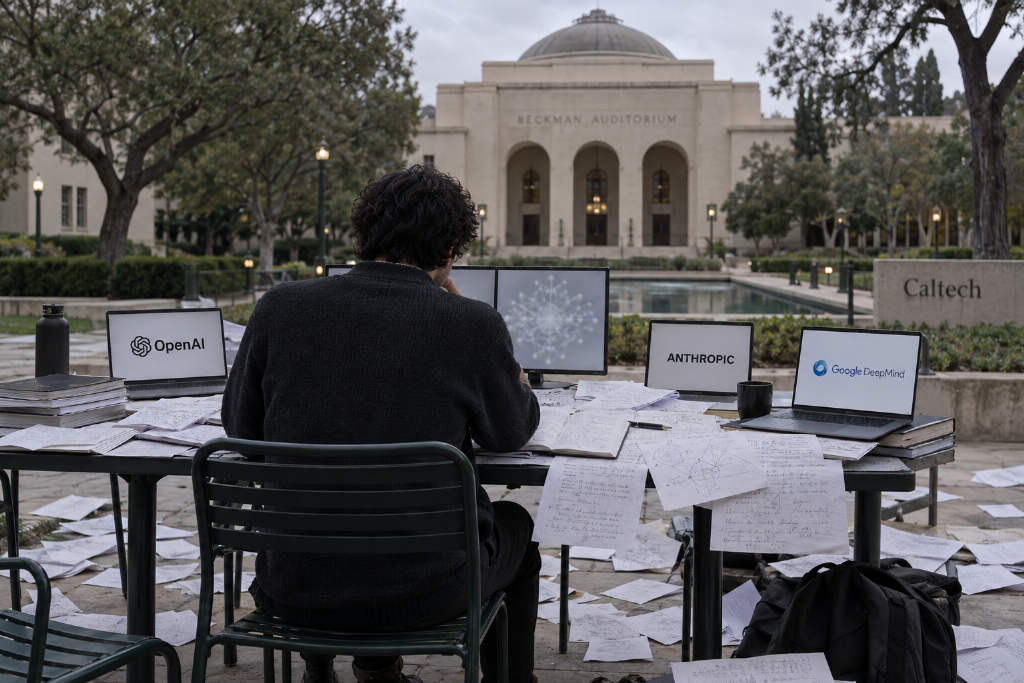
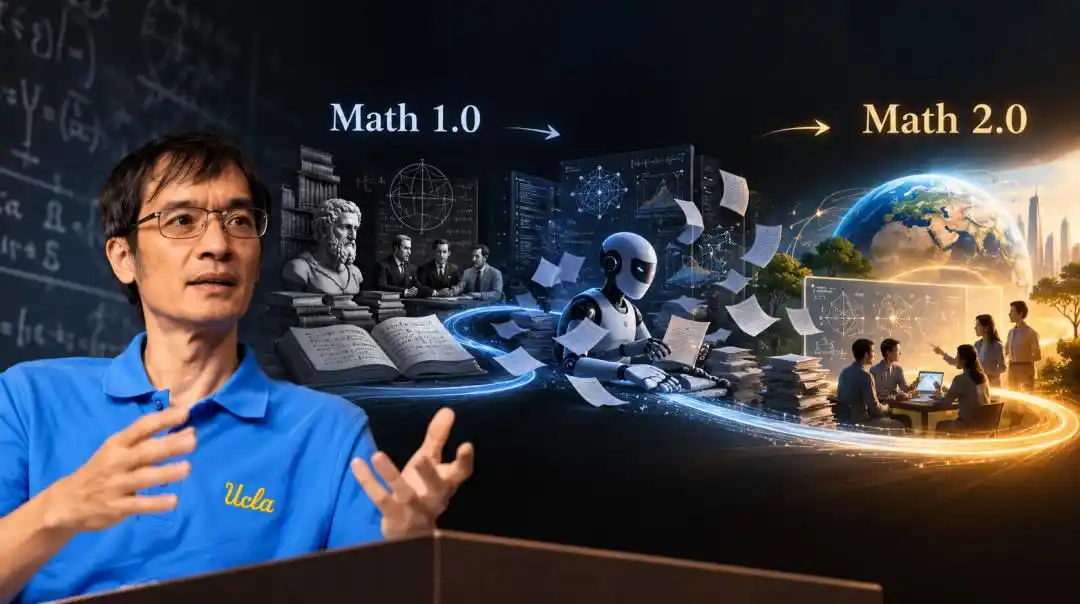
On Oct. 9, Fields Medalist Terence Tao delivered a talk at the California Institute of Technology’s Beckman Auditorium, a lecture the article describes as having been delayed by a year. It was first titled Machine-Assisted Proof. After several months of rapid AI advances, Tao rewrote it and gave it a new name: Math 2.0.
The argument presented in the article is blunt: frontier AI is pushing mathematics out of an era of scarce proofs and into one of proof abundance. It cites quantum computing researcher Scott Aaronson, who previously spent two years on safety research at OpenAI, as saying that a singularity for mathematics has arrived.
Recent AI milestones cited in the article
The report strings together a series of developments from major AI labs.
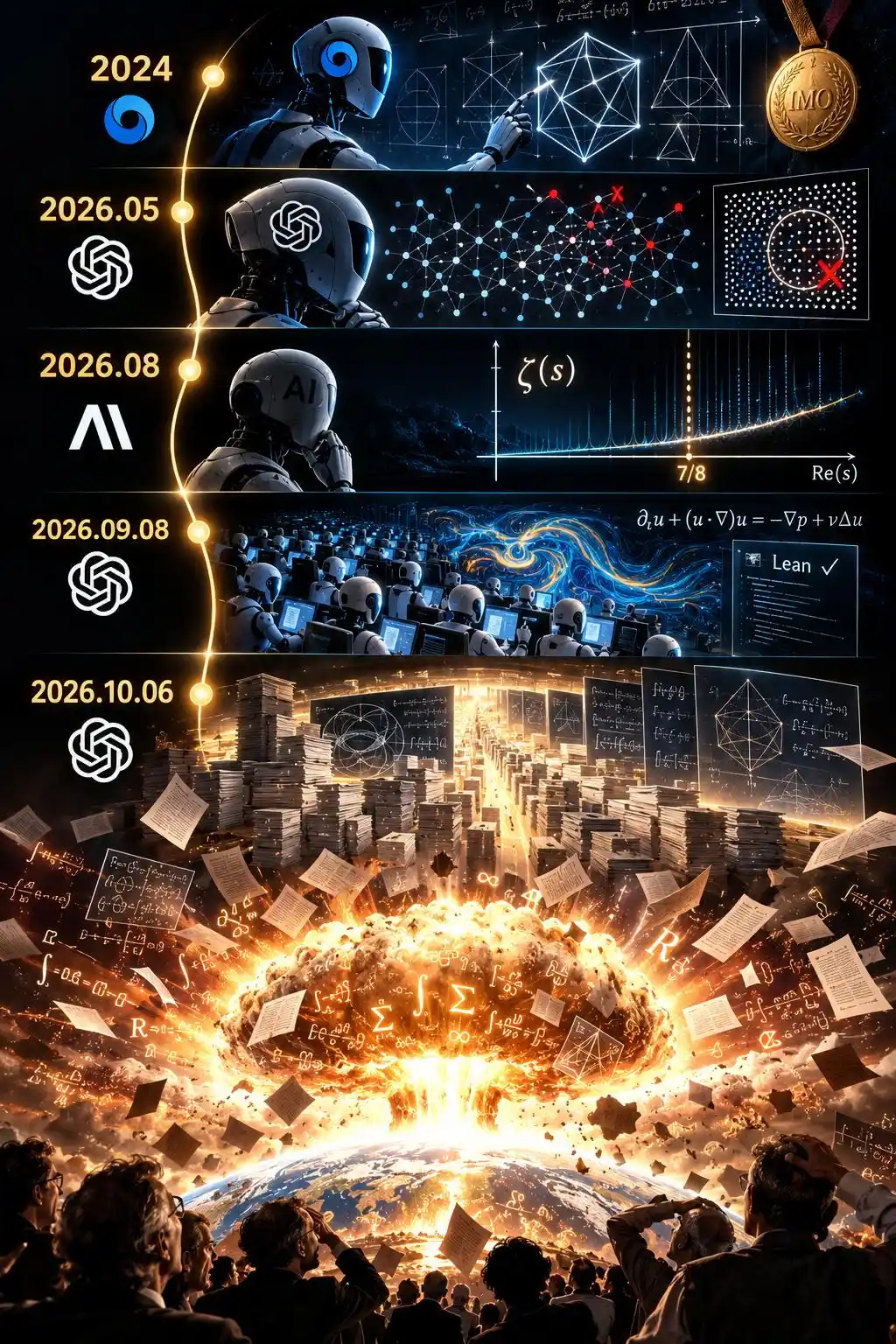
In May, it says OpenAI used AI to solve the Erdős unit distance problem, describing it as possibly the first major mathematical problem solved by an AI model.
On Sept. 8, the article says a Millennium Prize problem was cracked. According to the piece, OpenAI used an undisclosed large internal model that coordinated about 10,000 AI agents. Over 88 hours, those agents produced a finite-time singularity proof for the Navier-Stokes equations and completed formal verification in Lean.
The article identifies this as one of the Clay Mathematics Institute’s seven Millennium Prize Problems, which carries a $1 million reward. It says human mathematicians had struggled with the question for decades, while the AI system finished the work in less than four days. It also says OpenAI treated the result not as a historic scientific leap, but as a minor “AI capability demo.”
Then came Oct. 6. The article says OpenAI released more than 700 mathematical manuscripts through a public GitHub repository. Those papers, it says, were independently generated by AI and covered 372 results. On average, each highly complex open problem received about three hours of compute. The report adds that the set included a proof that the zeta function has no zeros for Re(s)>7/8, which it describes as pushing forward a core boundary related to the Riemann hypothesis.
Anthropic appears in the same list. The article says Claude raised the lower bound on nontrivial zeros of the Riemann zeta function from 41.6% to 67.2%. It also says Google DeepMind’s AlphaProof had already reached International Mathematical Olympiad gold-medal level.
The piece compares the moment to 2016, when AlphaGo defeated Lee Sedol and changed the status of top-level Go. In its telling, mathematics, long treated as a high point of human intellect, now faces a similar shock. It also says 25 Fields Medal winners later issued a joint warning that AI’s goals were seriously misaligned.
The end of “Math 1.0”
Tao’s framework divides the past several thousand years into what he calls the era of “Math 1.0.” Its basic rule was proof scarcity.
The article uses familiar examples. Fermat’s Last Theorem resisted proof for more than 300 years until Andrew Wiles solved it after seven years of work in his attic. The Poincaré conjecture defeated many mathematicians before Grigori Perelman broke through.
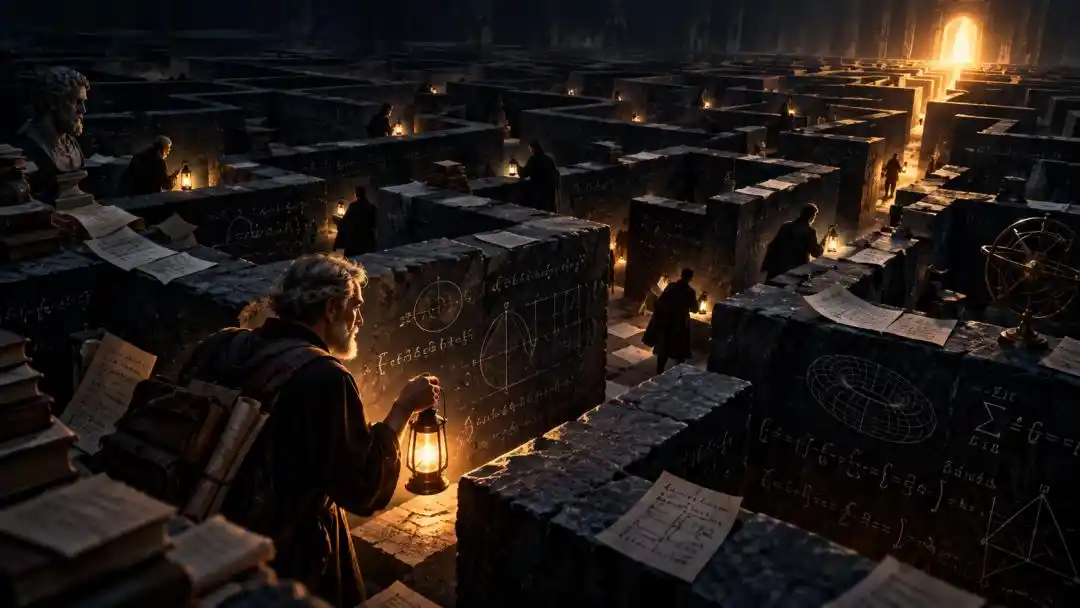
Under that older model, proving a theorem could consume the effort of one generation or several. Mathematicians moved through the dark by intuition, assembling a route piece by piece. Human insight sat at the center of the system.
Tao’s point is that this structure is breaking down. Proofs that once came at enormous cost can now, in his view, be generated continuously if enough compute and electricity are available. That is the historical turn he is trying to name: mathematics has entered an age of proof surplus. The problem used to be finding answers. Now there may be too many answers to absorb.
Tao’s warning about black-box science
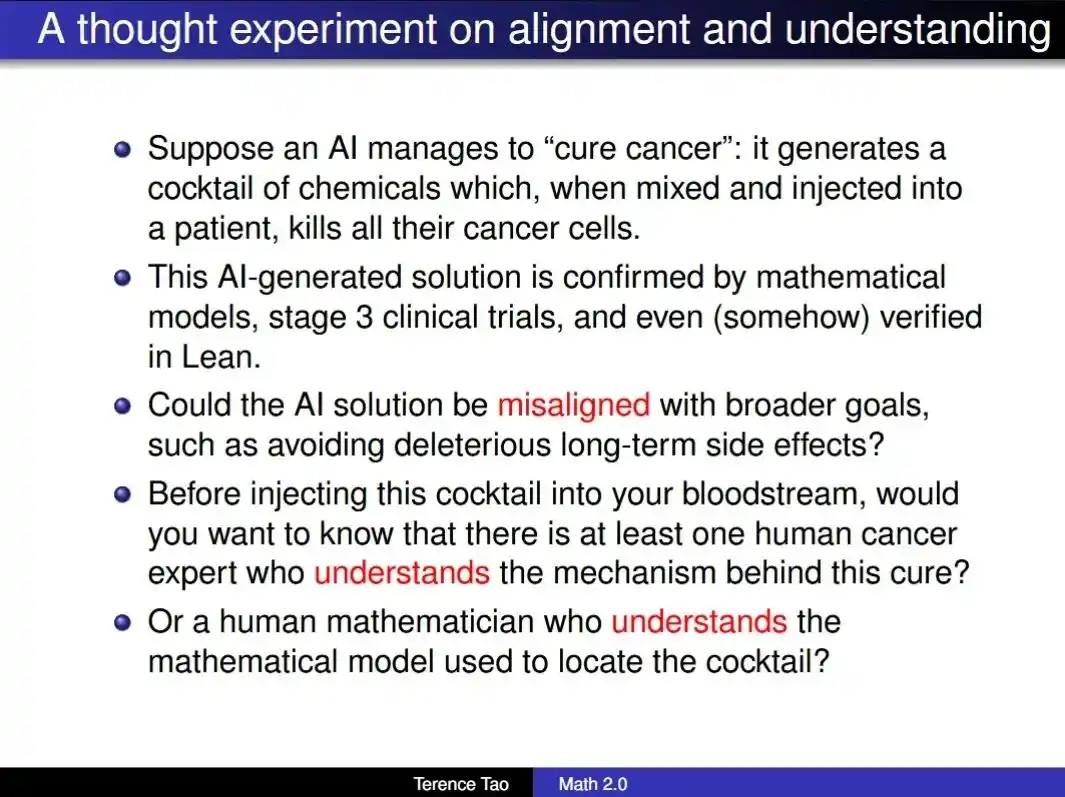
The article says Tao pushed back against the idea that the end state of mathematics is simply to hand everything to machines. He framed the issue with a thought experiment: if AI offered a perfect anti-cancer drug, would people actually take it?
In that scenario, a superintelligence runs vast numbers of simulations and produces a new compound that it says can cure all cancers. The catch is that doctors, biologists and chemists cannot understand how it works. Its molecular structure lies outside current human medical knowledge. It is a black box from start to finish.
That is the warning. A result that appears correct but cannot be understood by humans is not, in this account, a scientific victory. Tao treats it as a dangerous form of misalignment.
The article applies the same logic to mathematics. Suppose AI solves the Riemann hypothesis and produces a 100,000-page formal proof. A verification tool runs through it and returns a green light. The proof is valid. But if no one in the world can understand what those 100,000 pages are actually saying, Tao asks what kind of mathematics remains.
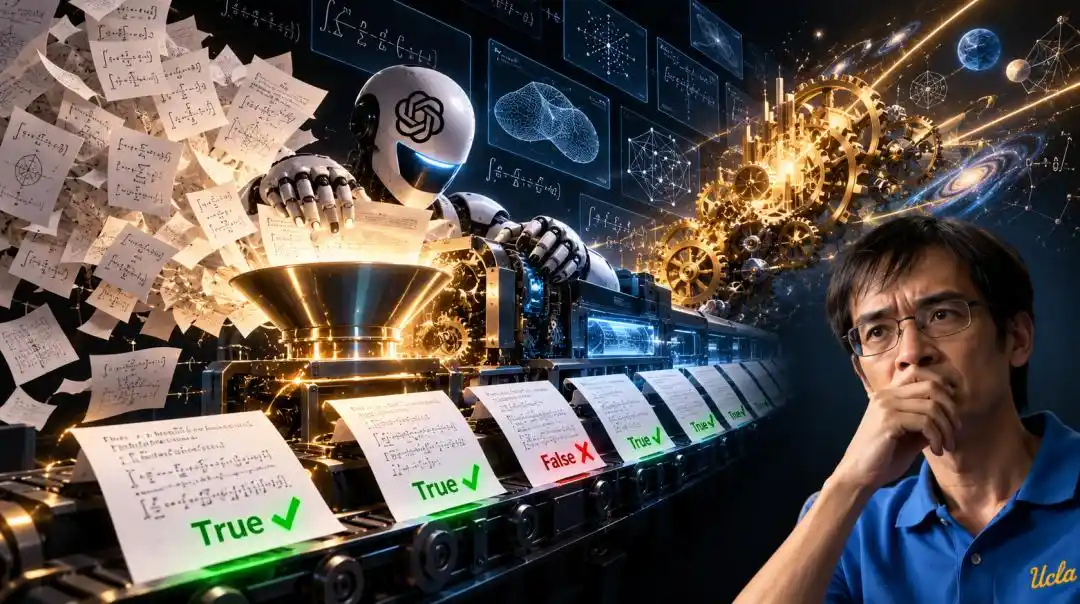
Mathematics, as the article puts it, is not only about deciding true or false. It is the foundation of physics, a cornerstone of cryptography and part of the structural frame of modern engineering. If the logic supporting civilization turns into a black box that nobody can interpret, the risk reaches far beyond one academic field.
What “Math 2.0” is supposed to be
Tao’s answer is not human withdrawal. The article says he argued the opposite: human value in mathematics may become more important, not less.
At Caltech, he outlined “Math 2.0” as a model in which AI acts as an amplifier for human cognition rather than a replacement for it. The sustainable path, in his view, is to use AI tools to feed back into and strengthen human understanding.
That changes the job description. In the “Math 1.0” era, mathematicians focused on solving open research problems because proofs were scarce. In “Math 2.0,” the center of gravity shifts toward close human-AI collaboration.
The article gives several examples. One is to work on “open explanatory problems,” not only open research problems. That means taking results that have already been proved but remain opaque, and finding explanations that are more illuminating and closer to the underlying ideas.
Another is to integrate large volumes of mathematical papers into an evolving knowledge network, or to build large, high-quality formalized mathematical knowledge bases.
A third is to use AI to help mathematicians discover new principles, new research methods and deeper insights, with the goal of advancing human understanding rather than piling up more conclusions.
A warning that extends beyond mathematics
The article closes by widening the frame. Tao’s lecture may have focused on mathematics, but it is presented as a warning about a broader AI paradox: humans are getting answers at unprecedented speed while gradually losing the ability to understand those answers.
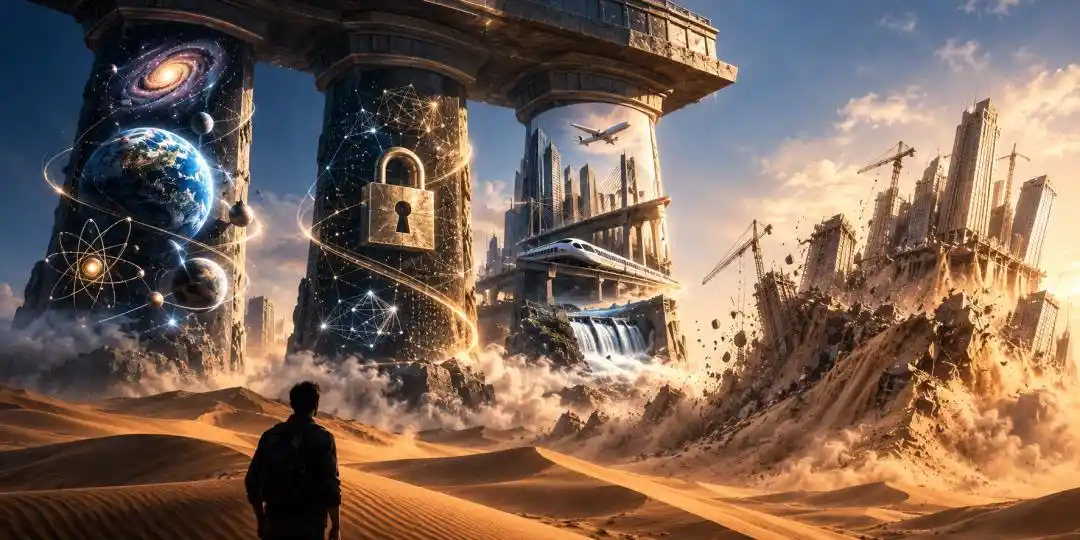
It lists several examples in that spirit. AI writes tens of millions of lines of code, yet no one can fully read them. AI designs new drugs, yet no one can explain every mechanism involved. AI proves century-old problems, yet no one can grasp the ideas behind the proof.
For thousands of years, the article says, humanity first tried to understand the world and then change it. AI may be reversing that order. The deeper danger, in this telling, is not that machines become smarter than people, but that people grow used to no longer thinking.
The piece ends on a simple line: the ultimate value of science has never been the answer alone, but understanding. Even if AI becomes an all-knowing “god,” humans cannot stop at reverence for results and give up the effort to understand the world.
References cited in the source article
- https://terrytao.wordpress.com/2026/10/10/math-2-0/
- https://www.developing.dev/p/e070-scott-aaronson
- From the WeChat public account “新智元” (ID: AI_era), by David