
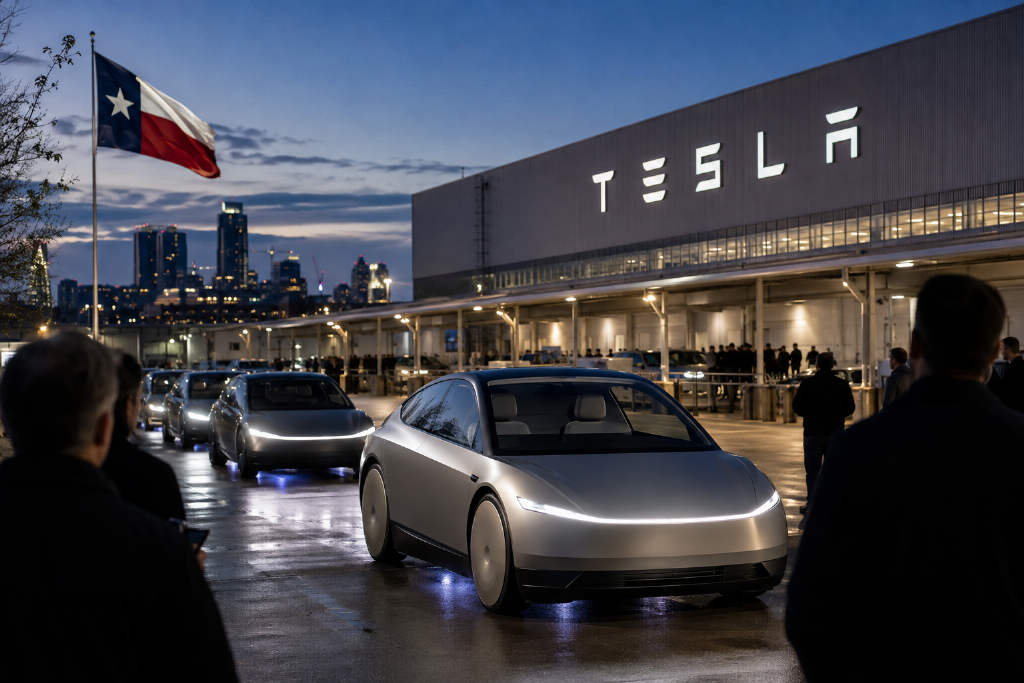
Tesla shares moved higher on Sept. 3, climbing about 4% at one point during the session. According to Yahoo Finance and other reports referenced in the source material, the main driver was Tesla’s Cybercab robotaxi event in Austin, Texas, which the market viewed as a milestone in the commercialization of autonomous driving.
Cybercab is Tesla’s first vehicle built solely for autonomous driving
Cybercab is a two-seat vehicle with no steering wheel and no pedals. It relies entirely on Tesla’s AI4 in-vehicle computer and is presented as the company’s first model designed purely for self-driving use. Paired with Tesla’s Full Self-Driving, or FSD, software, the vehicle is set to join the robotaxi fleet the company began operating in Austin last year with modified Model Y units.
Production started in the first half of 2026 at Gigafactory Texas. Reported specifications include a 48 kWh battery pack, a single 219-horsepower front-mounted motor, and an unadjusted range figure of 418 miles.
Sept. 3 event was a product launch, not regulatory approval
The Sept. 3 event was a product debut rather than approval from the U.S. National Highway Traffic Safety Administration, or NHTSA, and public participation remained limited. Tesla framed the event as a chance to let people experience 「the future of autonomous driving」, and outside observers broadly interpreted the event as likely to include Cybercab test rides.
On scale, Tesla secured the maximum regulatory quota of about 5,000 robotaxis. Still, Cybercab’s chief engineer told regulators that the company expects to deploy about 2,500 vehicles within a year, pointing to a phased fleet buildout instead of a full launch all at once.
Stock outperformed the broader market as investors focused on the Cybercab event
Tesla’s gain outpaced the broader market, suggesting the move was tied more directly to the Cybercab catalyst than to a general risk-on session. All three major U.S. stock indexes rose on the day, while AI-linked stocks continued to show momentum, giving Tesla a supportive backdrop.
On fundamentals, Tesla reported 26% year-over-year revenue growth in the second quarter. Expectations around its robotaxi business also helped support the stock ahead of the event. Even so, analysts remain divided on the shape of Cybercab’s commercial growth curve after rollout.