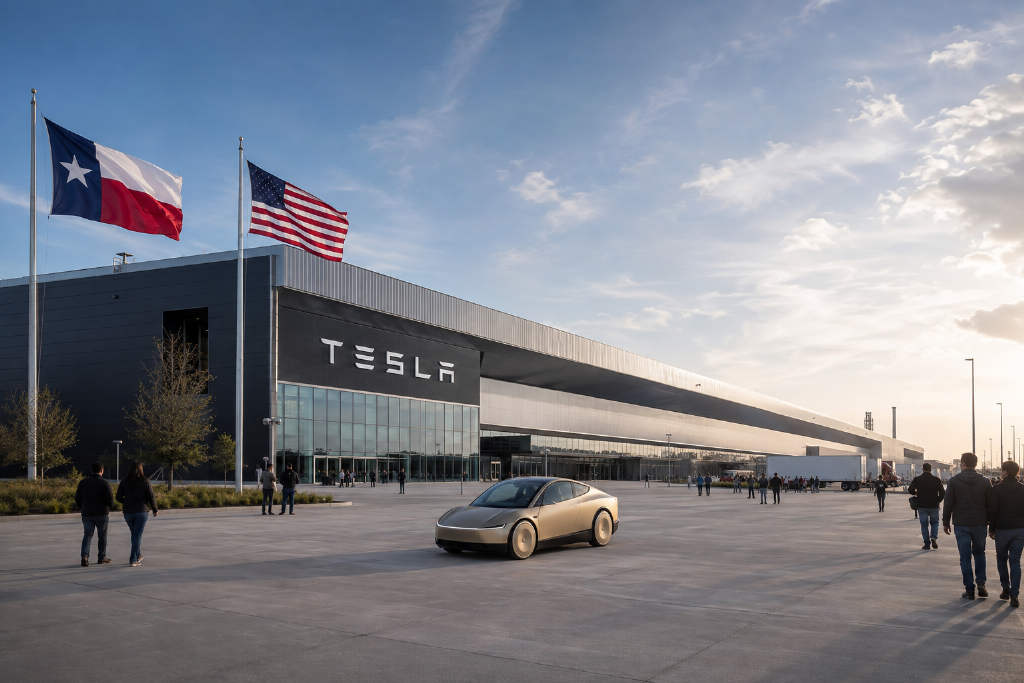
On September 3, Tesla held a Cybercab launch event in Austin, Texas, unveiling the production version of its autonomous vehicle. The Cybercab has no steering wheel, pedals, or traditional rearview mirrors, features a two-seat layout, and is fully controlled by Tesla's self-driving software. First shown as a concept at the "We, Robot" event in October 2024, the first production unit rolled off the line at Tesla's Gigafactory Texas in February 2026, with mass production beginning in April 2026. The vehicle relies on eight high-definition cameras and an end-to-end neural network, without lidar or high-definition maps. Tesla says its global fleet had accumulated over 22.5 billion kilometers of assisted driving as of September 2026. Efficiency: 9.8 km/kWh, 10.2 kWh/100 km, 673 km range, 1,412 kg curb weight, 47.6 kWh battery, 163 kW motor. Robotaxi operating cost is estimated at $0.20 per mile (0.84 yuan/km). The Cybercab will be displayed in Beijing and Shanghai from mid-September, but Tesla says no sales or commercial robotaxi operations in China are planned.
On September 3, Tesla held a Cybercab launch event in Austin, Texas, unveiling the production version of its autonomous vehicle. The Cybercab has no steering wheel, pedals, or traditional rearview mirrors, features a two-seat layout, and is fully controlled by Tesla's self-driving software.
First shown as a concept at the "We, Robot" event in October 2024, the first production unit rolled off the line at Tesla's Gigafactory Texas in February 2026, with mass production beginning in April 2026 — a span of roughly 18 months from concept to production. The vehicle relies on eight high-definition cameras for environmental perception, using an end-to-end neural network to make driving decisions, without lidar or high-definition maps. According to Tesla, as of September 2026, its global fleet had accumulated over 22.5 billion kilometers of assisted driving.
Efficiency figures: Cybercab is expected to achieve 9.8 km per kWh, with energy consumption of about 10.2 kWh per 100 km. Curb weight is 1,412 kg, with a 47.6 kWh battery pack and a 163 kW motor, giving a laboratory range of 673 km. Once operated at scale as a robotaxi, the cost per mile is estimated to drop to $0.20 (approximately 0.84 yuan per km).
Tesla said the Cybercab will be displayed in multiple Chinese cities including Beijing and Shanghai starting in mid-September. The exhibition does not involve sales in China, nor does it indicate that Tesla plans to launch autonomous ride-hailing operations in the country.
This article was originally published by Bit.Fan. For more cryptocurrency news and market insights, visit www.bit.fan. Disclaimer:
The market information, project data, and third-party content displayed on this platform are for industry information sharing only and do not constitute any form of investment advice or return commitment.
Cryptocurrency trading carries high risks. Users should fully assess their risk tolerance and make independent decisions. All profits, losses, and legal responsibilities are borne by the users themselves.