
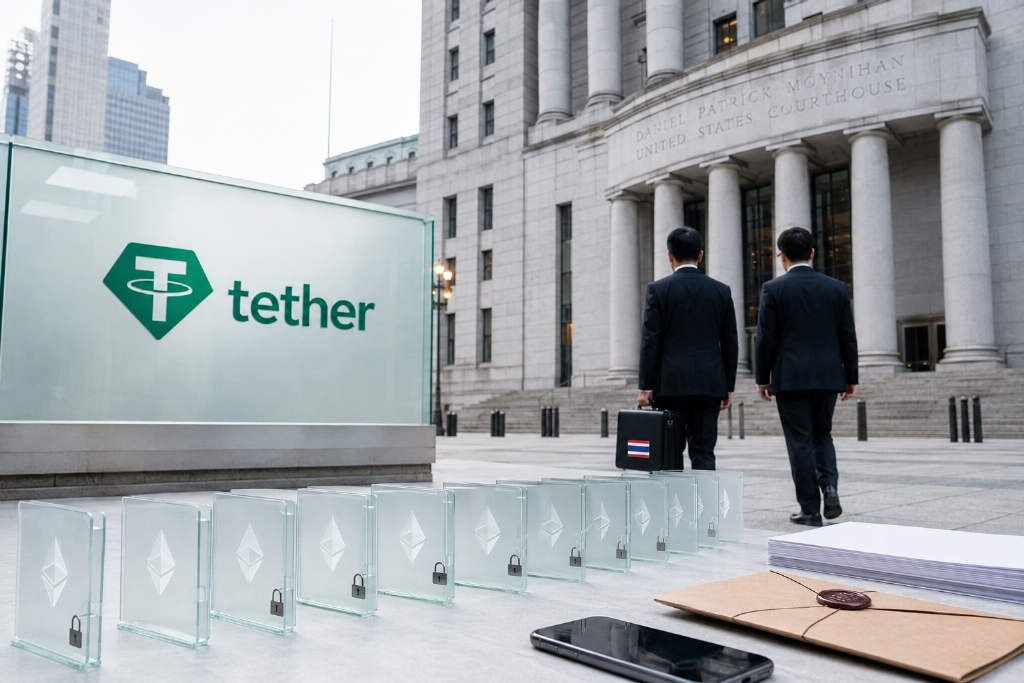
Two Thai businessmen have sued Tether over 42,417,785.62 USDT that the stablecoin issuer blacklisted across 10 Ethereum addresses, arguing the freeze came more than three months before the seizure warrant cited in their complaint. The suit was filed in the U.S. District Court for the Southern District of New York on Aug. 31 and re-filed the next day. Onchain records cited in the report show the addresses were frozen on Oct. 30, 2025, while the seizure warrant referenced in the complaint is dated Feb. 19, 2026.
Tether’s terms of service describe the right to buy and redeem tokens as “a contractual right personal to you,” and say the company may freeze tokens when required by applicable law or when it determines that doing so is prudent. The plaintiffs, Nutthawat Rukthammachalern and Natthawat Kasamvilas, say they acquired their USDT on the secondary market and had no contract with Tether.
All 10 addresses were switched in one batch
Queries to the USDT contract return true for all 10 addresses named in the complaint. Historical state data shows every one of them flipped to frozen status on Oct. 30, 2025, between 23:00:35 and 23:03:11 UTC. The change happened as a single batch over roughly two and a half minutes.
The combined balance of the addresses at that block was 42,417,785.617689 USDT, matching the complaint’s figure to the cent. The largest single address, attributed to Kasamvilas, holds 26.1 million USDT.
The complaint also describes two contract functions that appear in the verified source code. One, addBlackList, blocks outbound transfers while still allowing the address to receive tokens. The 10 addresses have taken in about 101 USDT since the freeze. The second, destroyBlackFunds, zeroes out a blacklisted balance and reduces total supply.
Five claims and four named Tether entities
The complaint brings five counts: declaratory judgment on the scope of federal seizure process, conversion, trespass to chattels, unjust enrichment in the alternative, and additional declaratory and injunctive relief.
It names four defendants: Tether Holdings, Tether International, Tether Operations, and Tether Investments. All four are S.A. de C.V. entities after the group’s 2025 move to El Salvador. Judge Lewis J. Liman has been assigned to the case. Summonses were issued to all four defendants on Sept. 1, and Tether has not yet appeared.
Plaintiffs say no warrant existed at the time of the freeze
The complaint alleges, on information and belief, that Tether acted on an “informal request by the U.S. government, acting through the HSI Agent” before any warrant existed. It says the warrant followed on Feb. 19, 2026, more than three months later.
It also alleges that Tether emailed Kasamvilas on Nov. 2, 2025, directing him to a Homeland Security Investigations agent and saying, “We do not have further information at this time,” without disclosing that Tether itself had frozen the funds.
Separate Rule 41(g) motion is pending in North Carolina
Before filing this case, the plaintiffs sought return of property through a Rule 41(g) motion in the U.S. District Court for the Eastern District of North Carolina on July 31, under case number 5:26-mc-00026. The matter is before Chief Judge Richard E. Myers II. The government received an extension on Aug. 21 to respond, and the motion remains undecided.
The complaint states that no civil forfeiture complaint has been filed against the addresses.
Tether previously said it had frozen more than $4.4 billion
Tether said in April that its cooperation with law enforcement had frozen more than $4.4 billion in assets. That total included more than $2.1 billion tied to U.S. authorities, spanning 2,300 cases and 340 agencies across 65 countries. The Defiant reported that disclosure at the time.
In a 2022 post about Tornado Cash, Tether described the trigger for wallet freezes as a request rather than a court order, writing: “When Tether receives an applicable/legitimate request from a verified law enforcement agent to freeze a privately held wallet, the Company complies.”
Tether calls the suit baseless
In a statement provided to reporters on Sept. 2, Tether said the lawsuit was “a baseless attempt to interfere with Tether’s important work with global law enforcement, including the Department of Justice, to prevent the unlawful use of USDT.” The company has not published anything about the case in its own newsroom.
According to CoinGecko, USDT traded at $0.9996 with a market capitalization of $183.3 billion at 7:32 a.m. ET on Thursday, making it the third-largest crypto asset. The 42.4 million USDT at issue represents roughly 0.02% of that supply.