
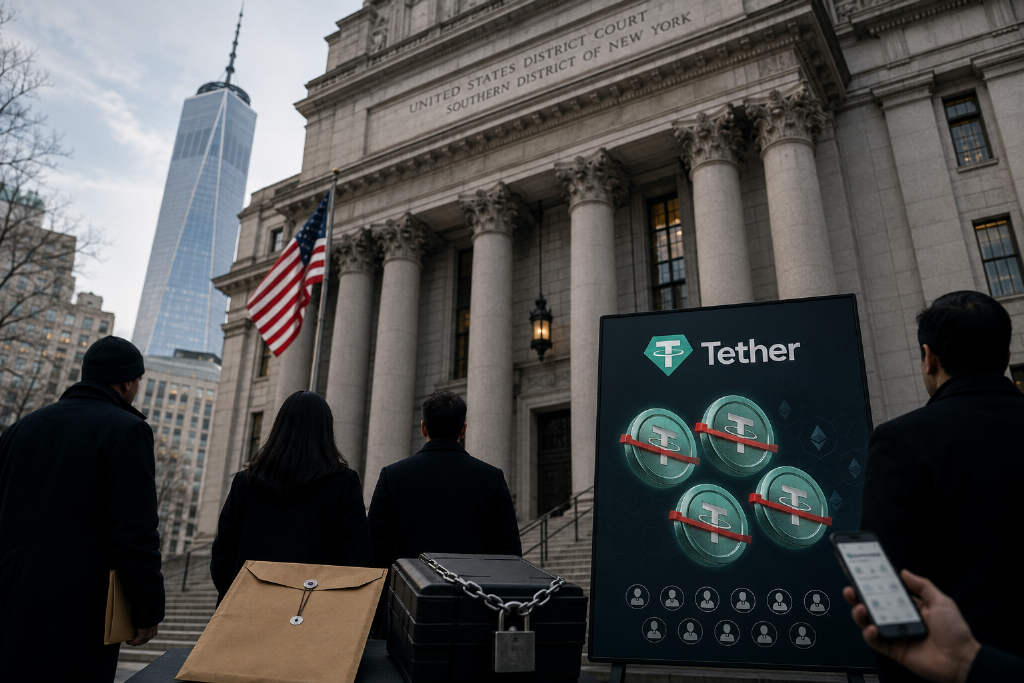
Tether has been sued in the United States over allegations that it froze more than $42.4 million in USDT belonging to two investors nearly four months before a formal court seizure warrant was issued.

The case, disclosed in the U.S. District Court for the Southern District of New York, centers on claims that Tether blacklisted wallet addresses without prior notice and without presenting formal legal documents at the time of the freeze.
According to court documents cited by Bitcoin.com and referenced in a report by TechFlow, the dispute involves two Thai investors whose 10 Ethereum addresses were blacklisted by Tether on Oct. 30, 2025. The amount frozen totaled $42,417,785 in USDT.
Warrant was approved months after the freeze
The plaintiffs say the court warrant used to legally seize the assets was not formally approved and issued until Feb. 19, 2026. That places the judicial authorization nearly four months after the blacklist action took effect.
The later warrant was tied to an investigation in North Carolina involving a $17 million pig-butchering investment scam. The plaintiffs maintain they were never involved in any fraud and describe the asset freeze as a case of mistaken enforcement coordination and misidentification. They also say they did not learn the full details until months after their funds had already been frozen.
The two investors have now filed a civil lawsuit in the Southern District of New York, asking the court to order Tether to remove the blacklist restrictions and compensate them for related losses.
USDT contract includes a blacklist function
The lawsuit has also drawn attention to how centralized stablecoins function on public blockchains. While USDT circulates on networks such as Ethereum and Tron, the report says its token contracts contain a hard-coded blacklist mechanism.
Tether, through its multi-signature administrative keys, can invoke contract functions that mark an address as unable to transfer tokens. Once an address is blacklisted, the USDT in that wallet cannot be transferred and cannot be used by decentralized exchanges or lending protocols.
Ties to law enforcement cooperation
TechFlow said the case highlights the gap between public blockchain settlement and practical control over centralized stablecoins. In traditional banking, account freezes usually follow investigative procedures and a judge-signed court order. On-chain, the report says, Tether works closely with U.S. law enforcement agencies including the Department of Justice, the FBI, and the Secret Service.
Official data cited in the report shows Tether has frozen more than $4.4 billion in USDT across over 2,300 cases. In practice, compliance teams may move quickly after receiving informal requests for investigative assistance or asset preservation from law enforcement, carrying out blacklist actions before the formal court paperwork is completed.
Self-custody does not prevent stablecoin freezes
The report also raises a broader point about asset ownership and control. Native crypto assets held in self-custody wallets, such as BTC and ETH, may retain censorship-resistant properties. USDT and similar centralized stablecoins are different: the issuer still controls key contract-level permissions.
In cross-border and cross-agency enforcement actions, mistaken flags and mistaken freezes can occur. If an address is tagged, ordinary users may face high legal and financial costs in trying to challenge the freeze across jurisdictions. The report said large holders using stablecoins for long-term value storage should weigh the concentration risk that comes with relying on a centrally issued token.
Risk notice
According to the Notice on Further Preventing and Disposing of the Risk of Virtual Currency Trading and Speculation jointly issued by ten Chinese authorities including the People’s Bank of China, the Cyberspace Administration of China, and the Supreme People’s Court, virtual currencies do not have the same legal status as fiat currency, do not have legal tender status, and should not and cannot circulate as currency in the market.
Activities related to virtual currencies are classified as illegal financial activities. Participation in virtual currency investment and trading carries legal and policy risks. Civil legal acts involving virtual currencies and related derivatives that violate public order and good customs are invalid, and resulting losses shall be borne by the participants themselves.
