
"Thank you all for your support. I need to say sorry here. Because of an adjustment to official business, I can only suspend updates for now." "Suspension notice. I’m sorry to let everyone down..." A batch of AI comic drama, AI art, and AI tutorial accounts that had once been treated as low-barrier business opportunities recently stopped updating in the same time window.
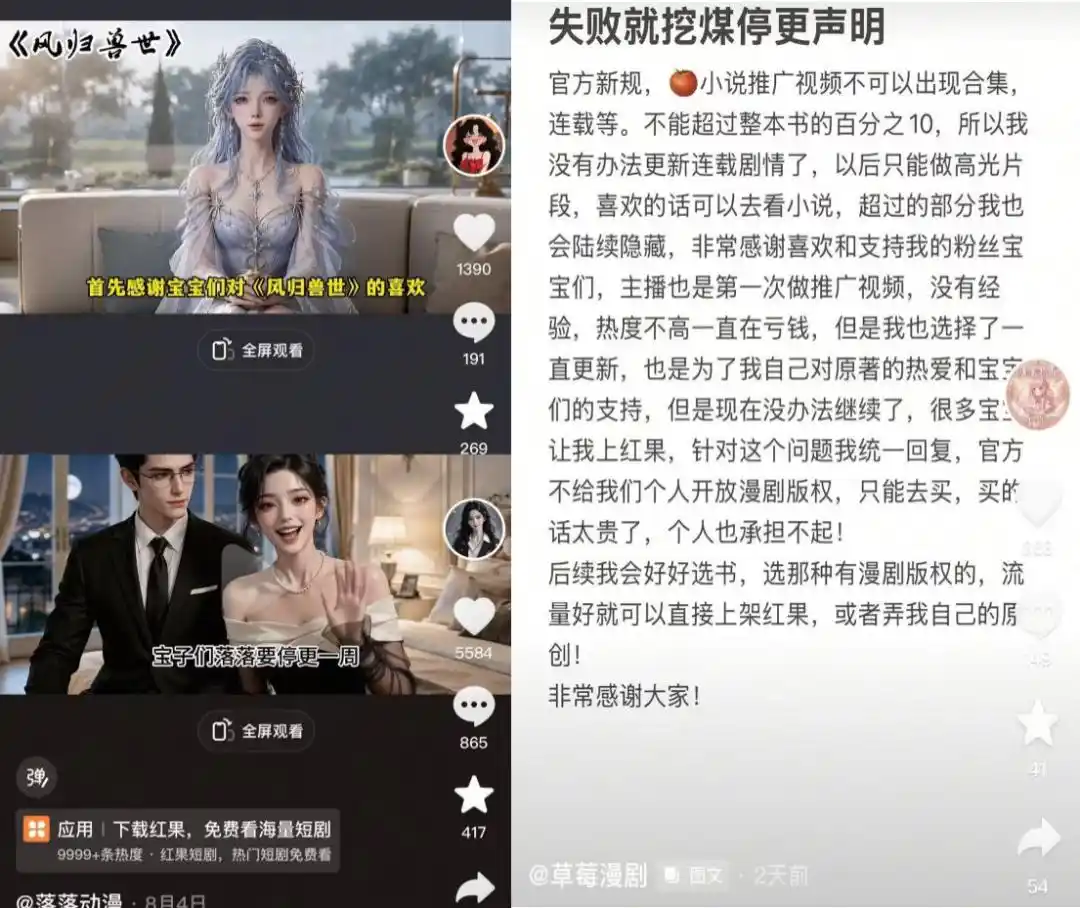
The immediate trigger was a new set of user-acquisition rules that Tomato Novel formally put in place on Aug. 17 for content and copyright compliance tied to "Hongguo Free Short Drama" comic adaptations.
But the rule change was not the only reason. The report says the sector had already been pushed toward a shakeout by tighter platform rules, tougher copyright requirements, rising cost pressure, and growing content homogeneity, all arriving in the same summer.
In the span of six months, AI comic dramas moved from noisy expansion to collective retreat. The easy traffic many creators chased is no longer easy to find.
The economics of AI comic dramas have turned harder
For many grassroots creators, computing cost was the first real ticket into the business. One AI comic drama creator told ifeng Tech that computing costs, including unusable footage, were about 1 yuan per second, while editing cost another 0.7 yuan per second. The creator said the most they could produce in one day was five finished minutes.
On that basis, a five-minute daily release schedule means about 510 yuan a day in combined computing and editing costs. The same creator said that "a video with 60,000 views only generates 45 yuan," leaving a wide gap between spending and revenue.
That has not stopped eye-catching examples from shaping public expectations. Some hit projects had been presented as proof that a few thousand yuan in cost could turn into returns worth hundreds of thousands of yuan.
One example in the report is the more than four-minute AI short film "Huo Qubing." Produced by a three-person team, it was completed in 48 hours with computing costs of less than 3,000 yuan. After gaining traction, the team behind it secured commercial orders worth more than 10,000 yuan. Another project, "Zombie Cleaner," was also made with 3,000 yuan in computing costs and spread widely online, including overseas.
Those cases, though, were not typical. The report says most small and mid-sized creators have not been able to reproduce that kind of result, and only a small number of accounts can consistently secure platform traffic recommendations.
The same creator told ifeng Tech: "Most people don’t have a background in directing or screenwriting. There’s a lot of uncertainty in what they make, and they don’t have the capital to buy traffic. Organic traffic is basically in the tens of thousands to hundreds of thousands. Combined income from Hongguo and Douyin was a little over 9,000 yuan, and that already counts as a hit." The creator added: "The reality is that most individual creators won’t break out. Even if they do, they can only cover their costs."
In an environment where many people want to enter the AI business, a solo creator without script reserves, team coordination, or a paid promotion budget faces long odds in trying to build a hit. Some post a few minutes a day and end up barely covering expenses, or staying in the red.
The report summed up the math this way: if a project works, the creator gets basic pay plus computing costs; if it does not, the return may be only tens or hundreds of yuan. That imbalance has left many AI comic drama creators wavering.
Tomato Novel’s new rules became the direct cause of the shutdown wave
If persistent losses created hesitation, Tomato Novel’s latest rules pushed many creators to stop outright.
According to the report, the main requirements are clear:
- comic-drama adaptations must obtain formal authorization from the original author or copyright holder, and unlicensed works cannot be listed or may need to be removed;
- a single video cannot exceed 15 minutes;
- the plot shown in a video cannot exceed 10% of the full original novel;
- titles and cover images cannot include labels such as "Episode 1," "Episode 2," "series," or "collection."
Those changes hit the previous model of mass production and traffic arbitrage. For small creators still in the trial-and-error stage, formal rights are often too expensive to obtain. As a result, many AI comic drama accounts on platforms such as Douyin and Hongguo short drama announced suspensions, and some removed past videos altogether.
Comments under those accounts filled with complaints from viewers who had been following the series. Some wrote, "It feels like the sky has fallen. The shows I like no longer have endings," and "The quality was quite good. What a pity." Some fans openly opposed the new rules, with one saying, "If it weren’t for people adapting them into comic dramas, who would go read the novels?"
For original web-novel writers, the reaction was very different.
One online fiction author involved in such a dispute told ifeng Tech that a short drama company had infringed the author’s original work. In one case, an AI live-action short drama did not pay any licensing fee at all. "The platform is helping me with the process, but it has stayed cold and unresponsive. I still haven’t received any compensation," the author said.
The report says this kind of rights-protection problem is not rare in online fiction circles. Many authors who discover their work has been repurposed into AI comic dramas face weak complaint channels and high evidentiary costs, and eventually drop the matter.
A gray-zone growth model has run into its limits
By the report’s account, the fast early growth of AI comic dramas was built on fragile ground from the start.
In 2026, AI comic dramas leaned on AI image-generation tools and AI voice models to rewrite online-fiction scripts and quickly turn out animated shorts designed for instant emotional payoff. A large number of individual creators and small studios rushed in, and the category was widely seen as an AI opportunity with a low barrier to entry.
Before Aug. 17, much of the industry followed what the report described as a "board first, buy the ticket later" path. Creators used large models to ingest publicly released comic materials and novel text, trained custom models, generated storyboards and dialogue at scale, then added AI voiceovers and published finished videos. The process was cheap, fast, and accessible enough that an account could catch on within a few months.
That efficiency came with persistent copyright risk. Searches on Douyin by ifeng Tech found that several AI comic dramas, including "Feng Gui Shen Shou," "E Nv Ran Ran," and "Shi Bai Jiu Wa Mei," had already posted suspension notices. In each case, the reason pointed to missing copyright authorization.
The last clause in the new rules — "commissions for violations will be reset to zero directly" — sent a shock through the sector. For many creators, halting updates became the only rational way to exit for now.
The next phase depends on content and compliance
The report says AI comic dramas often reused similar model templates and were criticized for rough execution, even as their themes clustered around rebirth, comeback arcs, and system-driven wish-fulfillment plots. Character setups and story formulas were highly repetitive, yet they still held the attention of many short-video users for a period of time.
As audience fatigue set in, complaints shifted. "Polished but forgettable" became a common reaction, and "physiological aversion to AI faces" repeatedly trended in public discussion. AI lowered the barrier to producing content, but it did not lower the barrier to making a hit.
The sudden pause by a large number of AI accounts led some viewers to conclude that the AI sector itself was slipping. The report takes a different view. It argues that the shutdowns do not reflect a failure of current AI technology, but an adjustment as a fast-growing business moves from rough expansion toward refined operations. Many creators entered AI comic dramas mainly to monetize quickly, not to focus on content creation itself.
After the new rules took effect, some creators began trying to "buy the ticket" after the fact by purchasing rights from original authors so they could keep updating under the new compliance framework. Even so, the report notes that formal adaptation rights for a web novel can take weeks or even months to secure.
China’s National Radio and Television Administration has issued the "Measures for the Administration of the Development of Micro Short Dramas," which will take effect on Sept. 1, 2026. The report says the latest regulation is not surprising. A sector moving from unchecked growth to standardized development will almost certainly go through a shakeout.
The article was first published by the WeChat public account ifeng Tech and written by Li Xinyang. Its conclusion is straightforward: the easy traffic has largely been taken, and the creators left standing will need content strength and compliance, not just fast production.