
TrendForce said in its latest supply chain weekly report that memory shortages are still intensifying, and the strain has spread from DRAM into NAND-based enterprise SSDs, or eSSDs. The firm also said ABF substrate prices are expected to rise 10% to 15% per quarter starting in the third quarter of 2026. This week’s main market focus also includes minutes from the Federal Reserve’s FOMC meeting and Samsung Electronics’ preliminary third-quarter results.
DRAM lead times reach 20 weeks as enterprise SSD shipments come under pressure
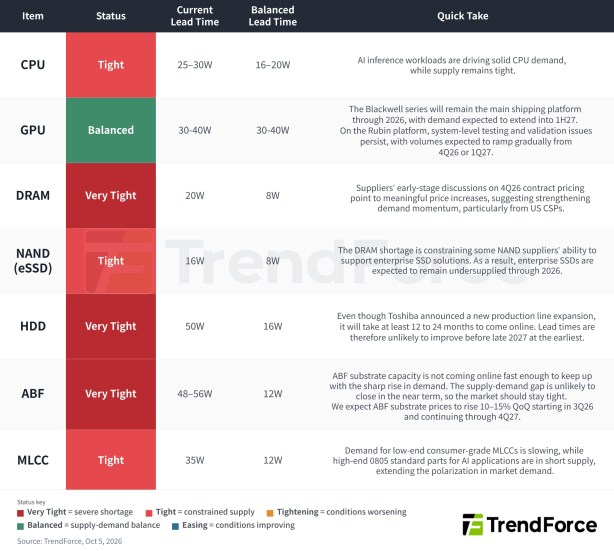
According to TrendForce, DRAM lead times have reached 20 weeks, or 2.5 times the 8-week level it sees as balanced. Initial discussions on contract pricing for the fourth quarter of 2026 are pointing higher, with demand growth mainly coming from U.S. cloud service providers, or CSPs.
At the same time, insufficient DRAM supply is limiting shipment capacity for some NAND vendors’ enterprise SSD solutions. eSSD lead times are now 16 weeks, double the 8-week balanced level, and TrendForce expects the segment to remain undersupplied throughout 2026.
The firm does not see the shortage as a short-lived event. Micron management said there is currently no clear timeline for supply and demand to return to balance. It also projected bit shipment growth for DRAM and NAND at only the low-20% range and mid-20% range, respectively, in 2027 to 2028, indicating continued supply constraints in both markets.
TrendForce said the drivers include limited cleanroom space, a rising share of standard DRAM capacity being displaced by HBM, and diminishing returns from process shrinks.
ABF substrates and HDDs show the widest gaps versus balanced supply
Measured by how far lead times have moved above balanced levels, ABF substrates and HDDs show the largest gaps in the report. ABF substrate lead times were estimated at 48 to 56 weeks, around 4 to 4.7 times the 12-week balanced level. HDD lead times were listed at 50 weeks, about 3.1 times the 16-week balanced level. TrendForce classified both as very tight.
For HDDs, Toshiba has announced additional production lines, but those lines will need at least 12 to 24 months before entering production. TrendForce said lead times are unlikely to improve before the end of 2027. With DRAM and eSSDs both under pressure, data centers have few alternatives on the storage side.
ABF substrates are facing a different issue: capacity additions are not keeping pace with the jump in demand. TrendForce expects substrate prices to rise 10% to 15% per quarter from the third quarter of 2026 through the fourth quarter of 2027. For substrate makers and related suppliers, that points to a clear pricing upcycle and continued cost pressure in advanced chip packaging.
CPU, GPU and MLCC markets are diverging as AI demand reshapes supply
In other parts of the supply chain, CPUs were classified as tight, with lead times of 25 to 30 weeks versus a balanced range of 16 to 20 weeks. TrendForce said AI inference workloads are supporting CPU demand.
GPUs were the only category described as balanced, though lead times still stand at 30 to 40 weeks, which does not suggest weak demand. TrendForce expects Nvidia’s Blackwell series to remain the main shipment driver in 2026, with demand extending into the first half of 2027. For the next-generation Rubin platform, system-level testing and validation issues still need to be resolved, and volume ramp is expected to begin gradually in the fourth quarter of 2026 or the first quarter of 2027.
Among passive components, MLCC lead times were listed at 35 weeks, about 2.9 times the 12-week balanced level, and the category was also marked as tight. TrendForce said the market is becoming more polarized: demand for lower-end consumer MLCCs is slowing, while higher-spec parts used in AI applications remain in short supply.
Micron results set the tone as Samsung’s third-quarter figures approach
Micron’s latest earnings showed revenue of $54.2 billion, up 31% from the previous quarter, while non-GAAP gross margin reached a record 87%. The company forecast next-quarter revenue of $61.5 billion. It also added 10 strategic customer agreements, bringing the total to 26, with some extending through 2031. More than 75% of its 2027 output has already been booked.
Samsung is scheduled to release preliminary third-quarter earnings on Oct. 8. According to the latest FnGuide consensus, the market expects operating profit of KRW 108.1 trillion and revenue of KRW 201.7 trillion. If those figures are met, Samsung would post operating profit above KRW 100 trillion in a single quarter for the first time, up about 21% from KRW 89.5 trillion in the second quarter.
Samsung previously said it had started shipping HBM4E samples and expects third-quarter HBM4 revenue to increase by more than three times from the prior quarter.
Fed minutes due as markets look for clues on internal policy debate
On the macro side, the Federal Reserve is set to release minutes from its Sept. 15-16 FOMC meeting on Oct. 7 Eastern Time. At that meeting, officials unanimously approved a 25-basis-point rate increase, lifting the target range to 3.75% to 4.00%. It was the first move after five meetings on hold.
The dot plot released after the meeting leaned hawkish, with the median year-end rate at 4.1%, briefly reviving discussion of a new tightening cycle. Later data shifted expectations. August core PCE inflation slowed to 3.0%, and New York Fed President John Williams said there was 「no urgency」. Markets have since moved toward expecting no change at the Oct. 28 meeting.
The minutes are expected to show which side of the committee had more influence, including how many officials still see another rate increase this year and how the committee is interpreting higher oil prices and softer labor demand. One week later, on Oct. 14, CPI data is also due and could reshape rate expectations again.