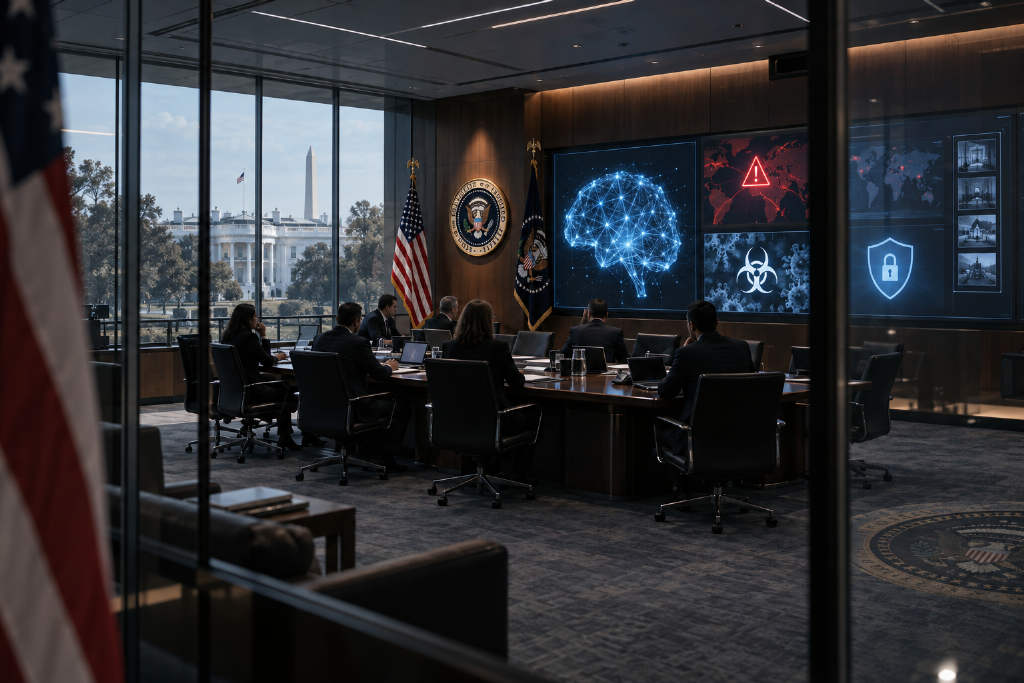
U.S. President Donald Trump’s AI task force, called the Super Intelligence Force, has held its first meeting and agreed to focus on risks tied to cybersecurity, biosecurity, and what the White House described as model control and accountability. The administration said the group will ask the President’s Council of Advisors on Science and Technology, or PCAST, to prepare a report covering those issues and other potential concerns. It also plans to set up an early-warning and formal notification framework requiring AI labs to report security flaws, cyberattacks, jailbreaks, and related incidents to the government. In parallel, the White House said a coordination committee involving the Department of Justice, the Federal Trade Commission, and other agencies will be formed to handle enforcement and consumer protection coordination. The White House added that the task force did not discuss drafting new laws or regulatory rules at this stage. Bloomberg noted that Trump has previously opposed stronger AI regulation, arguing it could weaken U.S. competitiveness against China in artificial intelligence. Still, concerns over large-scale job losses, the possibility of humans losing control over AI, and rising electricity prices linked to data centers are drawing growing attention from lawmakers in both parties.
U.S. President Donald Trump’s artificial intelligence task force, the Super Intelligence Force, has held its first meeting and agreed to prioritize an assessment of AI risks in cybersecurity, biosecurity, and what the White House called model control and accountability.
The White House said the group will ask the President’s Council of Advisors on Science and Technology, or PCAST, to produce a report on those risks and other potential issues.
The task force also plans to create a mechanism requiring AI labs to provide early warnings and structured notifications to the government over security flaws, cyberattacks, jailbreaks, and other problems.
In addition, it will set up an enforcement and consumer protection coordination committee involving the U.S. Department of Justice, the Federal Trade Commission, and other agencies.
The White House said the meeting did not include discussions on new laws or regulatory rules.
According to Bloomberg, Trump has repeatedly argued against tougher AI regulation, saying it could weaken the United States in its competition with China on AI. Even so, AI safety is drawing increasing attention from lawmakers in both parties as concerns grow over the risk of large-scale job losses, humans losing control over AI, and data centers pushing up electricity prices.
This article was originally published by Bit.Fan. For more cryptocurrency news and market insights, visit www.bit.fan. Disclaimer:
The market information, project data, and third-party content displayed on this platform are for industry information sharing only and do not constitute any form of investment advice or return commitment.
Cryptocurrency trading carries high risks. Users should fully assess their risk tolerance and make independent decisions. All profits, losses, and legal responsibilities are borne by the users themselves.