
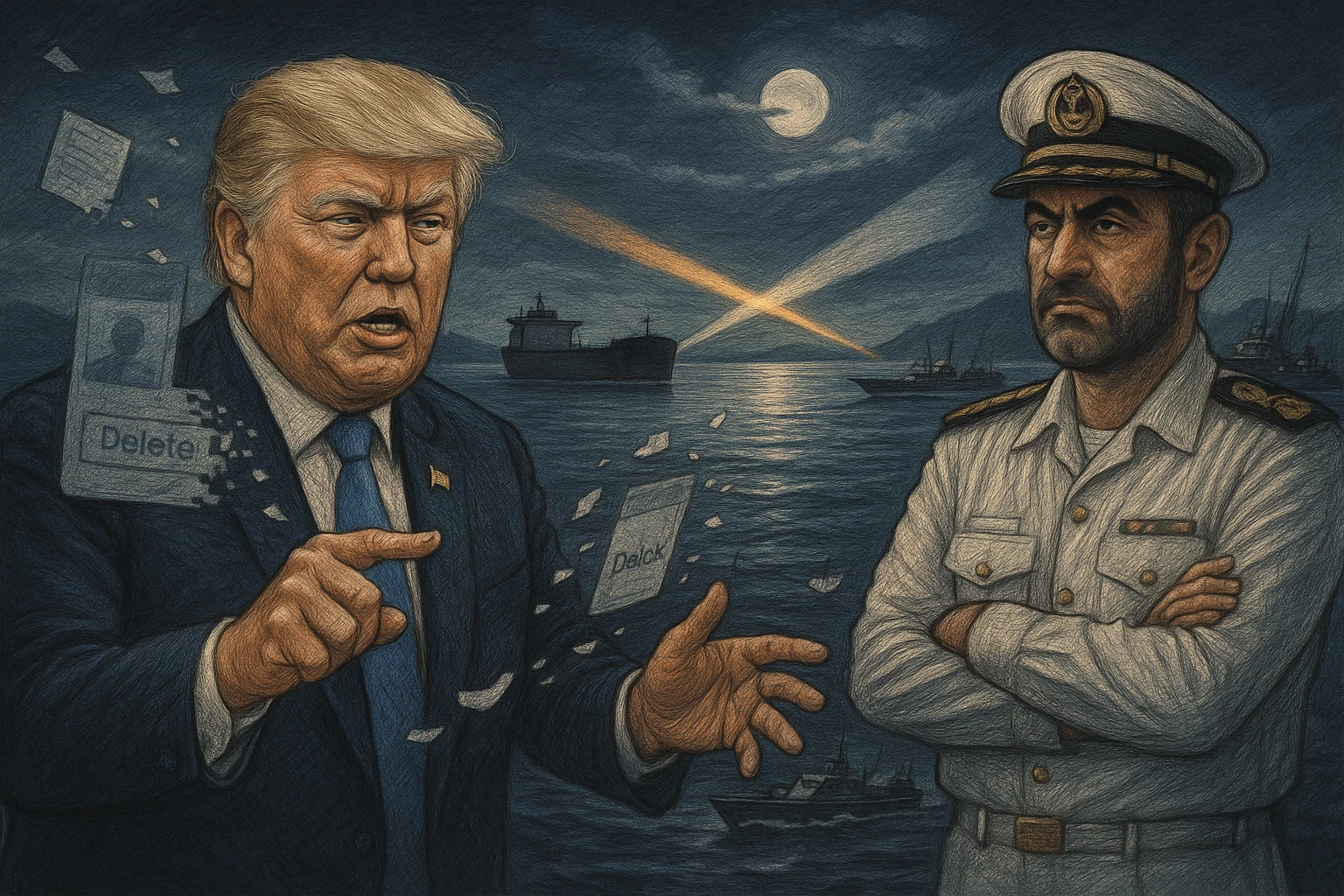
Donald Trump deleted a Truth Social post on July 10 about possible Iranian mining in the Strait of Hormuz, then reposted a revised version saying the U.S. would use the same technology and missile capabilities used against drug traffickers to “permanently eliminate” any vessel attempting to lay mines in the waterway. On the same day, Energy Secretary Chris Wright posted that the U.S. Navy had successfully escorted a tanker through the strait, only for that message to be deleted soon after.
Trump shifts from demanding mine removal to threatening direct destruction
In the earlier deleted post, Trump said that if Iran had placed mines in the Strait of Hormuz — while also noting there had been no reports confirming that — they should be removed immediately or face “military consequences unlike any before.” He also suggested that if Iran removed any mines that may have been placed, it would be a major step in the right direction. The reposted version changed the tone. It moved away from a demand for removal and toward a direct threat against ships involved in mine-laying.
Deleted tanker escort claim draws immediate White House clarification
Wright had written on social media that the U.S. Navy had already escorted an oil tanker through the Strait of Hormuz to help keep oil flowing to global markets. The post was later taken down. Media outlets then cited sources saying the U.S. Navy had not actually escorted any tanker through the strait. According to the report, officials inside the U.S. government had spent the previous week discussing when a naval escort operation might begin and under what conditions, but no such mission had been launched.
White House press secretary Leavitt later said in a briefing that the Navy was “not currently escorting any tankers or other ships through the Strait of Hormuz.” She added that such a move remained an option and said Trump would use it at the appropriate time. Leavitt also said Trump was not ruling out any military option against Iran, including the deployment of U.S. ground forces.
Iran rejects the claim as false while poll shows public confusion
Iran responded quickly. The commander of the Islamic Revolutionary Guard Corps Navy called the tanker escort claim “a lie” and warned that any action by the U.S. and its allies would be stopped within the range of Iranian missiles and drones.
AXIOS said in an analysis published on July 10 that Trump’s public comments on Iran across interviews, press conferences, and social media had been inconsistent. The outlet pointed to conflicting timelines, changing descriptions of escalation, and remarks suggesting Trump should decide Iran’s next leader even as U.S. officials denied that regime change was the goal. The formal U.S. position, according to the report, lists three objectives: destroying Iran’s nuclear capability, ending its support for terrorism, and defeating its naval forces.
A recent Reuters/Ipsos poll showed how that message was landing with the public. Among 1,021 respondents, only 33% said Trump had clearly explained the purpose of U.S. military action against Iran.