
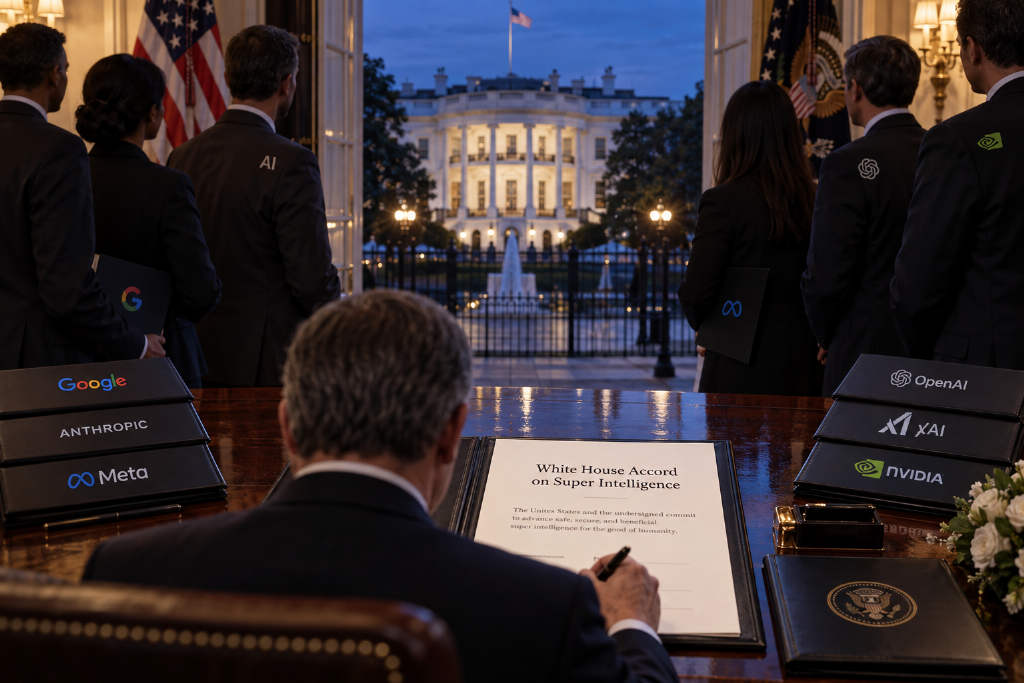
U.S. President Donald Trump recently signed the White House Accord on Super Intelligence at the White House alongside leaders from several major AI companies. The agreement says companies developing frontier models should put in place internal safety controls, independent external evaluation, and board-level oversight.
The signatories were Google CEO Sundar Pichai, Anthropic CEO Dario Amodei, Meta CEO Mark Zuckerberg, OpenAI President Greg Brockman, xAI founder Elon Musk, and Nvidia CEO Jensen Huang. Trump also signed the document.
Four layers of safety commitments
The document’s formal title is White House Accord on Super Intelligence — Joint Commitment on Frontier Responsibilities. It states at the outset that each company has a responsibility to develop its technology in a safe way that can build trust with customers and the public, and that all companies training and deploying frontier models should maintain sufficiently strong internal procedures and controls.
The accord lays out four layers of commitments. The first is robust internal controls. Companies are expected to continuously monitor model capabilities and alignment during training and deployment, especially in areas including cybersecurity, biosecurity, and chemical threats. The document also says companies should prevent models from engaging in unintended hacking behavior or accessing technical systems.
The second layer is an empowered internal safety team. That team is tasked with confirming that the monitoring, detection, and control mechanisms are functioning properly and with making sure problems can be remedied immediately if they are found.
The third layer requires companies to work with independent external auditors or evaluators to verify that internal safety controls are operating as intended.
The fourth layer requires a company’s board to establish an independent committee that receives reports from internal teams and outside evaluators and confirms that identified risks have in fact been addressed.
Voluntary for now, with room to become law
The accord also says participating companies should meet regularly to develop safety standards and best practices together. At this stage, the framework remains a voluntary commitment, but the text leaves open the possibility that it could later be converted into law or a regulatory regime.
Trump described it as a "morally binding" agreement and even compared it to an AI "constitution." That framing points to a U.S. policy approach that still leans toward industry self-regulation first, rather than immediate comprehensive mandatory regulation.
Huang says trust will shape the future of superintelligence
After the signing, Jensen Huang said the accord reinforces the responsibility technology companies themselves must carry. He said the core principle is simple: the companies building the technology should bear primary responsibility for developing and deploying it safely, and they should also be accountable when things go wrong.
Huang said superintelligence could create major opportunities in scientific discovery, productivity, security, healthcare, and economic prosperity. But whether society ultimately accepts it, he said, will depend not only on what the technology can do, but also on how much trust it earns.
"The future of Super Intelligence will not only be determined by what it can do, but also by the trust it earns," Huang said. He added that only by balancing ambition, rigor, and responsibility can the technology expand opportunity and improve human life over the long term.
Companies with different safety views signed the same baseline
Another notable feature of the accord is that the six companies have not approached AI safety from the same position. Anthropic has long argued for a stricter frontier AI safety framework. OpenAI has its own preparedness and external testing systems. Meta has put more emphasis on open models. xAI has taken visibly different positions from Anthropic on model releases, safety policy, and governance.
Even so, Google, Anthropic, Meta, OpenAI, xAI, and Nvidia all signed onto the same baseline governance framework in this case.
The accord does not currently specify criminal penalties or fines for violations. It also does not designate a single outside auditor, a shared testing standard, or a concrete implementation deadline. That leaves the real-world effect heavily dependent on how each company carries out the commitments.
An official typo in the official accord
The formal document on superintelligence governance also carried a conspicuous spelling mistake. Under Trump’s signature, the title should have read "President of the United States," but it was printed as "President of the Unites States."
That detail stood out because the accord itself is about building multiple layers of review and reducing the risk of errors in advanced AI systems, while the White House paperwork contained a typo of its own.