
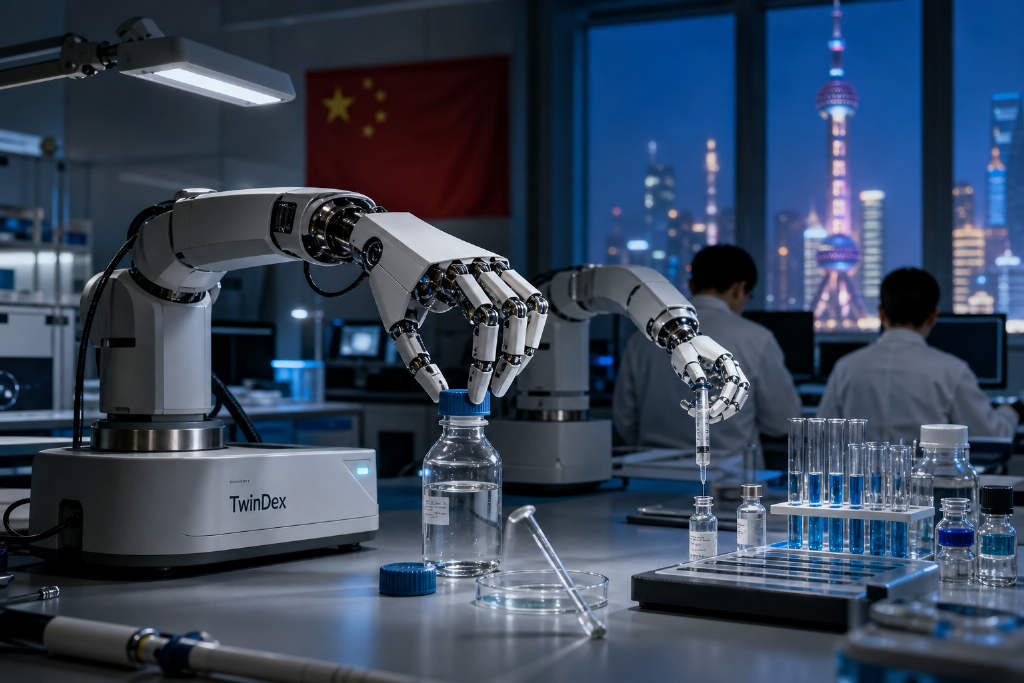
In May this year, NVIDIA robotics lead Jim Fan said in a public talk that VLA and teleoperation were dead. A few months later, that claim has found a concrete example.
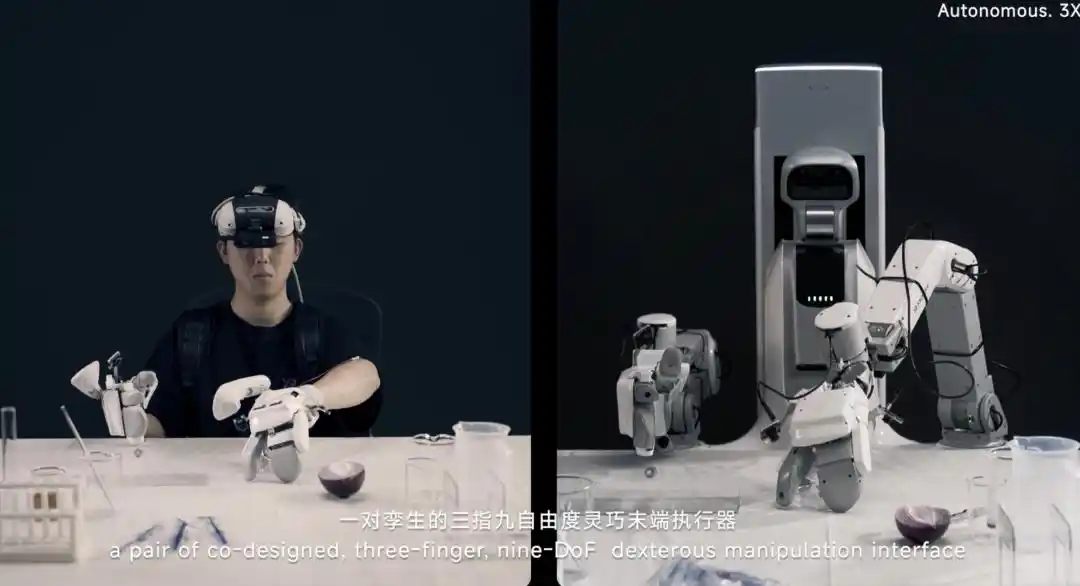
Zibianliang has unveiled TwinDex, a dexterous manipulation system that, according to the company, can complete post-training with zero real-robot teleoperation data. In the demo, the robot carried out a series of fine manipulation tasks in a chemistry lab setting, including unscrewing bottle caps and pushing a syringe plunger. Instead of relying on robot-body teleoperation data for this stage, TwinDex used a few hundred body-free data samples.
A full chemistry demo with 24 sub-actions
The most complete sequence released with the demo was a single-shot chemistry experiment. The system handled bottle opening and sampling, pipette and test tube operations, liquid guidance with a glass rod, shaking, and observation, all executed autonomously by the policy.
The experiment covered 24 sub-actions across three tools. It required repeated bimanual coordination, multiple tool switches, millimeter-level positioning, and stable force control throughout.
Broken down by capability, the demo highlighted several manipulation skills that have traditionally been hard to crack.
High-precision fine manipulation
One example was opening a toolbox. The robot had to align the index fingers of both hands with two narrow latches, insert them accurately, press downward to release the catches, then use the index finger and thumb to pinch the handle and lift the lid. The challenge was clear: the hand needed to enter a very low-tolerance space and still execute the movement accurately.
Syringe operation posed a similar problem. The index and middle fingers fixed the barrel in place, while the thumb aligned with the plunger and pushed forward, maintaining position while controlling direction and force.
The article argues that as embodied AI moves into laboratories, factories, and homes, this kind of small-tolerance, high-precision, contact-heavy manipulation will increasingly look like baseline robotic skill rather than edge-case performance.
Three-finger coordination
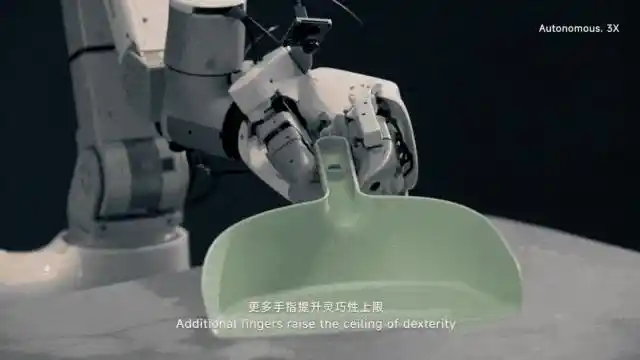
In a broom-and-dustpan task, the three fingers wrapped around the handle, with different digits sharing support and control. Compared with a two-finger gripper, the third finger adds another contact point and another way to stabilize an object.
That extra point matters in tool-use tasks and when grasping elongated objects.
Flexible, human-like in-hand adjustment
When unscrewing a bottle cap, TwinDex pinched the cap with the index finger and thumb, then rotated it through lateral finger motion with little need for large wrist movement.
In a book-flipping task, the thumb first rubbed the top book loose, after which the system pinched it, transferred it between hands, placed it down, and turned the page.
The takeaway in the source article was direct: a number of fine manipulation tasks once assumed to require a five-finger dexterous hand can already be handled with three fingers.
One structure for capture and execution
TwinDex is not only the robot-side manipulator. It also serves as a wearable body-free data collection system matched to the execution side.
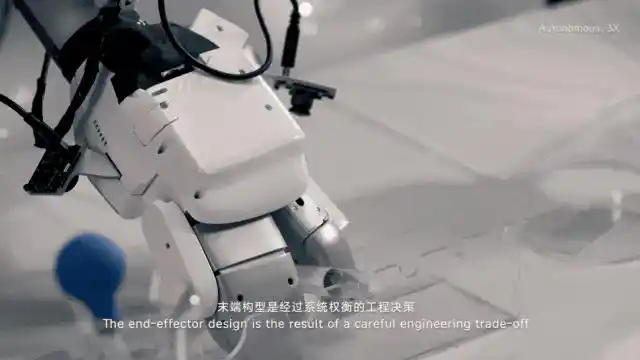
Many existing approaches use one hardware stack for data capture and another for robot execution. TwinDex uses an isomorphic design for both. In plain terms, the same three-finger structure is used not only to do the work, but also to collect the data that teaches the system how to do it.
That reduces the need to migrate demonstrations across completely different embodiments. Motions made by the operator at the collection end map more directly to the robot at the execution end.
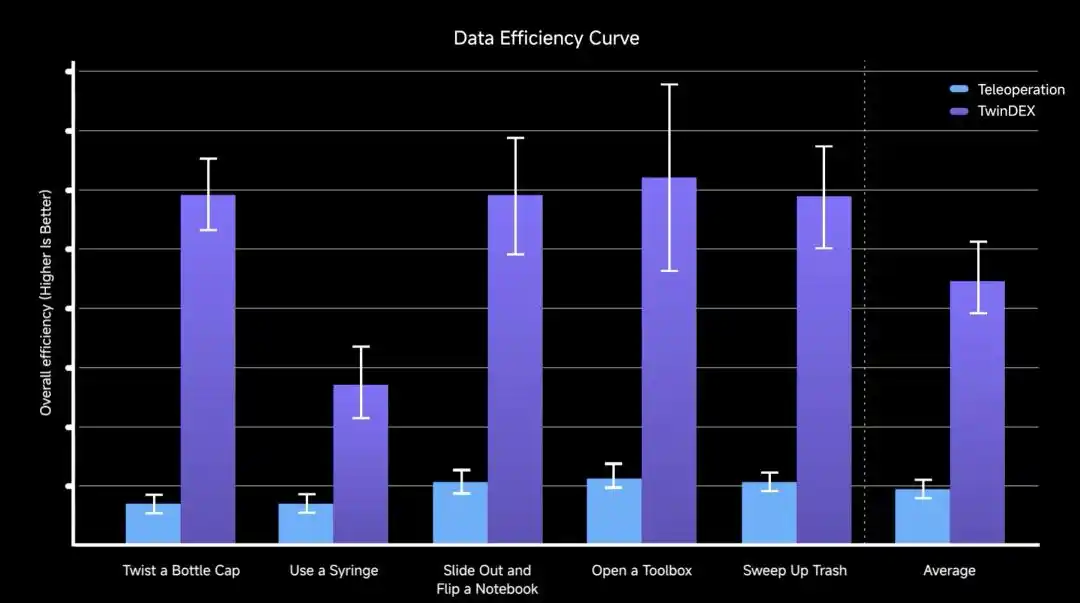
This is one reason the system can reproduce high-precision actions more reliably. Compared with directly teleoperating a heavy robot, a collector can move more naturally and more quickly, while gathering data at lower cost.
5.3x more valid trajectories per unit time
Zibianliang said TwinDex produced valid trajectories at about 5.3 times the rate of traditional real-robot teleoperation on a per-time basis.
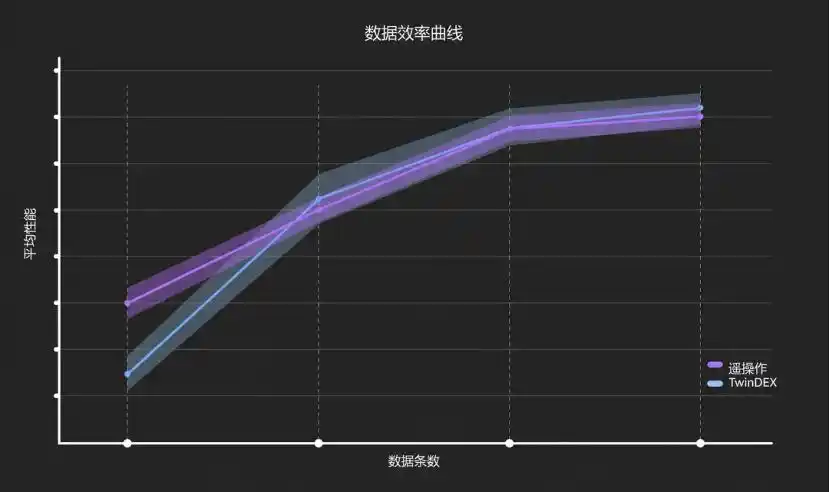
On data efficiency, the company said policies trained with body-free data and those trained with real-robot teleoperation data improved at the same rate as more data was added, eventually converging to similar performance.
In this experimental setup, the article said body-free data came close to replacing real-robot teleoperation data entirely for model training.
That pushes the discussion beyond collecting data faster. The system is aimed at reducing the precision loss that often appears when data is transferred from the collection setup to the robot. Both points lead to the same question: how to turn body-free data into data that a robot can actually use.
TwinDex as a full manipulation stack
Strictly speaking, TwinDex is not just a three-finger hand. The article describes it as a manipulation operating system made up of data collection hardware, a robot end effector, a data processing pipeline, and a model training workflow.
The core idea goes beyond making the collection device and the robot hand look similar. The system was designed backward from a specific target: use only body-free data in post-training and remove the need for real-robot teleoperation data at that stage. The hand structure, the motion style of the collection device, visual observation, time synchronization, data processing, and final model training were all organized around one question: how to make captured data resemble the data the robot actually needs from the start.
Dexterity: why three fingers and nine degrees of freedom
In the released demos, the thumb and index finger handled much of the opposition, pinching, twisting, and fine manipulation, while the third finger added enclosure, support, and stability.
TwinDex did not use a common two-finger gripper such as UMI, nor did it move straight to a five-finger human-like structure. Instead, it split the difference between dexterity, stability, and engineering complexity.
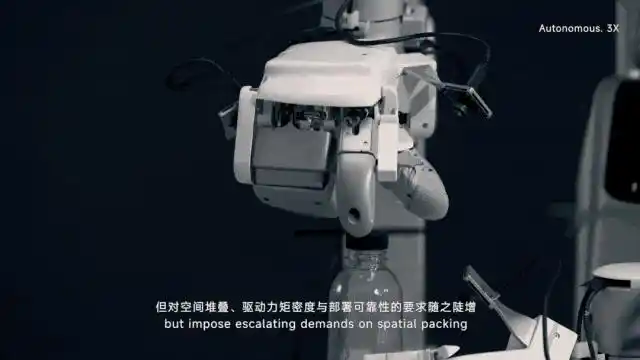
More fingers and a more human-like structure raise the theoretical ceiling for dexterous manipulation, but they also add joints, actuators, sensors, and higher calibration, control, and maintenance costs. A two-finger gripper is simpler, but it struggles with twisting, in-hand adjustment, and multi-point contact.
After testing basic grasping, in-place twisting, tool use, and in-hand manipulation primitives, and comparing multiple candidate configurations, Zibianliang concluded that three fingers and nine degrees of freedom represent the current sweet spot. In its view, that design covers most of the dexterity needed for current tasks while keeping complexity manageable.
Consistency: alignment before the data is even created
Consistency is presented as TwinDex’s central design principle. Here it refers to keeping the collection side and the execution side as close as possible in movement style, contact behavior, visual observation, collection precision, and time synchronization.
The article notes that many body-free datasets are easy to collect, but hard to transfer. The collection embodiment and the robot embodiment are often different. How a human hand moves, and how a capture device records that movement, may not map cleanly onto a robot. Kinematic mismatch and precision loss often enter the pipeline at that point.
That is why scalable body-free data often still needs a supplemental batch of real-robot teleoperation demonstrations for embodiment alignment and post-training. TwinDex is designed to tackle exactly that step.
Rather than waiting until data collection is finished and then trying to adapt the data to the robot, TwinDex attempts to make the collection hardware and the robot hand isomorphic from the hardware design stage. Put differently, embodiment alignment is moved forward from the data processing stage to the period before the data is generated.
That lowers transfer loss when body-free data is moved onto the robot and reduces the need for additional real-robot teleoperation data. In the tasks covered by these experiments, the article says TwinDex could complete post-training with a few hundred body-free samples and no new teleoperated demonstrations on the target robot, while still delivering the fine manipulation shown earlier.
Scalability: data collection no longer tied one-to-one to robot count
The data collection side of TwinDex is a wearable three-finger exoskeleton. One immediate advantage is that gathering data does not require occupying a real robot or staying at a fixed workstation.
An operator can wear the device and directly perform actions such as twisting, pressing, and tool use. Compared with teleoperating a robot through a controller, this is closer to natural human movement. The hand can contact objects directly and receive real force feedback, without the extra burden of adapting to spatial remapping or communication latency.
More importantly, data production is no longer tied one-to-one to the number of available robots. Multiple operators in different locations can collect data at the same time and then send it into the same processing and training pipeline.
During collection, the system records multimodal signals including vision, joint states, and wrist pose. Calibration, time synchronization, and normalization then bring data from different operators and locations into one training space.
The article also notes the trade-off that comes with scale. Different devices and different operators introduce jitter, drift, and localization error. Zibianliang said it addressed that in the model architecture and training workflow so the model can tolerate a certain range of collection error and still learn policies that the robot can execute in closed loop.
Pressure on the dominance of real-robot teleoperation data
The article’s broader point is not just that TwinDex collects data faster. It argues that high-quality data closest to robot actions may not have to come from real robots alone.
Over the past two years, teleoperated real-robot data has sat at the top of the embodied-data pyramid because visual observations, joint states, and end-effector trajectories are naturally aligned. The cost, however, is also the highest. Every trajectory requires a physical robot, and the system must be deployed and maintained while operators learn teleoperation. Once robot count becomes the ceiling on data output, scaling becomes difficult.
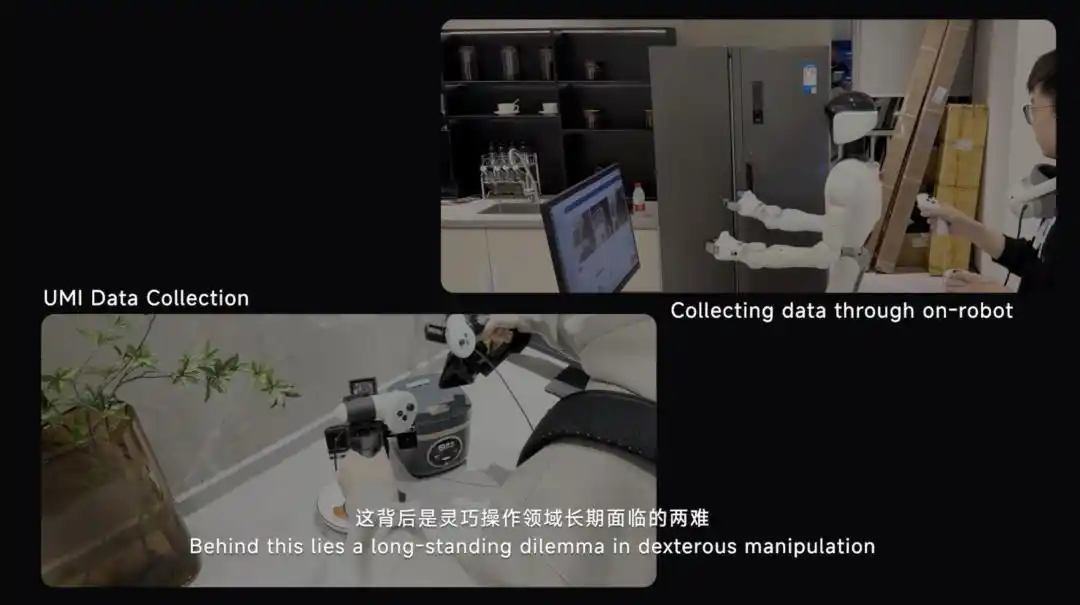
The article presents that as part of the backdrop to Jim Fan’s claim that teleoperation is dead. In response, the embodied AI community has explored alternatives such as UMI, gloves or exoskeletons, and ego-view capture. The common goal is to use more scalable body-free data to reduce dependence on real-robot data.
That has always involved a trade-off. The freer the collection method, the easier the scaling. But the farther the collection setup is from the actual robot, the harder mapping and transfer become. Structural differences, differing degrees of freedom, and different contact modes between human hands and robots all introduce motion retargeting and precision loss.
TwinDex is presented as an attempt to find a new sweet spot between scalability and preservation of the physical information the robot needs. It does not abandon the constraints imposed by the robot embodiment. Instead, it copies those action structures into the data collection side in advance.
As a result, in the tasks shown so far, a few hundred body-free samples were enough to do part of the alignment work that post-training has typically required real-robot teleoperation data to handle.
Project page is live
The article also stops short of declaring teleoperation dead across the board. It says embodied data recipes are still far from settled, and task coverage and data diversity still matter.
Even so, one shift is becoming clearer: the tight binding between high-quality data and real-robot teleoperation is starting to loosen. If body-free data can move closer to the training value of real-robot data in post-training, the next problem worth exploring is a scaling law for body-free data itself.
Zibianliang’s answer at this stage is straightforward. The era in which every new task had to begin with real-robot teleoperation data is starting to end.
Project page:
https://x2robot.com/pages/twindex
This article was sourced from the WeChat public account QbitAI, written by henry.