
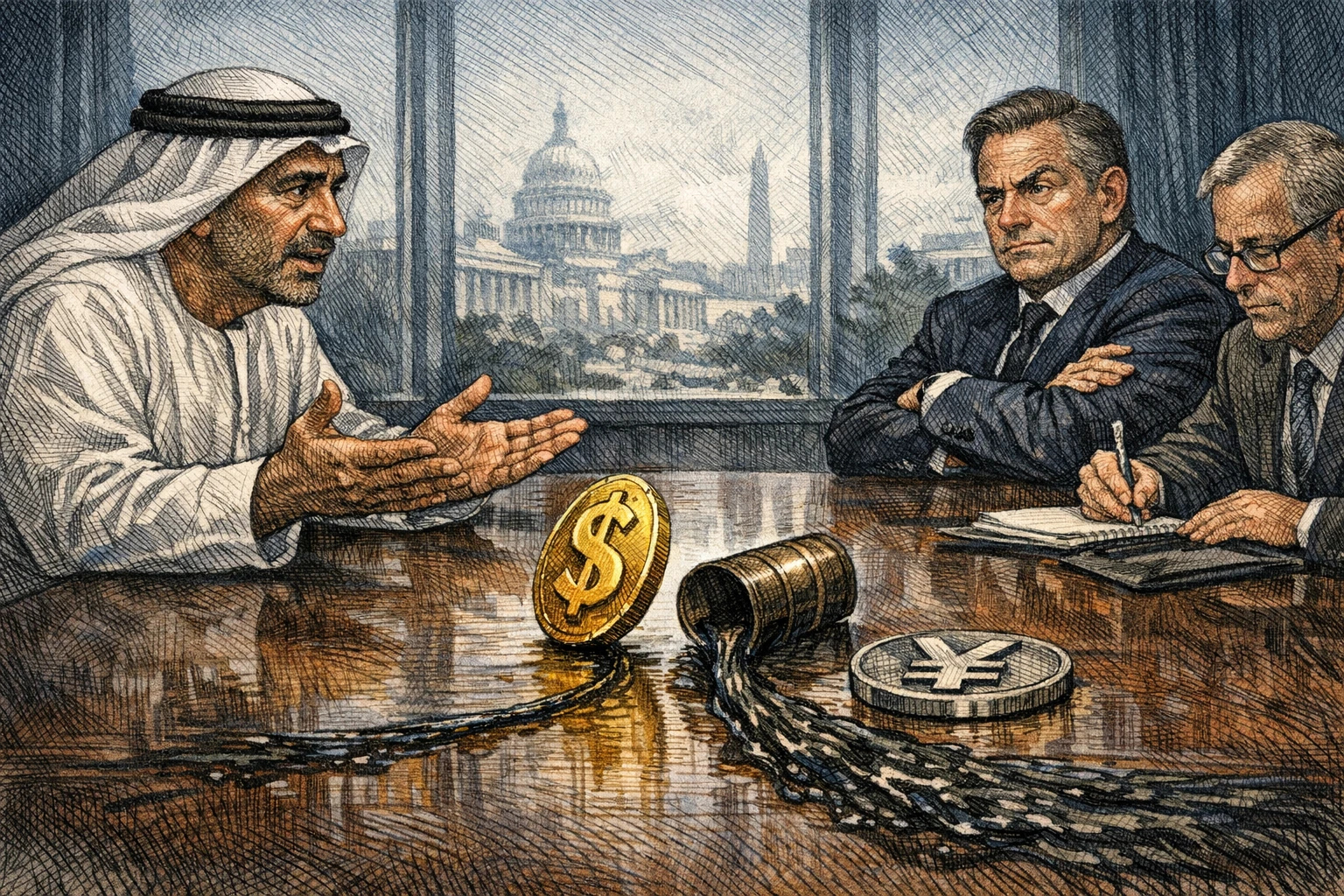
UAE Central Bank Governor Khaled Mohamed Balama confronted US Treasury Secretary Scott Bessent and Federal Reserve officials in Washington last weekend during the IMF and World Bank spring meetings, requesting a dollar-dirham currency swap line. The message was blunt: if dollar liquidity tightens, the UAE reserves the right to switch oil exports to yuan or other currencies. For the first time in over half a century, a core petrodollar ally has openly leveraged the threat of abandoning dollar pricing.
Dirham peg under stress: reserves squeeze triggers 'precautionary' request
The dirham is pegged to the dollar at a fixed rate, requiring ample dollar reserves to maintain stability. Historically, oil export revenues naturally replenished those reserves. Now two gaps have opened: energy infrastructure damage slashed output, and the blockade of the Strait of Hormuz cut off export routes, choking dollar-denominated income. The logic of a swap line is simple — the Fed provides cheap dollars, the UAE central bank swaps in dirhams to stabilize the rate, and reverses the trade after the crisis. The US has given similar facilities to Korea, Singapore, and Australia. UAE officials describe the request as 'precautionary' and not yet formal, but the signal is far bigger than the technical details.
41% settlement in yuan: the alternative is ready
This is no bluff. Since March 2026, the share of Middle East oil sold to China settled in yuan has exceeded 41%, with Saudi Arabia reaching 45%. China has already replaced Europe and the US as the UAE's largest oil buyer. The trade relationships, buyer demand, and infrastructure for yuan settlement are all in place. All that is missing is a political decision. UAE President Mohammed bin Zayed has stated that switching to yuan for oil payments is not off the table, and that the country will reassess the necessity of US military bases on its soil. A single move that touches both the petrodollar and the military alliance.
'The US started the war, but we pay the bill'
The UAE's core argument: the conflict with Iran was initiated by the US, yet the Gulf states bear the consequences. Destroyed infrastructure, blocked export routes, and lost dollar revenue — the UAE is forced to use its own reserves to hedge against a war it never chose. In this frame, asking for a currency swap is not just a financial need but a political claim: 'You dragged us in, so you owe us insurance.' Meanwhile, Qatar has also signaled a review of US base agreements. A collective repricing of Middle East alliances is underway.
Petrodollar's trust crack: with 41% yuan settlement, a closed Strait of Hormuz, and deep UAE-China trade integration, the yuan threat carries weight. The dollar's hegemony now faces not a rival power, but a negotiation from its closest energy ally.