
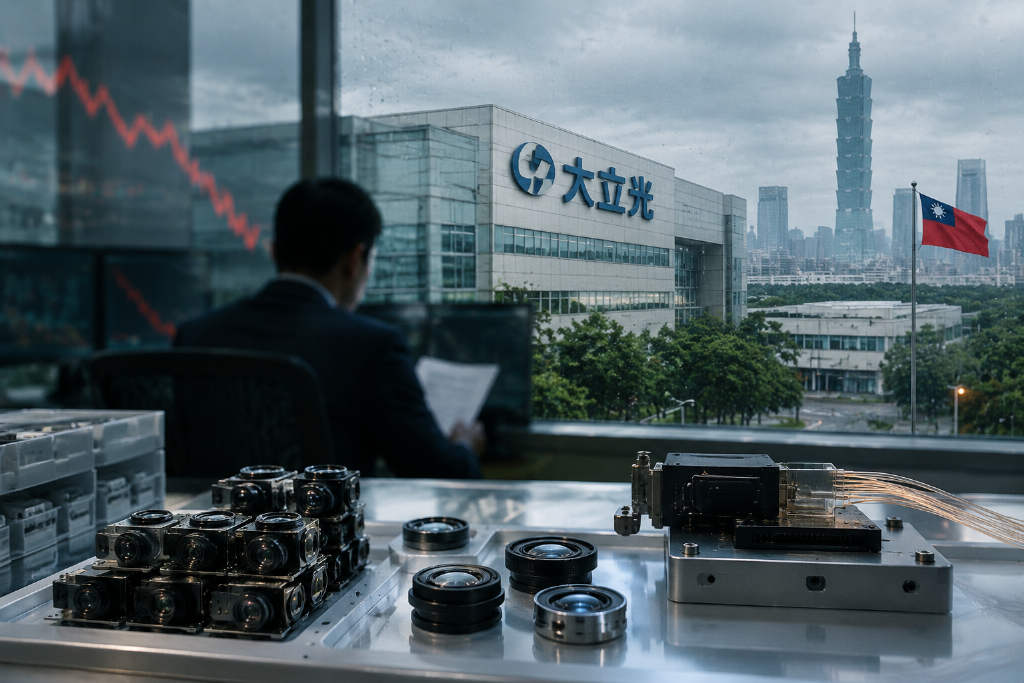
UBS lowers both rating and price target
Largan Precision, one of the big names in optics supply, has watched its stock jump more than 242% since April. The move came as excitement around co-packaged optics built fast, helped along by reports about land purchases and capacity expansion. Then on Sept. 6, UBS put out a research note that cut the stock to Sell from Buy and trimmed its target price to NT$5,000.
Using the NT$6,420 intraday price cited in that note, the target points to about 22% downside. UBS argued the market is getting ahead of itself on Largan’s CPO opportunity. Too much, too soon. It also said the company’s core smartphone lens business is running into cost pressure.
CPO progress is still early and mass production may take several quarters
UBS said investors have pushed the CPO narrative far ahead of where commercialization actually stands. Right now, Largan is still only at the early phase of sending FA, or fiber array, samples out for validation. The company still has to combine its Prism Micro Lens Array, V-groove photoelectric components, and Corning fiber, and then finish the verification process with system integrators.
Per the report, it could take several more quarters to lift yields before mass production is ready to start.
Largan has been moving deeper into the supply chain. Chain News previously reported that the company is expanding from being an FA supplier into downstream FAU, or fiber array unit, modules. That shift would move it from an indirect supplier to a direct supplier in NVIDIA optical communications, and it has already entered Taiwan Semiconductor Manufacturing Co.’s COUPE process circle.
But competition is still there. UBS said Largan is up against established supplier TFC, along with overseas manufacturers such as Coherent that can handle vertical integration.
On valuation, UBS said the current stock price is trading at 35x projected 2027 earnings. That is far above Largan’s historical range of 13x to 18x over similar periods.
August revenue fell from a year earlier, while September would need a 73% monthly jump to hit target
On the numbers, Largan posted August revenue of NT$5.012 billion, down 16.23% from a year earlier. UBS said revenue for July and August combined reached NT$10.1 billion, or just 53% of its full-year forecast.
So September revenue would need to jump 73% from August for the company to hit that target. UBS called that a hard ask in the current market environment.
Costs are another problem. UBS said memory prices have climbed sharply, pushing up component costs across the supply chain. At the same time, customers have passed part of that on by raising retail prices by roughly $200 to $300 year over year.
As for demand at the end market, Apple makes up about 80% of Largan’s total revenue, and shipments for Apple’s new phones are expected to remain flat. Some high-end models using variable aperture lenses could help a bit. Still, limited spec changes in foldable-phone lenses are not expected to add much.
UBS uses a 15x multiple to derive a NT$5,000 target
UBS said the smartphone business is stable, but there is no clear new growth leg. Because of that, it thinks Largan’s valuation should move back toward its historical price-to-earnings range instead of being driven mainly by the far-off CPO story.
The bank projects earnings per share of NT$190 this year and NT$214 next year. Using a 15x earnings multiple, it arrives at a fair target price of NT$5,000, or about 22% below the NT$6,420 intraday price mentioned in the note.
UBS wrote: "With the optimistic scenario already fully priced in by the market well ahead of time, the risk-reward profile of continuing to hold the stock now skews negative, so we are downgrading the rating from 'Buy' straight past 'Neutral' to 'Sell'."
FAU remains the key variable to watch
That said, the bull case for Largan is not baseless. Chairman Lin En-ping said for the first time at the company’s June shareholders meeting that Largan had won FA mass-production orders. Then at a July investor conference, he said the company was taking a wait-and-see approach to FAU alignment technology. The pilot line is set to be finished by the end of the third quarter of 2026, and mass production could start as early as mid-2027, bringing in meaningful revenue.
Financially, FAU as an integrated module has a higher average selling price and a better gross margin than selling FA parts alone. If Largan manages to push further downstream in the same supply chain, it would be selling products with more added value directly into end-customer demand. And that could improve its long-term profit mix and give the current valuation premium more support.