
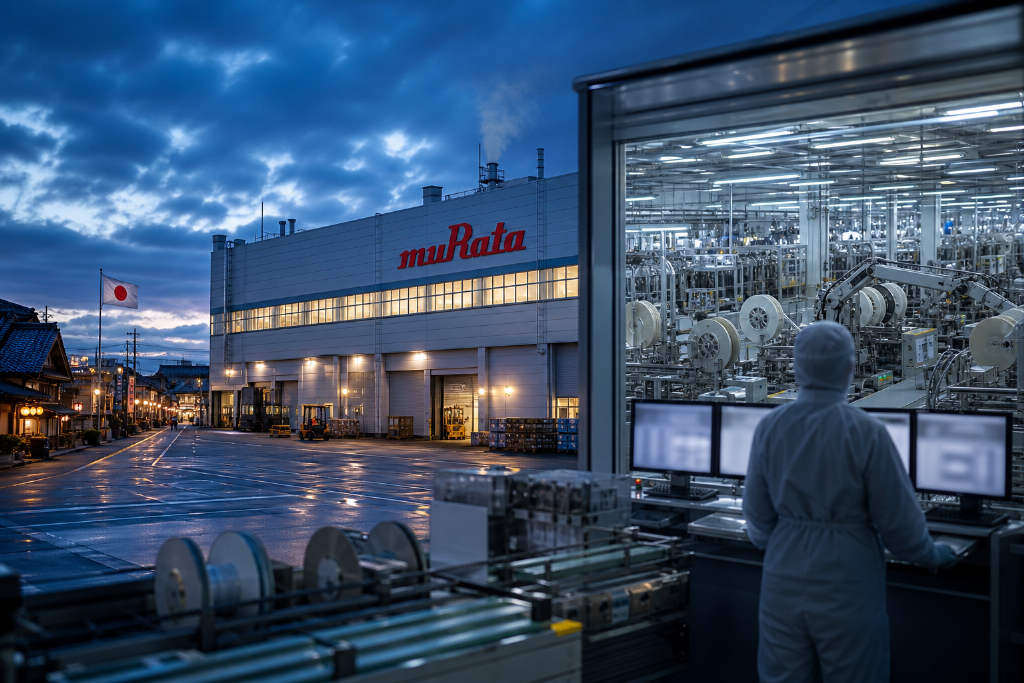
UBS analysts visited Murata Manufacturing’s Fukui Takefu plant on Aug. 18, in what the firm described as the first time the site had been opened to outsiders in about 20 years. After the visit, UBS said Murata still has roughly 20% output upside in its existing equipment base, even as room for physical capacity expansion is nearing its limit.
Murata is the global leader in MLCCs, or multilayer ceramic capacitors, with a market share of about 35%, according to the report summary. The Takefu plant serves as the mother factory for advanced MLCC products, mainly supplying AI servers and premium smartphones. UBS said the AI compute race is pushing supply chains toward their limits, and that the plant visit backed three key calls: the company’s technical moat remains deep, existing tools still have about 20% output upside, and further physical expansion is becoming harder.
Flexible production across 50,000 product types
Murata uses a segmented production system, with workshops organized by process stage. UBS said that setup requires more labor, but gives the company clear flexibility in handling 50,000 product categories, more than five times the number carried by competitors. It also helps maximize equipment utilization at each process step and reduces the chance that defective products move into the next stage.
UBS said Murata’s edge in high-end segments such as AI servers rests on three areas: control over the uniformity of ceramic materials, proprietary technology that maximizes capacitance, and optimization room created by self-developed production equipment. Those three elements reinforce one another. Material formulas are not disclosed, equipment is made in-house rather than purchased externally, and process parameters are not allowed to leak out. UBS described the resulting barrier as a “black box.”
The Takefu plant has 11 production buildings. UBS toured Building E, the largest one at the site. The building mainly produces 1005-size products, the specification where demand growth from AI servers is most visible.
Yield, feedback and automation are the main sources of output gains
The most striking figure from the visit came from management’s on-site explanation. Murata said three measures — yield improvement, better feedback between process steps, and automation in inspection — could release roughly 20% more output.
UBS framed that number against the reality of expansion constraints. Management said the scope for adding new buildings or more equipment at the Takefu plant is shrinking, with labor shortages also acting as a brake. Future physical capacity growth is expected to come mainly from three sources: a new building at Izumo Murata Manufacturing completed in April 2026, a new factory in Yasugi, Shimane Prefecture, where land has already been secured, and capacity freed up by shifting general-purpose products to the Thailand plant.
At the same time, lead times for components used in Murata’s self-developed equipment are getting longer. UBS noted that Murata had already made clear that capacity growth from newly added equipment would be unlikely to rise far beyond its earlier pace of about 10% a year. Against that backdrop, a 20% output gain from existing tools looks like a lower-cost path with higher certainty. UBS said the visit reinforced the supply rigidity of Murata’s advanced capacity, and that limits on new builds and longer equipment lead times are pushing the market to reassess the value of optimization within the installed base.
UBS ties margin expansion to a richer product mix
UBS set a target price of ¥13,200 based on 30x expected FY2029 earnings. In the bank’s model, Murata’s operating margin rises from 15.4% in FY2026 to 37.6% in FY2029.
The main driver, UBS said, is product mix upgrade. Demand from AI servers and premium smartphones continues to increase for high-capacitance, small-form-factor MLCCs, which carry higher pricing and margins than general-purpose products. As Murata shifts general-purpose output to overseas factories such as its Thailand site, while domestic plants in Japan including Takefu focus on advanced products, that layered capacity strategy is expected to lift overall profitability.
Risks include weaker demand and technology diffusion
UBS listed three main risks: a U.S. economic slowdown that hurts demand, diffusion of high-capacitance ceramic capacitor technology across Asia, and migration of high-frequency circuits toward IC integration. On industry structure, UBS took a relatively constructive stance, saying conditions should improve over the next six months and that there could be room for an upward revision to guidance around Oct. 31.
The article also stated that the ratings, target price, earnings forecasts and related judgments cited in the piece were drawn from a research report by UBS Securities Japan Co., Ltd. dated Aug. 18, 2026. Those views represent the analysts and their institution, not Chaoxiang Research, and do not constitute investment advice. The original text also said market risk remains, decisions should be made independently, and the article should not be used as a basis for buying or selling any security.