
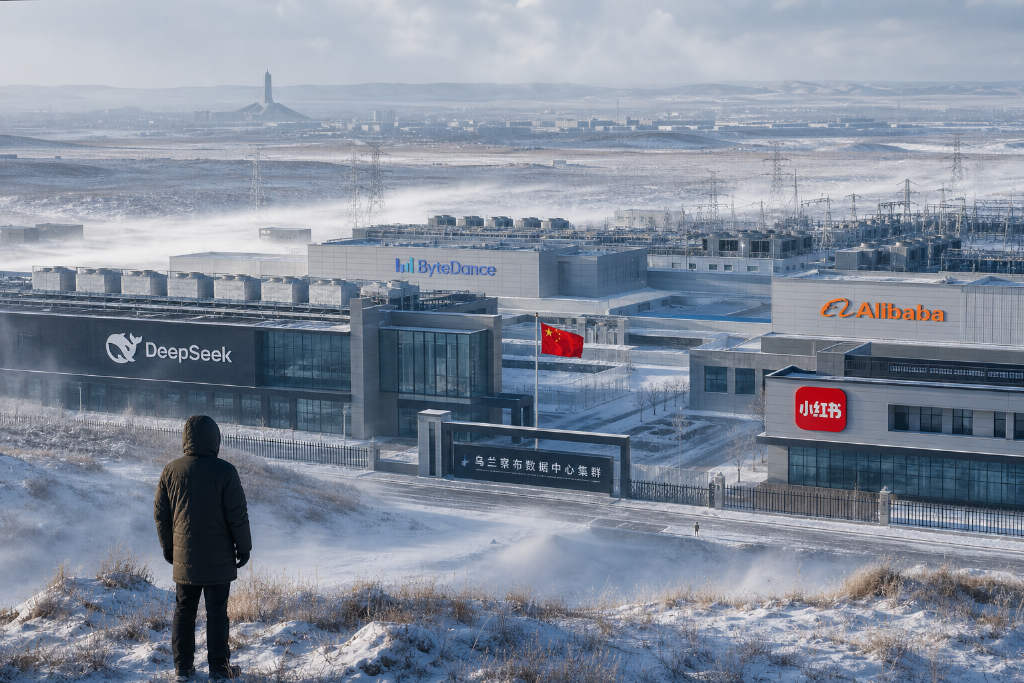
Inner Mongolia’s Ulanqab is moving to the center of China’s AI infrastructure race, not Beijing, Shanghai or Shenzhen, according to a recent WIRED report highlighted by ABMedia. The city, long associated with livestock and coal, is now developing into one of China’s most important AI data center clusters.
Goldman Sachs research cited in the report says nearly 100 data centers in Ulanqab have either gone live or begun construction since 2016. Chinese companies have committed projects with an estimated combined capacity of 12.5GW, and more than 70% of that planned capacity was announced in the past year.
On announced power capacity, that figure is larger than OpenAI’s Stargate. OpenAI has said its long-term Stargate plan carries a total investment target of $500 billion and would reach about 10GW when fully built. Using that published capacity figure, Ulanqab’s 12.5GW is about one-quarter higher.
Cheap electricity, cold weather and proximity to Beijing
The report lays out three reasons Ulanqab has become a data center stronghold. One is climate. Located on the Inner Mongolian Plateau, the city sits at higher elevation and endures long, cold winters, giving operators a way to use low ambient temperatures to reduce cooling energy demand.
Another is power cost. Inner Mongolia has large coal resources and is also one of China’s faster-growing regions for wind and solar power. That mix has kept local electricity costs below many other parts of the country. For AI data centers that consume large amounts of power around the clock, energy pricing has a direct effect on the economics of compute.
The third factor is location. Ulanqab is in Inner Mongolia, but it remains relatively close to Beijing. After two dedicated fiber lines were built in 2017 and 2019, average network latency reportedly dropped below 5 milliseconds. That leaves the city positioned not only for model training, but also for AI inference services that require real-time data exchange.
Taken together, the report says Ulanqab has the three things AI data centers need most: lower-cost energy, natural cooling and sufficiently low latency to major population centers.
Generative AI changed the economics of western data center hubs
Ulanqab’s data center expansion did not begin with generative AI. Huawei built its first data center there in 2016, and Apple followed in 2019. In 2021, the city was folded into China’s “Eastern Data, Western Computing” program as an important node.
The logic behind that policy is straightforward. China’s eastern cities, including Beijing, Shanghai and Shenzhen, concentrate population and internet services but carry relatively high land and energy costs. Western regions have lower population density, while offering land and energy resources that include coal, hydropower, wind and solar. The policy aims to shift part of the country’s data center footprint westward and send data generated in the east to those regions for processing.
The problem has been latency. For years, remote data centers were better suited to backup and storage tasks that did not require instant responses, rather than workloads handling direct user requests.
WIRED cited Singapore Management University professor Andrew Stokols as saying that after AI took off in 2022, the industry began to recognize that these remote data centers were actually well suited to model training. Large AI models can take weeks or even months to train, unlike search, video or e-commerce services that depend heavily on immediate user interaction. That reduces the importance of network latency in the training phase.
In that framing, AI has given the “Eastern Data, Western Computing” strategy a workload that fits.
DeepSeek, ByteDance and Alibaba join the buildout
The report also points to a change in who is spending on this infrastructure. In the past, Chinese AI companies were more conservative than major U.S. technology firms in capital expenditure on physical infrastructure, and many AI startups relied mainly on cloud providers for compute.
WIRED says that is starting to change. DeepSeek is reportedly building a large AI data center in Ulanqab, while ByteDance, Alibaba and Xiaohongshu are also investing in infrastructure there.
The report draws a parallel with the U.S. AI sector, where model companies are turning into infrastructure companies.