
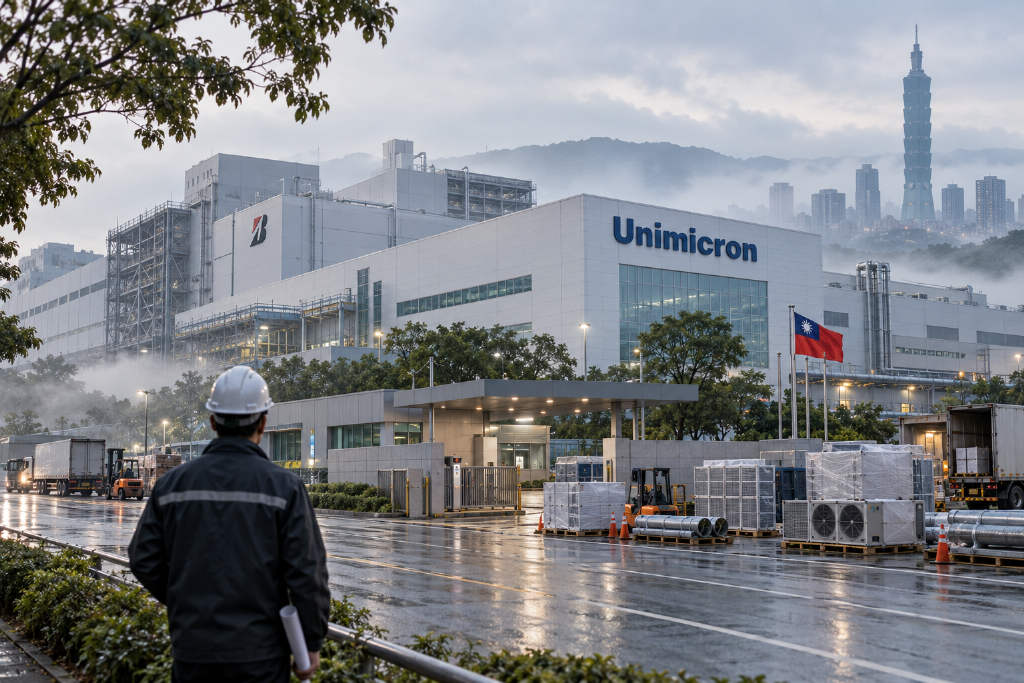
Unimicron Electronics (3037) recently acquired a factory and land owned by Bridgestone Taiwan in Hsinchu County’s Hukou Industrial District through a bidding process for NT$10.088 billion. The assets include about 19,072 ping of land and 17,601 ping of buildings.
Purchase price exceeded the appraised range
The transaction value was above the appraisers’ valuation range of NT$8.424 billion to NT$8.856 billion, representing a premium of about 14% to 19.7%.
According to the report, Unimicron secured the site at a price above market valuation in the tender process, reflecting limited supply of large industrial plots with unified ownership in northern Taiwan, especially around Hsinchu Science Park and nearby industrial districts.
The company said the main purpose of the purchase was to meet future customer demand for expanded high-end substrate capacity and to make medium- to long-term capacity arrangements. Acquiring an existing plant and office complex could help shorten construction timelines. Compared with building from the ground up, existing buildings can also save time otherwise needed for environmental impact reviews and basic engineering work, allowing clean room and production line installation to move faster.
Expansion targets demand for high-end substrates
The company’s filing said the core driver behind the asset purchase was future customer demand for additional high-end substrate capacity.
The source article said the market broadly views the expansion as linked to rising demand from AI servers, high-performance computing, or HPC, chips, and data centers. As applications for AI servers and HPC chips continue to grow, high-end ABF substrates carry technical features such as larger size and higher layer counts. Unimicron’s initial commitment of more than NT$10 billion shows it is arranging capacity based on the medium- to long-term needs of key customers, with the aim of maintaining its market share and supply capability in the global integrated circuit substrate market.
Capital spending and depreciation will be in focus
A single real estate transaction worth NT$10.088 billion will significantly increase Unimicron’s annual capital expenditure. Beyond land and building costs, front-end equipment and clean room investment for high-end substrate manufacturing are also expensive. The article said total funding needs for the site are expected to reach several hundred billion New Taiwan dollars.
The report added that the expansion plan will put pressure on the company’s free cash flow and capital allocation in the short term. After the new capacity comes online, a large amount of fixed-asset depreciation will be recorded in operating costs. The company will need to offset that early depreciation burden by increasing the shipment mix of high-end products and maintaining gross margin.