
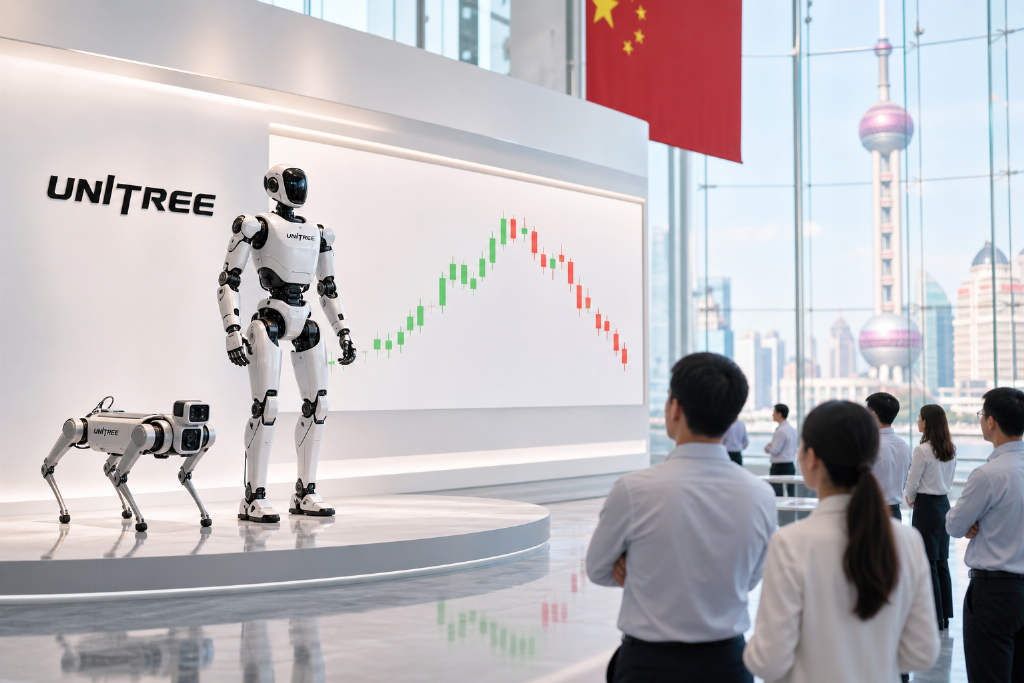
On Aug. 19, SoSoValue hosted a public Space on Unitree Technology’s first trading day, the pace of commercialization in embodied AI, Unitree’s competitive position, and where value may accrue across the robotics supply chain. Participants included SoSoValue co-founder Levi, embodied AI investor Adam, and industry practitioner Echo. Their shared view was that Unitree’s listing gives embodied AI a public market pricing reference, but that price still reflects long-range expectations more than it confirms a proven business model.
Day-one trading exposed valuation disagreements in real time
Unitree opened at 1,100 yuan on its first day of trading, then gave back part of the gain and closed at 845 yuan. That was 460.34% above its 150.80 yuan offering price. The company finished the session with a market capitalization of about 341.8 billion yuan, while turnover reached 23.1 billion yuan.
The early jump pointed to strong expectations around humanoid robotics. The later pullback showed that investors were far from aligned on valuation. In private markets, valuation can stay relatively stable through financing cadence. In public markets, pricing adjusts continuously as investors weigh orders, revenue, profit, and the sector’s actual progress.
According to Unitree’s prospectus, the company posted 392 million yuan in revenue and 94.5 million yuan in net profit attributable to shareholders in 2024. For the first nine months of 2025, revenue rose to 1.167 billion yuan, while net profit attributable to shareholders came in at 105 million yuan.
Against a closing valuation above 340 billion yuan, speakers said the stock is already pricing in a long runway of revenue expansion, lower product costs, and broader deployment scenarios. That is why Unitree’s valuation cannot be judged only on the sector’s theoretical addressable market. The more immediate question is whether orders, profits, and technical capability over the next few years can match what the market is already expecting.
Levi said during the Space that one trading day is not enough to define Unitree’s long-term value. Still, he said the listing gives embodied AI a continuous and public pricing signal for the first time. In his view, that signal is closer to a collection of market expectations than a confirmation of commercial maturity.
Shipment growth alone is not enough; repeat purchases are the real test
Roundtable participants said humanoid robots have made visible progress in motion control, but fine manipulation, task generalization, reliability, and customer return on investment remain the main constraints on commercialization.
A robot that can complete a single handling, sorting, or assembly demonstration is not necessarily ready for sustained work in a factory setting. Industrial customers care about uptime, failure rates, maintenance cost, deployment complexity, and whether labor savings can cover procurement spending.
Echo said the key metric to watch is whether pilot projects convert into repeat purchases. Pilot counts and shipment figures can show market interest, but they do not always prove that customers are already generating stable returns. Some projects may be funded by R&D budgets, policy support, or demonstration procurement. Only when customers add orders after the first deployment does a product begin to show repeatable economic value in a specific use case.
Unitree also acknowledged in its prospectus that high-performance general-purpose robots have not yet formed complete and mature commercial applications across broader industry scenarios. Existing use cases remain relatively limited and fragmented. For that reason, the next stage of industry analysis needs to distinguish between prototype demonstrations, pilot deployments, first purchases, and repeat orders. Each points to a different level of commercial certainty.
Unitree’s manufacturing edge is clearer than its platform story
Unitree’s current advantages, as discussed in the Space, are concentrated in product delivery, cost control, supply chain management, and brand recognition. The prospectus shows that in 2025 the company shipped more than 5,500 pure humanoid robots, excluding dual-arm wheeled products. It also has more than ten products on sale, spanning bipedal, quadrupedal, wheel-legged, and robotic arm form factors. Some joint drives, mechanical structures, batteries, software, and algorithm capabilities can be reused across those products.
That gives Unitree a base for full-system iteration and mass production. Its listing also adds capital for research and development, manufacturing capacity, and market expansion.
One guest in the Space said Unitree has a high in-house ratio for core components. The public prospectus confirms that the company has achieved in-house development and production of joint modules, and that it has research and development capability in motors and motion control. At the same time, the prospectus does not disclose a statistical standard that fully matches the claim that more than 90% of core components are self-developed, so the exact ratio still depends on future company disclosures.
Whether manufacturing scale and cost advantages can become a durable moat remains unresolved. More companies are entering the humanoid robotics market, hardware performance gaps may narrow, and competition is likely to push down full-system pricing. If Unitree’s revenue remains heavily tied to hardware sales over the long term, its margins could face pressure as pricing normalizes.
Speakers summarized that issue in simple terms: Unitree’s strength in the robot’s “body” is easier to see today, while its “brain” still needs to be tested. Adam said embodied AI requires hardware, models, and data to form a closed loop. Robots generate data in real-world environments, that data improves models, and better models then improve task capability. Only if that loop keeps running can a robot maker move beyond hardware manufacturing and become a general platform.
Unitree’s prospectus currently places its “general humanoid robot embodied foundation model” in the basic research stage. That means model capability and platform ecosystem are still in an investment phase, with limited external indicators for judging commercial value at this point. Levi said it is still too early to call Unitree the eventual winner of the industry.
Upstream names may be easier to track, but that does not make them safer
With the end-market structure still unsettled, the roundtable also examined upstream segments including motors, motion control systems, reducers, bearings, batteries, sensors, simulation software, and data infrastructure.
Compared with trying to predict the final winners among robot makers, upstream analysis can rely more directly on order flow, value per robot, capacity utilization, and customer mix. Even so, that does not mean every company in the robotics supply chain will benefit at the same pace.
First, Unitree and other robot makers are raising their in-house capability in core components, so growth in full-system shipments may not pass through to external suppliers in equal proportion. Second, some suppliers may have entered the robotics chain, but revenue from that business could still account for only a small share of overall performance today. Third, when large amounts of capital crowd into the same theme, valuations of upstream companies may also move ahead of actual demand, and order growth may not be enough to justify stock prices.
That leaves several concrete questions for evaluating upstream companies: whether they are inside leading customers’ supply chains, how much value they capture per robot, how large robotics revenue is as a share of total revenue, whether gross margin can hold, and whether customers are actually capable of buying at scale.
The roundtable’s suggested framework was to track two lines at once: whether key component suppliers can secure sustained orders, and whether robot makers can turn pilot projects into large-scale repeat purchases.
This article is based on SoSoValue’s public Space on Aug. 19 and supplemented with checks against Unitree’s prospectus and public first-day listing data. Views expressed by guests do not represent the position of this article and do not constitute investment advice.