
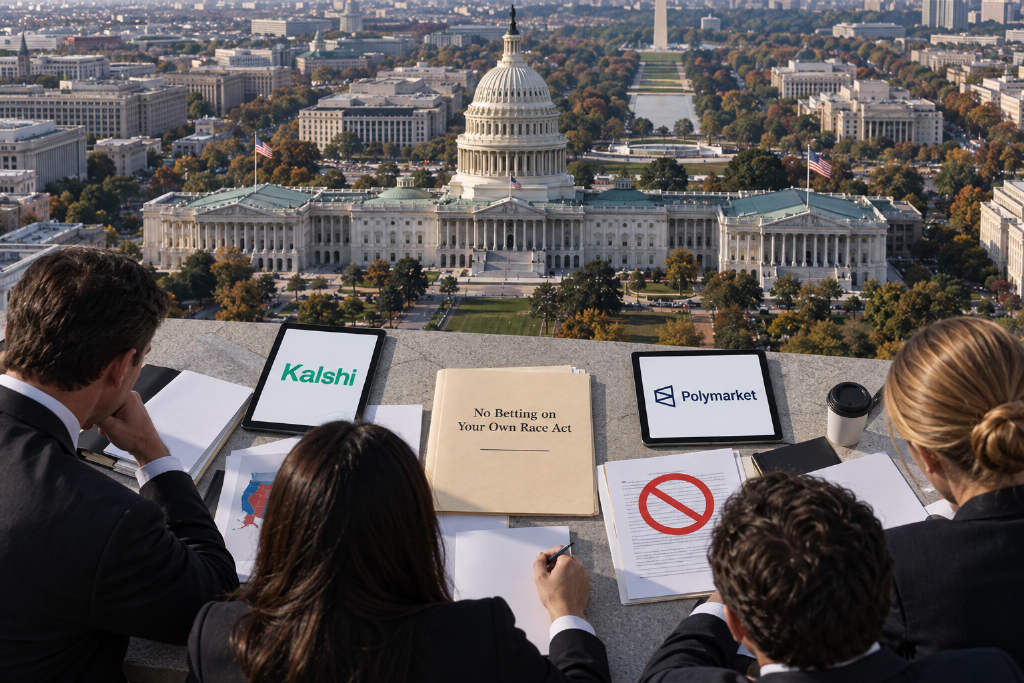
The US House has its first federal bill aimed directly at politicians trading prediction market contracts tied to their own elections. North Carolina Representative Don Davis introduced the No Betting on Your Own Race Act on Monday, seeking to bar federal candidates, their campaign teams, spouses, and children from buying or selling political event contracts linked to the candidate’s own race.
The measure sets civil penalties of up to $10,000 per violation or three times the profits earned.
The bill does not name platforms, but its wording reaches election contract venues
The text does not mention Kalshi or Polymarket by name. Still, it uses the broader term “political event contracts,” a definition described in the report as wide enough to cover these kinds of event-contract platforms. In practical terms, if a contract is tied to the outcome of a US federal election, candidates and their relatives would be barred from trading it regardless of the platform name.
In a news release, Davis said the bill is intended to prevent market manipulation, insider trading, and politicians “cashing in” on elections. He argued that candidates hold non-public information unavailable to ordinary participants, including polling data, fundraising progress, and knowledge of an opponent’s weaknesses. Allowing them to bet in prediction markets, he said, would damage market integrity and erode public trust in the electoral system.
Laurie Buckhout case cited as the direct trigger
The immediate event behind the proposal was the August action taken by Kalshi against Republican congressional candidate Laurie Buckhout. Buckhout traded event contracts tied to her own race, and Kalshi said that activity violated its terms of use. The platform imposed a three-year suspension and a $2,590 fine.
That was a platform-level disciplinary action, not a civil or criminal case. According to the report, the Buckhout case exposed a gray area in the current framework: platforms can restrict political figures through their own terms, but there is no explicit legal basis that gives those restrictions formal force. Davis’s bill is meant to close that gap by turning a platform rule into federal law.
No action expected before the 2026 midterms
The proposal is not expected to make meaningful progress before the 2026 midterm elections. Congress is in recess, and the House and Senate will not return to formal session until November, by which time the midterms will already be over.
That means the bill is likely to remain at the committee stage in the near term and will not reach a vote before the election. In the meantime, election-related event contracts on Kalshi and Polymarket are expected to keep trading. The report said Kalshi currently lists contracts on control of the House and Senate, with market odds pointing to a higher chance that Democrats regain control of Congress in 2027.
Prediction markets are moving into a sharper regulatory debate
Even if the No Betting on Your Own Race Act does not pass soon, the proposal points to a broader shift. Prediction markets are moving from a niche product associated with crypto into a subject of direct regulatory attention.
The report notes that Kalshi, after receiving approval from the Commodity Futures Trading Commission, has operated legalized event contracts and attracted institutional capital. Polymarket, by contrast, has faced an illegal gambling lawsuit in New York, showing that different layers of government are not aligned in how they treat prediction markets.
Questions remain over how far the ban should extend
In its current form, the bill applies to federal candidates and their family members. The report also raises a boundary question for any future revision: whether the restrictions should be extended to state-level candidates, party leadership, or close political aides.
That debate goes to the core tradeoff in prediction markets. Their transparency and liquidity depend on broad participation. Restrict the pool too much, and market function may suffer; leave insider trading unchecked, and the credibility of prediction markets as a gauge of public sentiment becomes weaker.