
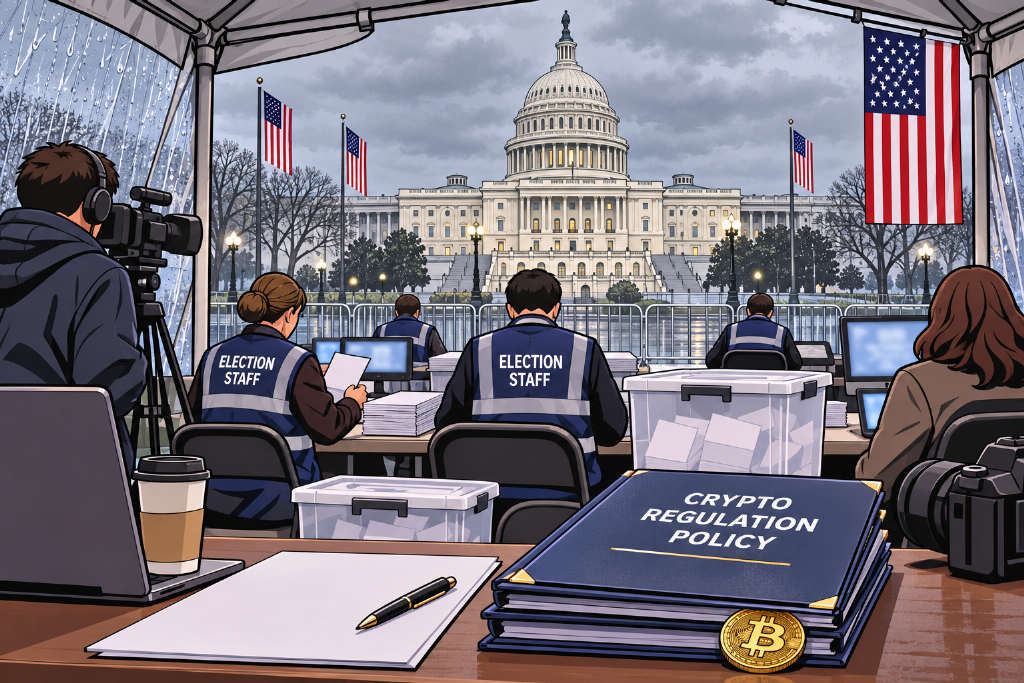
Vote counting in the 2026 US midterm elections is underway, and the next few hours are expected to show whether President Donald Trump’s Republican Party can hold Congress and preserve his ability to move legislation during the final two years of his term.
All 435 seats in the US House of Representatives and 35 Senate seats are on the ballot. The result could shape the future of US cryptocurrency regulation, including the stalled CLARITY Act. If Democrats win either chamber, scrutiny of Trump’s crypto ventures could also intensify.
At the point covered in Cointelegraph’s live report, Democrats and allied independents had secured 43 Senate seats to Republicans’ 31, including seats not up for election. In the House, Democrats had won 41 seats to Republicans’ 18. Democrats need 51 Senate seats and 218 House seats to secure majorities.
The Blockchain Association’s election dashboard lists 62 priority congressional races, including 18 Senate contests and 44 House races.
Live election updates
Cointelegraph said it is using live election results data from the Associated Press, with updates presented in reverse chronological order and focused on races drawing crypto industry money, election results and prediction-market reactions.
Nov. 3, 8:08 pm ET: Democratic Senate odds rise above 90%
Prediction markets moved deeper in favor of Democrats taking both chambers of Congress on Tuesday evening.
As of 8:05 pm ET, the Blockchain Association’s dashboard showed Democratic Senate-control odds at 94% on Kalshi and 93% on Polymarket, up from 75% and 75.5% earlier in the day. Democratic House-control odds were 98% and 99%.
The move came as Democrats and allied independents had secured 42 Senate seats to Republicans’ 31.
Nov. 3, 8:01 pm ET: Markey and Coons win reelection
Massachusetts Senator Ed Markey and Delaware Senator Chris Coons, both Democrats, won reelection, according to the Associated Press.
Markey voted against the GENIUS stablecoin bill in 2025. Coons has criticized President Donald Trump’s crypto ventures and called his latest event for memecoin holders “corruption.”
Nov. 3, 7:57 pm ET: Ossoff holds Georgia Senate seat
Democratic Senator Jon Ossoff won reelection in Georgia, defeating Republican Representative Mike Collins.
In April 2025, Ossoff said Trump should be impeached over plans to host a private dinner for top holders of the president’s TRUMP memecoin, arguing that the arrangement amounted to selling access to the presidency.
Nov. 3, 7:41 pm ET: 1inch says agencies will drive the next phase of US crypto regulation
Maylea Ma, deputy general counsel at 1inch, said she expects federal agencies to lead the next phase of crypto regulation.
The election could change the path of the stalled CLARITY Act, but Ma said “real movement” in US digital-asset regulation over the next few years will come from the US Securities and Exchange Commission, Commodity Futures Trading Commission and Treasury, rather than Congress.
She added that those agencies are engaging more with crypto projects. Even so, agency engagement does not deliver the stability the industry had hoped to secure through legislation.
“The long-term goal, of course, remains a statute that cannot be reversed every time a government changes,” Ma said.
Nov. 3, 7:09 pm ET: CLARITY opponent Wasserman Schultz wins reelection
Democratic Representative Debbie Wasserman Schultz won reelection in Florida’s 20th Congressional District. She voted against the CLARITY crypto market structure bill when it passed the House in July 2025.
Nov. 3, 7:05 pm ET: Warner keeps Virginia Senate seat
Democratic Senator Mark Warner won reelection in Virginia, defeating Republican challenger Bert Mizusawa. Cointelegraph noted that Warner had been widely favored to win.
Warner voted against advancing the CLARITY Act in September, saying crypto legislation needs safeguards to prevent President Donald Trump from personally benefiting from the industry. He supports federal rules for digital assets, with his opposition centered on the bill’s ethics protections.
Nov. 3, 6:00 pm ET: First US polls close
The first polls in the US midterm elections closed at 6 pm ET in parts of Indiana and Kentucky. The remaining polls in both states close at 7 pm ET.
Polls also close at 7 pm ET in Georgia and Virginia, followed by Ohio at 7:30 pm ET. In Ohio, Republican Senator Jon Husted is facing Democrat Sherrod Brown in a race that has drawn major crypto industry spending.
Nov. 3, 11:37 am ET: Early voting tops 57 million
More than 57 million Americans had cast ballots as of Monday, with early voting running ahead of 2022 levels in several closely watched states, according to the Associated Press.
Key crypto races to watch
Ohio Senate: Jon Husted vs. Sherrod Brown
In Ohio, Republican Senator Jon Husted is facing Democrat Sherrod Brown, a longtime crypto critic, in a race that has attracted about $63 million in crypto industry spending. That total includes roughly $56 million from Fairshake and $7 million from the Winklevoss-backed Digital Freedom Fund, with both groups spending to support Husted or oppose Brown.
Crypto advocacy group Stand With Crypto describes Brown as strongly opposed to cryptocurrency, citing 17 statements and his 2024 vote against overturning the SEC’s SAB 121 crypto custody accounting guidance.
Brown was also targeted by crypto industry spending in 2024, when Fairshake affiliate Defend American Jobs spent more than $40 million backing Republican Bernie Moreno, who defeated Brown in that year’s Senate election.
Nebraska Senate: Pete Ricketts vs. Dan Osborn
In Nebraska, Republican Senator Pete Ricketts is facing independent challenger Dan Osborn. Fairshake had spent nearly $11 million supporting Ricketts, according to an Oct. 27 report by the Washington Examiner.
More recent spending data compiled by Bankrolled from Federal Election Commission filings showed that, as of Nov. 3, Fairshake-affiliated crypto super PAC Defend American Jobs had spent about $13.5 million opposing Osborn.
Ricketts, a member of the Senate Banking Committee, has supported crypto legislation including the CLARITY Act and GENIUS Act. Stand With Crypto said he voted in May to advance the CLARITY Act out of committee and backed an unsuccessful Senate procedural vote on the bill in September.
Texas Senate: Ken Paxton vs. James Talarico
In Texas, Republican Ken Paxton is facing Democrat James Talarico. The Winklevoss-backed Digital Freedom Fund is supporting Paxton, even though both candidates received A ratings from Stand With Crypto.
Paxton has called for passage of the CLARITY Act, saying clear rules are needed to keep the US competitive in digital assets. In a June statement, he said the country must become the “crypto capital of the world” and support innovation and growth.
Talarico has also called for clear regulation that protects consumers while allowing innovation. As a Texas state representative, he also voted in 2025 to establish a state strategic Bitcoin reserve, according to legislative records cited by Stand With Crypto.
Wyoming Senate: Harriet Hageman vs. James Byrd
In Wyoming, Republican Representative Harriet Hageman is facing Democrat James Byrd for the seat being vacated by Senator Cynthia Lummis, a leading crypto advocate who is not seeking reelection.
Lummis, who chairs the Senate Banking Subcommittee on Digital Assets, sponsored the BITCOIN Act of 2025 to establish a US strategic Bitcoin reserve and has supported the CLARITY and GENIUS Acts.
Hageman has also backed crypto legislation. She voted for the CLARITY and GENIUS Acts in 2025 and the FIT21 market structure bill in 2024. Stand With Crypto also says she cosponsored legislation that would bar the Federal Reserve from issuing a central bank digital currency. The group lists no documented crypto position for Byrd.
Maine Senate: Troy Jackson vs. Susan Collins
Maine Senator Susan Collins was one of four Republicans who opposed advancing the CLARITY Act in September, citing concerns about its effect on bank deposits. She is now defending her seat against Democrat Troy Jackson.
Jackson, unlike Collins, expressed support for clear crypto legislation ahead of the election. Stand With Crypto rates him “very pro crypto” and says he called for ending the debanking of “lawful crypto businesses, and ensure Americans’ right to self-custody digital assets.”
Crypto super PACs spend millions to influence Congress
Fairshake, backed by Coinbase, Ripple and Andreessen Horowitz, has led the spending through its affiliated super PACs Defend American Jobs and Protect Progress.
In early October, the group announced support for 32 incumbent House candidates, including 19 Republicans and 13 Democrats. All of them voted in favor of the CLARITY Act in 2025.
Other crypto-aligned groups include the Digital Freedom Fund, backed by Gemini co-founders Tyler Winklevoss and Cameron Winklevoss, and Fellowship PAC, which has supported candidates from both parties.



