

US media reports cited by Chinese outlets including China News Service and Yicai said the Federal Communications Commission is drafting a ban on imports of new Chinese optical transceiver modules, with US officials hoping to publish and enforce the measure in 2026. The same report said the FCC could still revise or shelve the restrictions.
The headline landed between the close of A-shares and before the US session, and optical-module stocks reacted differently across the two markets. US names linked to the sector strengthened at one point, while the A-share group known as "Yi Zhong Tian" opened lower. By the close, losses had narrowed, and Tianfu Communication (300394.SZ) remained in positive territory.
Chinese vendors hold more than 60% of the global market
LightCounting data cited in the report shows Chinese manufacturers account for more than 60% of the global optical module market, with companies such as Eoptolink and Innolight named among the key players. In 800G and 1.6T products, Chinese suppliers hold an even larger share.
Optical modules are used for high-speed fiber data transmission inside data centers. Demand has climbed with the expansion of AI computing infrastructure, making 800G and 1.6T the core products in the global market. Nvidia's continued AI server upgrades are also pushing the cycle from 800G toward 1.6T and even 3.2T. Goldman Sachs, according to the report, expects the sector to move from an 800G installed-base cycle into a new earnings cycle driven by 1.6T and 3.2T technology.
By 2025 optical interconnect revenue, Eoptolink's global market share is put at about 21.2%. In high-speed data-center optical interconnects of 400G and above, the company held 28.1%, making it the world's largest optical interconnect solutions provider, the report said.
US companies remain in the top 10, but domestic capacity is limited
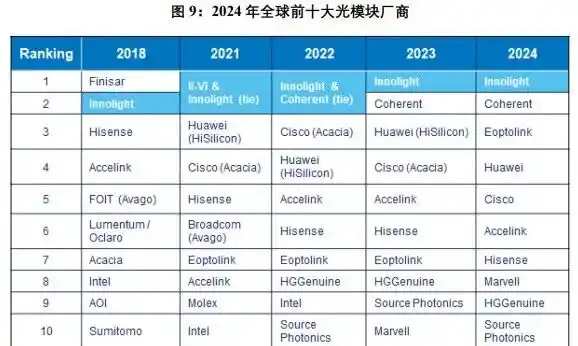
The report describes the global competitive map as one largely split between China and the US. LightCounting data for 2018 through 2024 shows Chinese suppliers rapidly expanded their presence among the world's top 10 optical module makers. There were three Chinese companies in the top 10 in 2018. By 2022, that number had risen to seven and has stayed there since.
In 2024, the remaining three spots in the global top 10 were held by US companies, ranked second, fifth and eighth in LightCounting's list.
Still, the report's answer to a core question was blunt: if the US were to fully ban purchases of Chinese optical modules, domestic producers would not be able to meet demand.
US companies retain strengths in upstream optical chips, DSPs and silicon photonics. They lag Chinese suppliers in large-scale module manufacturing, cost control and delivery response, according to the report. Current US domestic capacity cannot cover all AI-related optical-module demand from North American cloud operators and can only serve as supplemental supply.
Demand from cloud companies far exceeds current US output
A market analysis article published on ETU-LINK's website and cited in the piece estimated combined demand for 800G modules from Meta, Google, Microsoft and Amazon at about 27.5 million to 29.5 million units. Meta alone was said to need at least 10 million units and possibly as many as 12 million. Google and Microsoft together were put at about 12 million, while Amazon was estimated at about 5.5 million.
For 1.6T modules, Nvidia's 2025 demand was projected at 2.5 million to 3.5 million units, accounting for 80% of the global market, then rising to more than 5 million in 2026. Google was estimated at about 4 million units and Meta at about 1 million.
On that basis, the report said total demand for high-speed optical modules from major buyers in 2026 would be around 40 million units.
Against that, US domestic production looks small. Industry analysis cited in the article said major US makers have monthly 800G capacity of only about 40,000 units. Coherent places a large share of finished-module production with overseas contract manufacturers. Applied Optoelectronics Inc. (AAOI) is still ramping its US lines. The company previously announced capacity expansion at a new Texas plant and at its Taiwan, China site, but its near-term goal is only to lift monthly output of 800G and 1.6T products to more than 500,000 sets by the end of 2026.
The article said combined monthly high-speed module capacity in the US is less than one-fifth of that of a single leading Chinese supplier. Eoptolink's 2025 capacity for optical communication transceiver modules exceeded 28 million units, with actual output of 23.76 million and sales of 21.09 million. Innolight's optical interconnect product capacity in 2025 was about 17.47 million units, with actual output of 16.34 million and sales of 16.03 million.
The actual output of those two companies alone exceeded 40 million units. In high-speed data-center applications, Chinese vendors were said to hold 65% to 70% of the global market, with Eoptolink and Innolight together close to 50%.
Revenue disclosures show strong dependence between US buyers and Chinese suppliers
Financial commentator Liu Xiaobo was cited as saying the main US players - Coherent, Lumentum and AAOI - are not a match for Chinese manufacturers, while capacity expansion for high-speed optical modules usually takes 18 to 24 months and cannot be turned into immediate output simply by spending more money.
Another set of figures in the report points to heavy reliance by the US market on Chinese supply. Eoptolink said more than 90% of its revenue of over 38.2 billion yuan in 2025 came from overseas markets. Innolight posted revenue of more than 24.8 billion yuan that year, with more than 96% coming from overseas.
Eoptolink's Hong Kong listing prospectus also said most of its revenue comes from US customers. Revenue from US customers accounted for 75.9%, 60.5%, 57.3% and 61.7% of total revenue in 2023, 2024, 2025 and the three months ended March 31, 2026, respectively.
The company also said its business, financial condition and operating results are susceptible to changes in the US economy, politics, laws, regulation and market conditions, as well as changes in purchasing patterns, demand, financial condition and business strategy among its US customers.
No formal US rule has been issued so far
The report stressed that the US has not formally released new rules targeting Chinese optical module products, and many details circulating in the market remain unconfirmed.
China Business Network and other outlets cited responses from Eoptolink, Innolight and Tianfu Communication saying the FCC has not issued any restrictive document in this area and that there is no authoritative body currently available to verify the reported information.
The article placed the issue in the broader context of AI competition, noting earlier US restrictions on Nvidia's H200 sales to China, a direct ban on sales of Nvidia's latest chips to China, and the ban on exports of EUV lithography machines to China.
Eoptolink also said in its prospectus that on June 8, the US Department of War placed the company on a list of Chinese military-related enterprises. So far, it said, there has been no large-scale cancellation, suspension, reduction or delay of customer orders, and no customer relationship has been terminated as a result.
The company added that its products are designed for civilian commercial technology and integrated into related commercial applications rather than developed as customized military products. It also said the list is not an economic sanctions list and, absent other applicable restrictions, does not itself bar the company from doing business with US customers.
Overseas factories may or may not help, depending on the rule design
The article said a key question is whether any future US action would target corporate entities or the products themselves.
One industry source cited in the piece said that if restrictions are aimed at companies, then Chinese optical-module makers could still be blocked from the US market even if production is moved to Vietnam, Thailand, Malaysia or Mexico, so long as the companies themselves are on a restricted list.
If the restriction is based only on country of origin, then overseas manufacturing could in theory leave some room to bypass it.
Public information cited in the report shows nearly all leading Chinese data-center optical module makers already have overseas assembly plants, mostly in Southeast Asia, including Malaysia and Thailand, with some capacity in Mexico and Europe. Eoptolink, Innolight, HGTECH and Accelink are among the companies that have built or are building production bases in Thailand.
The same source said the path of past restrictions on Huawei and Semiconductor Manufacturing International Corp. suggests the US usually does not leave obvious loopholes open for long. Measures may begin by targeting some products, technologies or places of origin, then expand to entities, affiliates, supply-chain partners and end use.
If the restrictions eventually broaden to cover entities and affiliates, possible responses could include overseas private labeling or other sales channels. The practical outcome, the report said, would still depend on how US rules define corporate control, actual manufacturer, source of core components and final beneficiary.
A-share optical names cut losses by the close
A-share optical-module stocks swung sharply early in the session before recovering part of the decline. Eoptolink opened at 880 yuan and closed at 947.74 yuan, down 7.27%. Innolight opened at 400 yuan and closed at 424.3 yuan, down 5.29%. Tianfu Communication rebounded after an early drop and finished at 216.85 yuan, up 2.29%.