
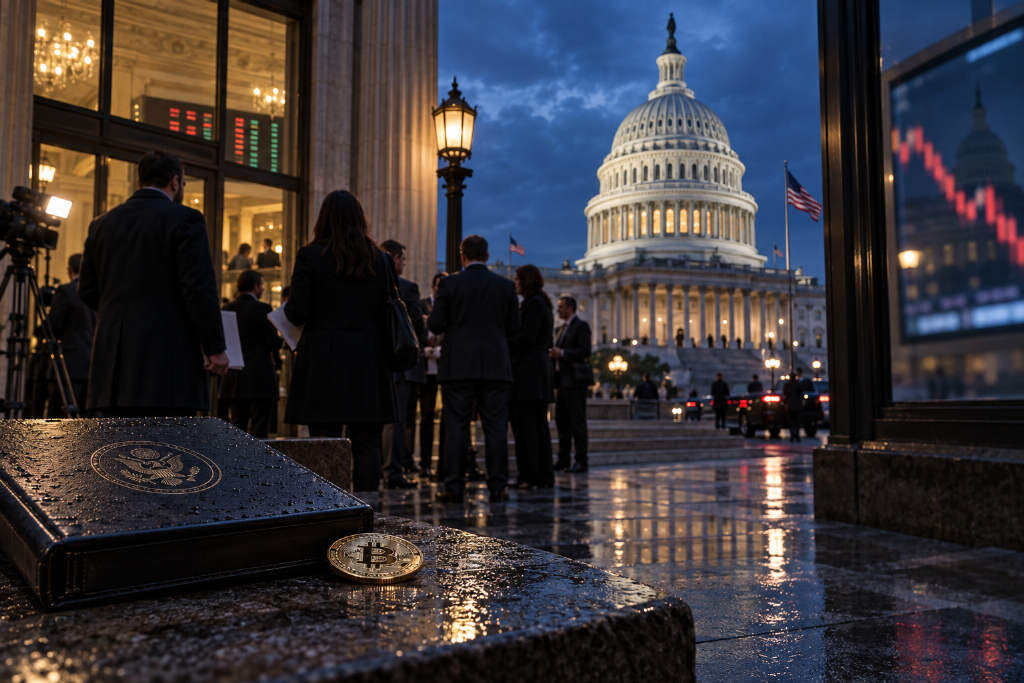
The U.S. Senate failed to advance the Digital Asset Market Clarity Act in a cloture vote held early on Sept. 16 Beijing time, with the tally ending at 49 in favor and 50 against. The measure needed 60 votes to move forward. Republicans currently hold 53 seats, and at least three members of the party did not vote yes.
The vote came after more than a year of back-and-forth and two earlier delays. After the result, Bitcoin briefly fell toward $75,000, while crypto-linked stocks including Coinbase, Circle, Robinhood and Strategy declined. On Polymarket, the probability of the bill becoming law by the end of 2026 fell from above 30% at the start of the week to about 5%.
Why the bill fell short
The immediate reason was that Democrats did not accept the Sept. 14 text released by Republicans. Republicans described that version as their final proposal before the vote. Democratic negotiators did not take it and instead submitted a counterproposal just hours before voting began.
Afterward, Mark Warner said disputes tied to enforcement and national security were close to being resolved, but conflicts of interest involving public officials profiting from the crypto industry remained unsettled, and that was why he voted no. Ruben Gallego, Angela Alsobrooks, Kirsten Gillibrand, Catherine Cortez Masto and Cory Booker, all Democrats involved in negotiations, also ended up opposing the measure.
The Democratic counterproposal remained stuck on ethics provisions. Its core points were a broader scope of restrictions, mandatory divestment of equity stakes in certain crypto companies, tighter enforcement and promoter disclosure rules, and added DeFi safeguards. Even in the revised text, the criminal safe harbor for developers, miners and validators from the Blockchain Regulatory Certainty Act, or BRCA, was not restored.
Katie Warbinton, a spokesperson for Cynthia Lummis’ office, said that if Democrats were serious about reaching a deal, they should actually start negotiating instead of resubmitting prior demands and calling that progress. Neither side moved again before the vote.
The failed vote does not amount to a final rejection of the bill. It only means the legislation cannot for now enter formal consideration and amendment. There is still no timetable for whether another 60-vote push can be organized this year.
What Republicans changed in their final text
On the eve of the vote, Republicans framed the Sept. 14 version as their last proposal before the chamber voted. Compared with the merged July draft, the main revisions focused on four areas: ethics provisions, stablecoin yield, DeFi and developer protections, and Agriculture Committee provisions.
Ethics provisions
On ethics, Trump accepted about 80% of a proposal associated with Thom Tillis and Ruben Gallego. Under the new text, federally elected officials, judges and their spouses who hold major economic interests in token issuers would have to divest those positions or place them into a blind trust.
State attorneys general would also receive limited enforcement authority for the first time. That authority would extend to suing trading platforms that list non-compliant assets, but it would not reach the president. Previously, that power was reserved for the U.S. attorney general. The provision would sunset in 2029, and existing holdings would not face mandatory liquidation.
Stablecoin yield provisions
For stablecoin yield, payment stablecoins would still generally be barred from paying passive interest solely because users hold them. The new text added a circuit-breaker mechanism lasting up to 18 months. If signs emerged that community bank deposits were flowing into stablecoins on a large scale, federal regulators could intervene, with Treasury Secretary Scott Bessent deciding whether the trigger had been met.
The change was a direct response to months of lobbying from the banking industry, but eight groups including the American Bankers Association were not convinced. Their position was that the circuit breaker would only kick in after deposits had already left.
DeFi and developer protections
In the DeFi and developer section, the bill split decentralization into two scenarios. On the side that truly does not handle user assets, validators, node operators and wallet software publishers would receive clearer safe-harbor exemptions.
Protocols that are decentralized in name but still retain actual control, however, would have to register with the Commodity Futures Trading Commission, or CFTC, and comply with the Bank Secrecy Act.
At the same time, BRCA protections were narrowed. Language that had previously extended into criminal cases was removed, leaving only Bank Secrecy Act and civil-level protections in place.
What the bill would mean for exchanges, stablecoin issuers and protocols
The reason the CLARITY Act has drawn such close attention from the crypto market is that it touches three unresolved issues at once: whether digital assets are securities or commodities and whether the Securities and Exchange Commission, or SEC, or the CFTC should take the lead; where the boundary lies for rewards tied to stablecoins sitting between payment tools and deposit-like products; and how decentralized a protocol must be to avoid being treated as a regulated intermediary.
Exchanges face a broader compliance map
For exchanges, the clearest change would be the compliance cost tied to listing assets. By giving some litigation authority to state attorneys general, the ethics section means exchanges reviewing tokens would need to consider not only federal compliance lines but also enforcement risk at the state level.
Before the vote, Letitia James led 18 state attorneys general in sending a joint letter saying the text would weaken the first line of defense states use to fight fraud.
Miles Jennings, head of policy at a16z crypto, said measures such as segregation of customer assets, qualified custody and restrictions on related-party conflicts are exactly the kinds of safeguards that were missing in the FTX case. In his view, the bill essentially imports rules long used in traditional finance into crypto. Nate Geraci, president of ETF Store, said the changes were more about increasing certainty and speeding innovation, and that the bill itself was not the key variable determining where crypto goes next.
Banks remain unconvinced by the stablecoin compromise
For stablecoin issuers and related banks, the 18-month circuit breaker did not truly solve the concerns raised by the banking sector. That became one concrete reason Republican support slipped.
Eight groups including the American Bankers Association wrote to Senate leaders in both parties saying the mechanism would only activate after large-scale deposit outflows had already happened and therefore did not amount to a real safeguard. Republican Senator John Cornyn said publicly before the vote that the new text might still fail to address core concerns from community banks, which was one reason he was counted among possible no votes.
The White House Council of Economic Advisers had tried to rebut the argument that stablecoin growth would squeeze community bank deposits through an interactive tool, but that did not shift the stance of banking groups or lawmakers such as Cornyn.
Control remains the dividing line for protocols
For protocols, the real dividing line remains whether teams are willing to give up control. The way that line was drawn left few fully satisfied.
Coin Center, which advocates for developer rights, said it was disappointed by the narrower BRCA protection. In its view, removing language that extended into criminal cases weakened the developer protections that had previously been won.
Galaxy Digital founder Mike Novogratz said inadequate developer protections were one reason at least four Republican senators opposed the bill. That suggests the dissatisfaction was not limited to the developer community and had also reached the Republican vote base itself.
Failure to advance the bill does not erase the regulatory agenda
The immediate market response reflected lower confidence in the bill’s path, but a failed procedural vote does not mean the U.S. crypto regulatory process drops back to zero.
Mike Novogratz had said earlier that if the bill made no progress, the U.S. could go a very long time without crypto legislation, or even never get it, pushing more of the industry offshore. White House crypto adviser Patrick Witt also said that once a procedural vote fails, no one can say when the next opening will come.
Other voices have argued that regulation will continue moving through other channels. SEC Chair Paul Atkins said the SEC will keep pushing the Project Crypto agenda whether or not the bill passes. That includes setting rules for crypto asset issuance, bringing blockchain ownership ledgers into transfer-agent rules, and clarifying custody requirements for investment advisers and regulated funds.
Zach Pandl, head of research at Grayscale, said regulatory frameworks for stablecoins, token issuance, tokenized securities and perpetual futures are gradually becoming clearer, and that the GENIUS Act has already established a federal framework for payment stablecoins. Bernstein said that if legislative efforts stall while monetary policy signals remain tight, crypto assets and crypto-related stocks could face a sizable pullback.
The text Republicans called their “last, best and final” offer did not win 60 votes. Even so, it set out the outer boundary of the concessions Republicans were willing to make and may serve as the starting point for the next round of negotiations.