
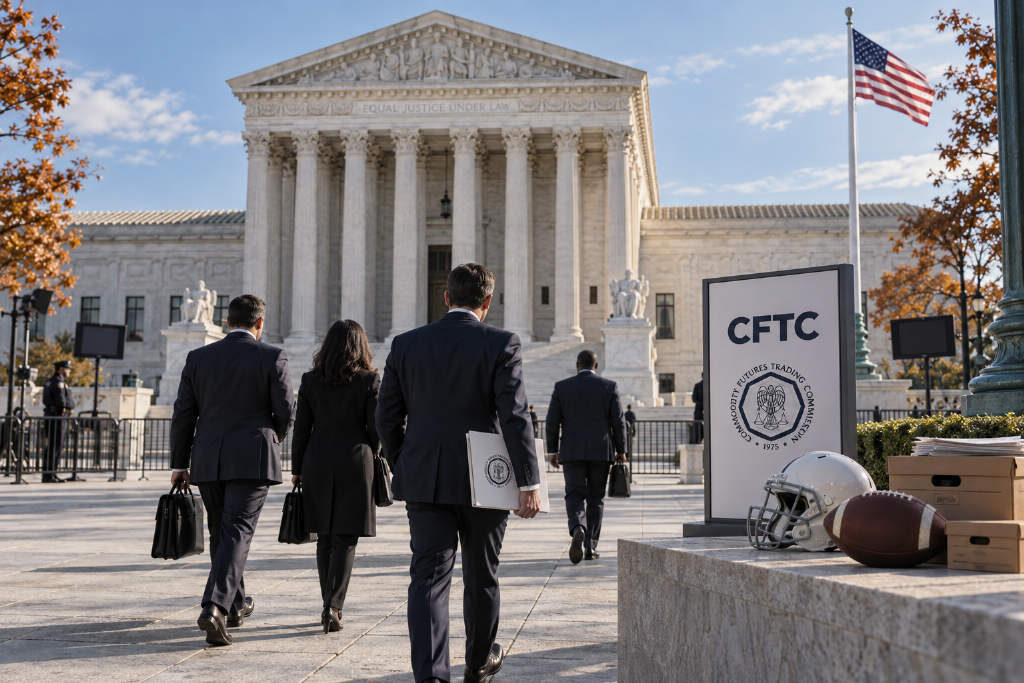
The U.S. Supreme Court has not said whether it will hear the prediction markets dispute, but the case drew a fresh wave of support last week as multiple parties filed amicus briefs urging the justices to step in. At the same time, the Commodity Futures Trading Commission released two rule documents on Friday, one already in effect, laying out how it views the products at the center of the fight.
According to CoinDesk, former Senator Chris Dodd, former CFTC and Securities and Exchange Commission Chair Gary Gensler, the National Football League, 39 states and the District of Columbia, 145 tribal nations and other parties all filed amicus briefs with the Supreme Court. Many of those filings asked the court to take up the case and argued that sports-based prediction market products are not swaps and should not be regulated by the CFTC.
CoinDesk noted that it had flagged the possibility of Supreme Court involvement a month ago. That view has not changed. What has changed is the weight of the split among federal appeals courts: two appellate courts have ruled that prediction markets touching sports are gambling products that should be regulated by the states, while one appellate court has ruled that the matter belongs with the CFTC.
The central question before the court
Most of the amicus briefs filed last week backed the states’ position. Their argument is that at least sports-related prediction markets are gambling products and should be regulated at the state level rather than the federal level.
One of the most closely watched filings came from former Senator Chris Dodd, whose name is attached to the 2010 Dodd-Frank Wall Street Reform and Consumer Protection Act, the law at the center of the dispute. In his brief, Dodd said the statute was not meant to give the CFTC authority to displace state governments and their ability to regulate gambling.
That filing rejected a 2-1 ruling from a panel of the U.S. Court of Appeals for the Third Circuit, which had found that the CFTC had jurisdiction over swaps and prediction markets covering sports. Dodd’s brief said there is a distinction between derivatives as financial instruments and sports wagers.
「Parlays that chain together multiple wagers — often on point spreads or player performances in different games, in different cities, in different sports — do not facilitate hedging or price discovery,」 the filing said. It used that example to describe a type of sports-related prediction market product that has gained popularity. The brief added that such products are not 「associated with」 the kind of 「potential financial, economic, or commercial consequences」 required to qualify as swaps under the Commodity Exchange Act.
Dodd’s filing also challenged the CFTC’s claim that it has 「exclusive jurisdiction」 over these products.
「Nor is the CEA’s grant of ‘exclusive jurisdiction’ to the CFTC an express preemption provision immunizing every contract listed on a DCM from otherwise applicable state and tribal law. Rather, it identifies the CFTC as the federal regulator of covered financial instruments,」 the brief said.
Gensler and the NFL weigh in
Gary Gensler, a former CFTC chair who also played a key role in drafting regulations that implemented Dodd-Frank, made a similar argument. He said the law did not give the CFTC authority to preempt state gambling laws. CoinDesk said Gensler has advanced the same position in an appellate case as well.
The NFL said it has a direct stake in the outcome because of the importance of sports betting to sports. The league criticized what it described as the CFTC’s 「laissez-faire」 approach to the issue. It also pointed to a broader divergence between how states regulate gambling companies and how the CFTC regulates designated contract markets, the license category held by prediction market providers.
CFTC issues two rule documents
While the court process moves ahead, the CFTC on Friday proposed an interim final rule and a separate proposal meant to clarify how it interprets these products under the definition of a swap.
The agency said casino-style gambling falls outside its definition of a swap, but event contracts remain within it. It also wants to formally include sports, politics, cultural and weather-related events as event contracts that count as swaps.
Kalshi gets more time
Kalshi asked for an extension to file its response to the Supreme Court and received it. Its new deadline is Nov. 9, 2026.
CoinDesk also said there are no Congressional hearings on its watch list this week.