
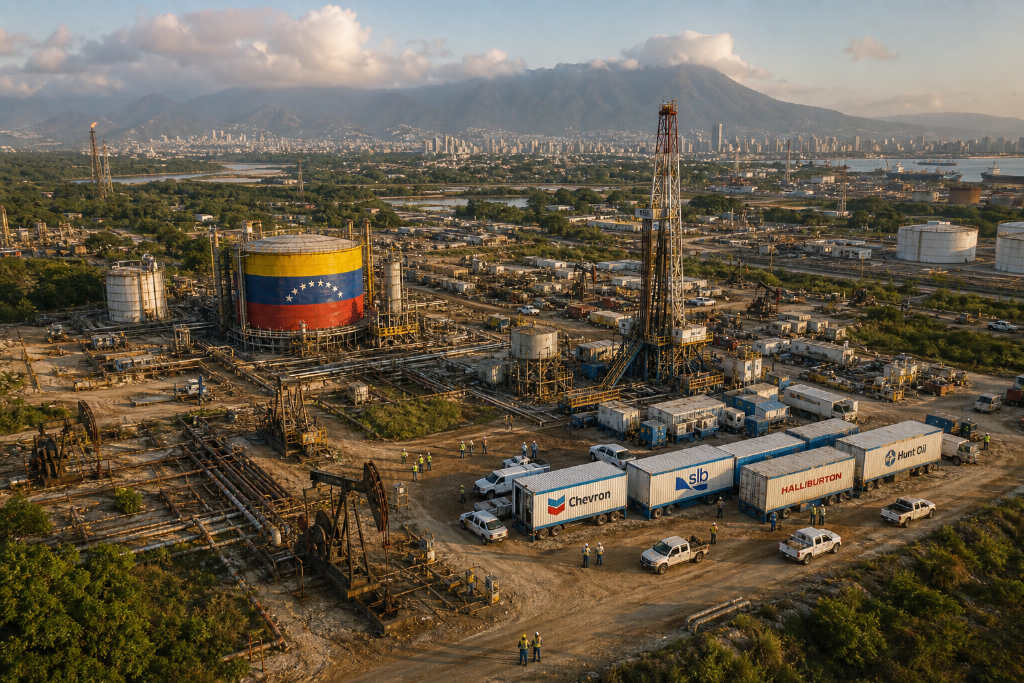
The U.S. government has announced a new energy cooperation framework with Venezuela, seeking development and control rights tied to more than 65 billion barrels of crude reserves through partnerships with private companies.
The move comes after a political shift in Venezuela. According to the input, Washington has taken an effective lead role in the country’s crude export sales and has been gradually easing economic sanctions. With geopolitical tensions rising and risks to Middle East energy transport increasing, the U.S. is trying to reorganize Venezuela’s oil supply chain to help refill its own strategic reserves and ease energy-driven inflation.
Deal targets 65 billion barrels and long-term leases
President Donald Trump said on Friday that the United States had reached an agreement with Venezuela that would give it majority control over more than 65 billion barrels of oil reserves.
According to Bloomberg, U.S. officials are discussing a large-scale energy agreement with Venezuela’s interim government covering about 20% of the country’s proven reserves. Some leases are being considered for terms of up to 100 years. The talks are being pushed by Secretary of State Marco Rubio and other officials, marking a sharp shift in bilateral trade and energy policy.
The input also says Venezuela’s oil output has risen by nearly 300,000 barrels a day from its low after the internal change in government. Washington is using a gradual sanctions rollback to draw foreign capital back into the sector.
U.S. companies move back into upstream and oilfield services
American energy companies are already accelerating their return. Chevron is in talks to add operating rights for two oil fields. Its joint ventures currently account for about 20% of Venezuela’s total output, and the company is targeting a 50% production increase by the end of 2028.
At the same time, SLB and Hunt Oil Co. have signed agreements, while Halliburton has started discussions over equipment imports. That points to a broader restart by oilfield technology and service providers in the country.
Washington is looking for supply alternatives and SPR support
The main policy driver behind the agreement, according to the input, is energy security. With unrest in the Middle East and the risk of a disruption in the Strait of Hormuz, access to alternative crude supply has become more important.
The U.S. Strategic Petroleum Reserve, or SPR, is currently at about 41% of capacity, which the input describes as a relative low over nearly 40 years. Additional Venezuelan supply, if it materializes, could help stabilize the market and reduce broader inflation pressure.
Infrastructure damage and legal disputes remain
Large reserves do not mean a quick recovery. Venezuela continues to face an unstable power grid and heavily deteriorated pipeline and field infrastructure.
An energy research body cited in the input estimated that restoring output to the former peak of 3 million barrels a day could take more than 10 years and require substantial capital. There is also a sovereignty and constitutional dispute. The model of granting long-term access to core national resources to foreign investors has drawn questions from some Venezuelan scholars and legal experts over legality under the constitution and over national control.