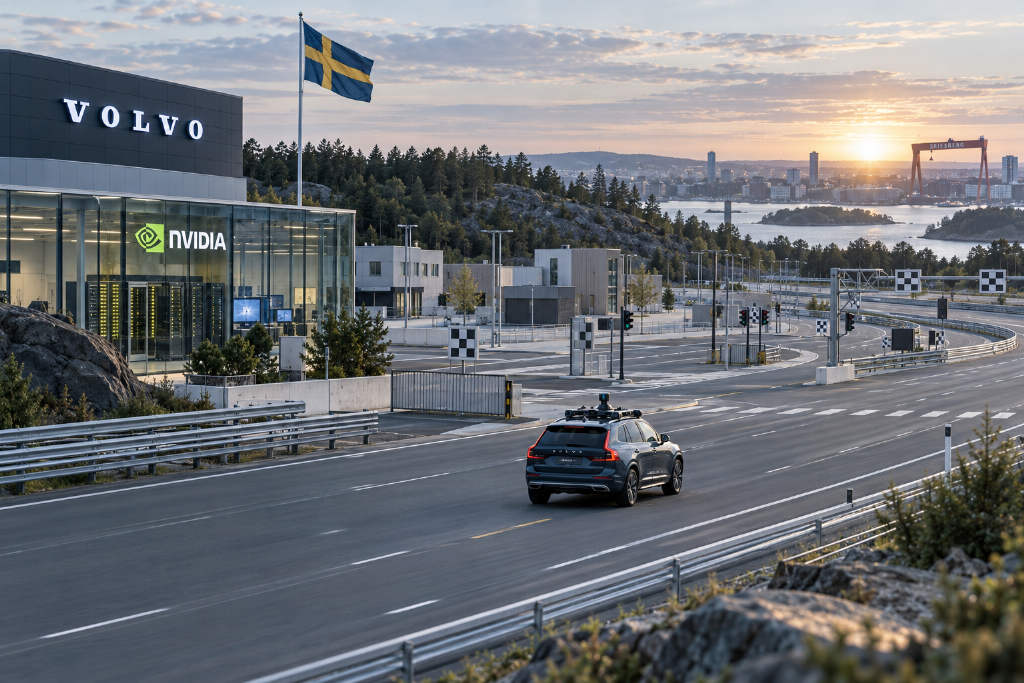
Volvo said it is expanding its nearly decade-long partnership with NVIDIA and will use three sets of NVIDIA hardware and software in future vehicles to build an autonomous driving system designed for both city streets and highways. The plan combines Volvo’s vehicle safety systems and engineering capabilities with NVIDIA’s Hyperion sensor and compute architecture, the Alpamayo driving software stack, and the Halos safety assessment layer.
Ali Kani, head of NVIDIA’s automotive business, said the Alpamayo stack is built with redundancy and diversity. He said it combines the Alpamayo family of AI models, datasets, simulation tools, and development tools for autonomous driving software with traditional software that uses machine learning, cameras, and radar perception. Kani also said the open-source Alpamayo software has been downloaded by more than 650,000 developers.
Volvo software chief Alwin Bakkenes said the company will kick off the expanded collaboration with an all-new model that will arrive in the “not too distant future.” He added that the first vehicle using the new NVIDIA technology stack will debut within the next decade. According to Bakkenes, Volvo has shifted from a vehicle-based development model to becoming a full technology stack company and plans to standardize more of its work on the Hyperion architecture.
Volvo is expanding its nearly decade-long partnership with NVIDIA and plans to use three sets of NVIDIA hardware and software in future vehicles to build an autonomous driving system for city streets and highways.
The expanded effort brings together Volvo’s vehicle safety systems and engineering capabilities with NVIDIA’s Hyperion sensor and compute architecture, the Alpamayo driving software stack, and the Halos safety assessment layer.
Technology details outlined by both companies
Ali Kani, head of NVIDIA’s automotive business, said the Alpamayo stack has redundancy and diversity. He said the stack combines the Alpamayo family of AI models, datasets, simulation tools, and development tools used to build autonomous driving software, along with traditional software that relies on machine learning, cameras, and radar perception.
Kani also said the open-source Alpamayo software has been downloaded by more than 650,000 developers.
Volvo says an all-new model will start the rollout
Alwin Bakkenes, Volvo’s head of software development, said the company will launch the collaboration through an all-new model that will arrive in the “not too distant future.”
He also said the first vehicle equipped with the new NVIDIA technology stack will appear within the next decade.
Bakkenes said Volvo has moved away from a vehicle-based development model and has become a full technology stack company. He added that Volvo plans to standardize more work on the Hyperion architecture as it deepens its cooperation with NVIDIA.
The item was carried by Techub, citing TechCrunch.
This article was originally published by Bit.Fan. For more cryptocurrency news and market insights, visit www.bit.fan. Disclaimer:
The market information, project data, and third-party content displayed on this platform are for industry information sharing only and do not constitute any form of investment advice or return commitment.
Cryptocurrency trading carries high risks. Users should fully assess their risk tolerance and make independent decisions. All profits, losses, and legal responsibilities are borne by the users themselves.