
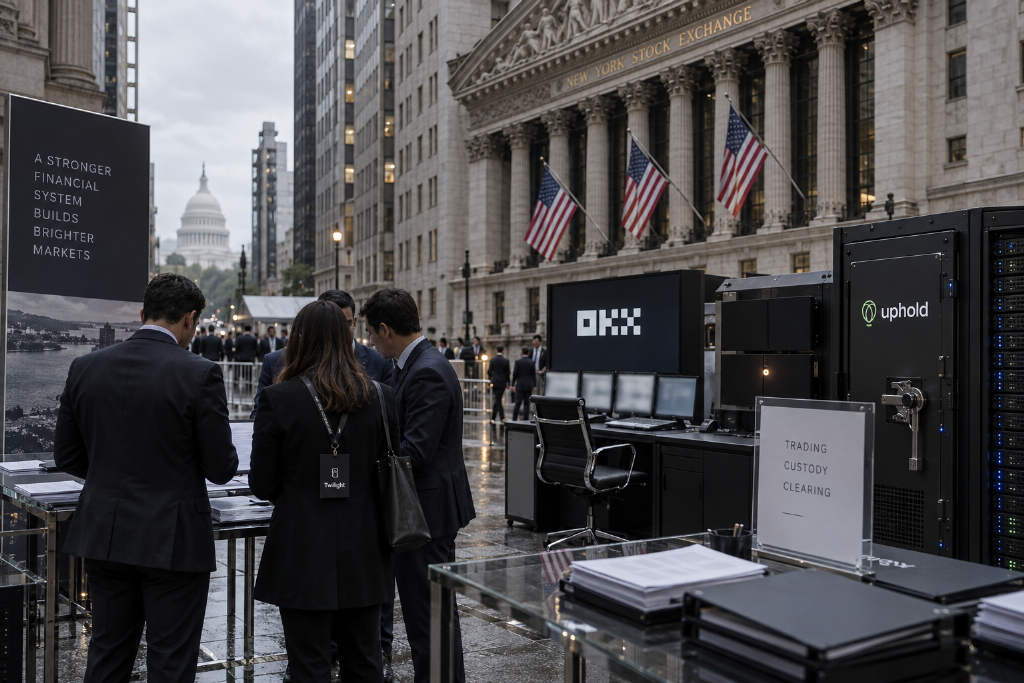
Wall Street firms are building crypto compliance standards and market infrastructure on their own as Congress still has not produced a comprehensive federal framework for digital assets.
In the latest edition of CoinDesk’s weekly Crypto for Advisors newsletter, the publication said the U.S. Senate failed to advance the CLARITY Act on Sept. 15, leaving the country once again without a full federal structure for the sector. Two days later, the U.S. Securities and Exchange Commission issued an "innovation exemption" that allows certain venues to trade tokenized U.S.-listed stocks onchain.
The newsletter stresses that an exemption is not a statute. It can be narrowed or withdrawn as easily as it was granted, leaving financial firms with a practical question: what should they build while they wait for lawmakers?
Industry executives say the market is moving ahead anyway
According to the newsletter, that question ran through a Crain’s New York Business event last week. Whether the discussion was tokenization, compliance or cybersecurity, the people closest to the work were not waiting on Congress. They were building for current conditions.
Adam Schumann, vice president of legal at OKX, described the legal challenge facing U.S. firms. Companies must answer to federal statutes, federal agencies, state laws and state regulators, and those systems do not move at the same speed. As Schumann put it, 「You want general consistency, but you’re not going to reach uniformity」.
That leaves firms to solve the remaining issues state by state and country by country, while regulators address the most immediate gaps.
Compliance has become a major operating cost
The patchwork comes with a price. Aravind Raju, chief financial officer of Uphold, said compliance is now one of the company’s largest departments because it has to build tailored solutions for each state’s requirements. He said those resources could be redirected if rules become clearer and better aligned.
For advisors, the newsletter’s point is straightforward: compliance is a real cost of doing business on these platforms, and firms that manage it well are likely to have an advantage.
Private networks are multiplying instead of converging
One possible expectation would be for duplicated work to push the industry toward shared infrastructure. The newsletter says that has not happened. Instead, many institutions launched private, closed networks this year for tokenized assets, stablecoins and securities ledgers, and those systems do not easily communicate with one another.
Lewis Tuff, chief executive officer of Twilight, a company that builds clearing and settlement technology, said the result is that each firm ends up rebuilding the same connections.
Risk is moving in another direction at the same time, toward separation of functions. Early crypto firms often bundled trading, custody and clearing under one roof. Now, traditional custodians are holding digital assets, while execution venues are increasingly separate from the platforms that safeguard those assets.
That structure means no single entity has to control every critical function or become a single point of failure.
Checks are shifting from periodic reviews to continuous monitoring
The newsletter also says compliance and security practices are changing. Annual attestations and periodic reviews are giving way to checks that run continuously and apply to every transaction.
None of that required Congress, which is the central point of the piece. Without a comprehensive federal framework, the industry is converging around practices that any future law may find difficult to ignore: verified counterparties, clearer boundaries between trading and custody, and compliance systems that keep running without pause.
Whether those practices become a bridge to legislation or something closer to a substitute remains unresolved, the newsletter says. The direction, however, is already visible.
Raju offered one prediction. Within three years, he said, 「we’ll probably stop using the word ‘crypto’ as tokenized Treasuries and money funds become routine.」 If that happens, the infrastructure being built now without a formal statute could matter well beyond the current cycle.
What advisors should check before trusting a tokenized platform
In the issue’s Ask an Expert section, Diego Grassano, commercial director at Shyft and chief product officer at Lumia, answered three questions for institutions and advisors.
How risky is it to invest long-term capital under temporary regulatory permissions?
Grassano said the primary risk is committing long-term capital to infrastructure that may only have temporary authorization to operate. Exemptions can help institutions begin, but they need a credible plan in case those permissions change or expire.
He said he would want to see clear ownership rights, segregated custody and a tested exit path that allows investors to recover their assets.
How can firms connect siloed private blockchains without weakening security or regulatory separation?
Grassano said institutions need to connect networks without losing control over ownership, compliance or privacy. Bridges are improving, but they still carry real security and operational risk.
While regulatory standards remain fragmented, he said he would keep the legally recognized ownership record on the original chain and allow backed, redeemable representations to circulate elsewhere, with eligibility and transfer restrictions enforced on both networks.
What should advisors use to vet tokenized platforms while investor protections remain unsettled?
Grassano said he would begin with two questions: what does the client actually own, and how do they get their money back?
After that, advisors should check who holds the assets, who independently verifies the numbers and what happens if the platform fails. Fees, conflicts of interest and withdrawal restrictions also deserve close scrutiny.
His standard is direct: if an advisor cannot clearly explain the ownership structure, the risks and the recovery process to a client, the due diligence is not complete.
Other items highlighted in the newsletter
The issue also briefly noted three other developments:
- The U.S. Commodity Futures Trading Commission has published its first proposed regulatory framework for crypto markets.
- AI agents are driving record transactions through Coinbase’s x402 protocol on Base, and U.S. wallets dominate AI model inference payments, according to a Chainalysis report.
- A group of 100 bitcoin mined for pennies during the Satoshi era, now worth $8.5 million, moved for the first time in 16 years.
The main commentary in the newsletter was written by Eric Soufer, partner and head of advanced tech at Tusk Strategies. The expert Q&A featured Diego Grassano of Shyft and Lumia.