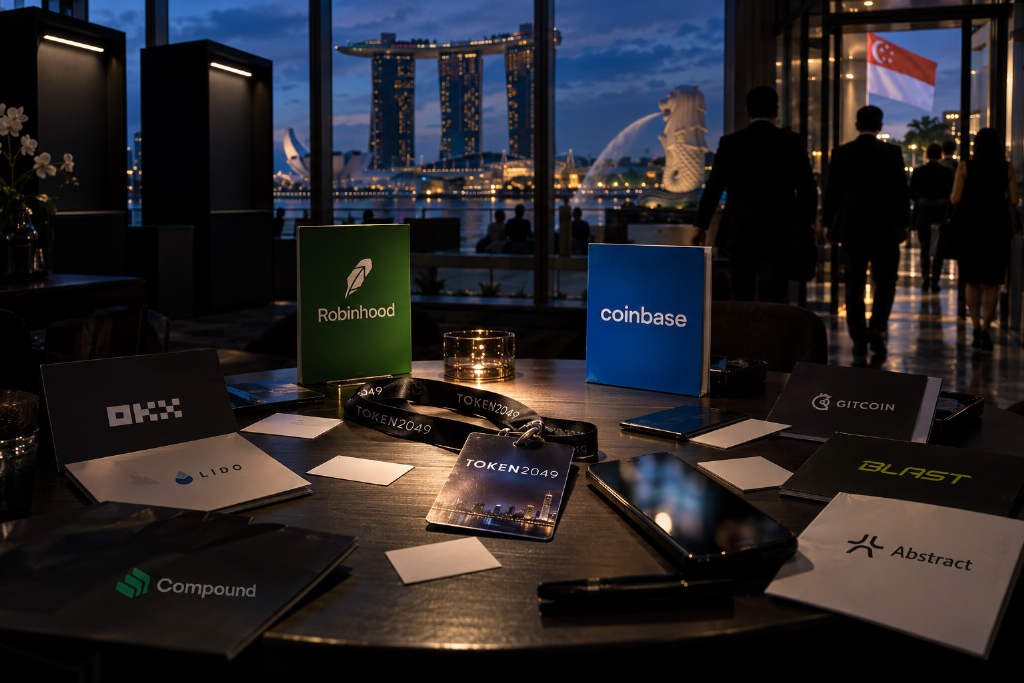
Foresight News lists the crypto stories drawing the most attention
Foresight News released a curated roundup of crypto topics and recommended reads from the past two weeks, grouping them into three sections: market conversations, projects that are disappearing, and project-level analysis. The list covers TOKEN2049, Robinhood, Compound, NFTs, Blast, Abstract, OKX, Gitcoin, Quantus and Lido.
Market conversations
TOKEN2049 recap centers on depth, not attendance
One of the highlighted pieces revisits Singapore’s TOKEN2049 after the event wrapped. Its author, who said they have attended for four straight years, argued that the real value was not in racing from party to party or collecting business cards, but in deeper conversations, firsthand information and non-consensus observations.
In the article titled "I attended TOKEN2049 for four consecutive years. Here’s what was most worth digging for this time," the author wrote that five days is short: no one can meet everyone, attend every event or fully understand everything happening in crypto. In that view, using TOKEN2049 well means identifying a few important people, asking a few important questions and spotting things that had gone unnoticed before. The piece says TOKEN2049 comes every year, but the bugs and opportunities that matter to each participant do not.
The industry is talking less about stories and more about metrics
Another featured story, "Crypto has started to stop believing in stories," says this year’s TOKEN2049 showed a change in tone. According to the piece, the market is moving away from sweeping narratives and toward value capture, real users, business revenue and profit allocation.

It cites comments such as: "We have enabled QR payments in 18 countries, and Indonesia and Brazil have performed especially well over the past year." Another example: "Last month, more than 100,000 users used stablecoins for real-world payments, including QR scans, card payments and bank transfers. Average monthly payment volume per user was more than $100." A third quote focused on returns: "Our quantitative strategy can deliver a 15% annualized return... This year, 10% to 20% is enough to avoid underperforming the market." The article’s point is that discussions are now anchored in payment use cases, actual users and measurable returns, with people asking where users are, where revenue comes from and who ultimately captures profit.
Vitalik Buterin’s novel tests Web3 governance under wartime conditions
Foresight also highlighted an article on Vitalik Buterin’s sci-fi novel "Snowmoon," which places Web3 cryptographic governance ideas into a wartime setting. Through societies such as Veridia and Dzego, the story explores tensions among privacy, distributed organization and public coordination. Mechanisms including quadratic voting, zero-knowledge proofs and Zipcoin are pushed past theory and exposed to failure under pressure.
The recommended piece says "Snowmoon" has 32 chapters. On the novel’s homepage, Buterin states that he wrote the main text himself, while Kimi K3 and Qwen 3.8 Flash Next were used mainly for spelling, grammar and style checks, to verify Minpentai game rules and the Dzegoban language, and to handle HTML, CSS and SVG. The article argues that beneath the surface story of several countries resisting the expansion of a northern empire lies a long-running question for Buterin: how a free, decentralized and privacy-preserving society can gain the capacity to act against concentrated power without becoming a new concentration of power after victory.
Robinhood challenges Coinbase on multiple fronts
The roundup says the structure of the US crypto industry is shifting as Robinhood scales up with its in-house Layer 2 network, Robinhood Chain. Using its large existing user base, the company is connecting stocks, prediction markets and onchain assets, and is pressing Coinbase across several business lines.

According to the featured coverage, Robinhood Chain generated $15.85 million in weekly revenue in September, topping Coinbase and Hyperliquid, which the article described as two leading US exchanges. Robinhood Chain has processed more than 750 million transactions. The network went live on July 1, and by the end of July its cumulative onchain transaction count had already exceeded 150 million, making it the fastest EVM chain to reach 100 million transactions, the article said.
Compound reserve conversion sparks governance fight
The Compound Foundation’s handling of v2 DAI reserves has become another focal point. The roundup says the foundation exchanged 8.42 million DAI for COMP tokens and then secured voting power ahead of a proposal deadline to help push through v4-related proposals. It adds that the onchain transactions are real, while the accuser is also linked to a whale with a history of governance attacks.
In the recommended article, "Did the Compound Foundation guard and steal at the same time?", Foresight says a post titled "The Foundation misappropriated v2 DAI reserves" appeared on the Compound governance forum on Sept. 28. The post’s author, ugurmersin, accused the Compound Foundation of violating governance authorization by converting 8.42 million DAI entrusted by the DAO into COMP governance tokens. The post also alleged that, 58 minutes before voting closed on a key proposal, the foundation delegated voting power to its own address, helping advance a $52 million v4 plan and the transfer of treasury management authority. The post included a full set of onchain transaction records and said evidence had been preserved for possible legal action.
NFT discussion returns with a focus on utility and cash flow
After four quieter years, NFTs are being discussed again in a different frame. The roundup says the market is moving away from the 2021 era of profile-picture speculation. Instead of relying on social consensus and identity premiums, the emphasis is shifting toward utility and cash flow. With experiments tied to real-world assets and onchain asset containers, NFTs are increasingly being described as certificates that can carry assets and distribute returns.

The recommended article on that theme says meme coin trader Ansem, speaking in a video interview on Sept. 28, was optimistic about NFTs returning in this cycle. He said art NFTs could see another breakout, but placed more weight on experiments involving the NFT format itself, including combinations with AI agents, ownership structures, new issuance models and broader links between NFTs and onchain products. Ansem also said capital rotation onchain remains at an early stage and that creative room in NFTs has not yet been fully explored.
Projects that are disappearing
Blast begins shutdown process
Ethereum Layer 2 project Blast is shutting down, according to the roundup. The story says Blast’s total value locked once approached $2.2 billion before dropping sharply to $32 million. It attracted capital through native yield and an airdrop narrative, but did not build enough real business activity to sustain itself once incentives faded.
Foresight’s recommended article, "Blast shuts down after pulling in $2.2 billion and dying from zero self-sustaining revenue," says Blast announced on X on Oct. 2 that it would wind down in stages. The statement said operating fees on the network could no longer cover the high costs of node maintenance and state synchronization, and that the team had lost confidence in the coherence of the project’s economic model.

Abstract sets closure for Dec. 15, 2026
Abstract, another Ethereum Layer 2 network, is also being closed. Foresight says the project spent tens of millions of dollars over two years without finding product-market fit. It had used the Pudgy Penguins IP to draw users, but after its peak, TVL and transaction volume kept falling and onchain revenue was too small to support ongoing operations.
The featured article says concerns began circulating after Pudgy Penguins founder Luca Netz removed the Abstract label from his X account name, while still listing Abstract in his profile. On Oct. 7, Abstract formally announced that the chain will shut down and set Dec. 15, 2026 as the closure date. Users are required to bridge assets out before then through migrate.abs.xyz or native-bridge.abs.xyz. Funds that are not migrated in time will become inaccessible, according to the announcement.
Project analysis
OKX pushes beyond the usual exchange model
In the project analysis section, Foresight says OKX is expanding past the standard boundaries of a crypto exchange. Starting from spot crypto trading, the platform has moved into tokenized stocks, pre-IPO assets and AI trading tools.
The recommended piece says OKX founder and CEO Star Xu told the opening session of the OKX NOW Global Product and Ecosystem Conference on Oct. 6 that, "The exchange is our starting point, but not our end point." According to the article, OKX began in 2013 as a spot cryptocurrency exchange and now offers access to crypto assets, tokenized stocks, stock perpetual contracts and commodity perpetual contracts.

Gitcoin’s Techne relaunch is planned for mid-December
Gitcoin’s reboot effort, which has been in the works for about half a year, was also included. Foresight says the new project, named Techne, is scheduled to go live in mid-December. It will not issue a new token, but it will separate value from the existing GTC token system.
The article says Gitcoin founder Kevin Owocki published a post titled "October 2026 reboot update" on Oct. 2 in the governance forum, giving the initiative its formal name. He said legal paperwork, not code, is the factor most likely to slow the launch. GTC has risen since the end of September, climbing from around $0.1 to as high as $0.249 after October began, a gain of nearly 150%. The piece adds, citing data from Baokong, that the move may reflect a float-driven chip game rather than a return of underlying value.
Quantus draws attention with a post-quantum pitch
Quantus is presented as a new chain built around resistance to the threat that quantum computing poses to current cryptographic systems. The roundup says the network uses the post-quantum primitive ML-DSA natively, combines it with zero-knowledge proofs for private transfers and proof aggregation scaling, and adopts a proof-of-work design.
The recommended article says QTC has a maximum supply of 21 million tokens. Based on white paper v0.4.1, 27% of that total is allocated at genesis. Of that amount, investors, founders and team members receive a combined 23%, while the company receives 4%. The remaining 73% is issued through mining. The article says the 23% allocation, along with 3% of supply from the company’s allocation, is locked for one year from mainnet launch and then released linearly over 36 months. The remaining 1% of supply allocated to the company is liquid at genesis for initial liquidity.

Lido turns to lending for its next product line
With the liquid staking market looking more settled, Lido is trying to build a second line of business through lending. Foresight says the proposed Lido Lend protocol is based on a modified version of Morpho Blue and is aimed at assets with strong price correlation such as stETH and ETH. The product is intended for lower-risk lenders and leveraged borrowers, with an emphasis on reducing problems seen in earlier DeFi lending markets, including cascading liquidations and liquidity squeezes.
The recommended article says Lido contributor lzzy posted a proposal titled "Unveiling Lido Lend" on the governance forum on Oct. 7. It described a new decentralized lending market built on a modified fork of Morpho Blue and targeted for launch in the fourth quarter of this year. Lido co-founder Konstantin Lomashuk also backed the proposal, saying Lido had created the safest staking solution in crypto and that more than $24 billion worth of tokens has been staked through the protocol. "The staking problem has been solved. Lending is next," he said.
The original article closes with a risk reminder, saying the market carries risk, the piece does not constitute investment advice, and readers should judge whether the views or conclusions discussed are suitable for their own circumstances.