
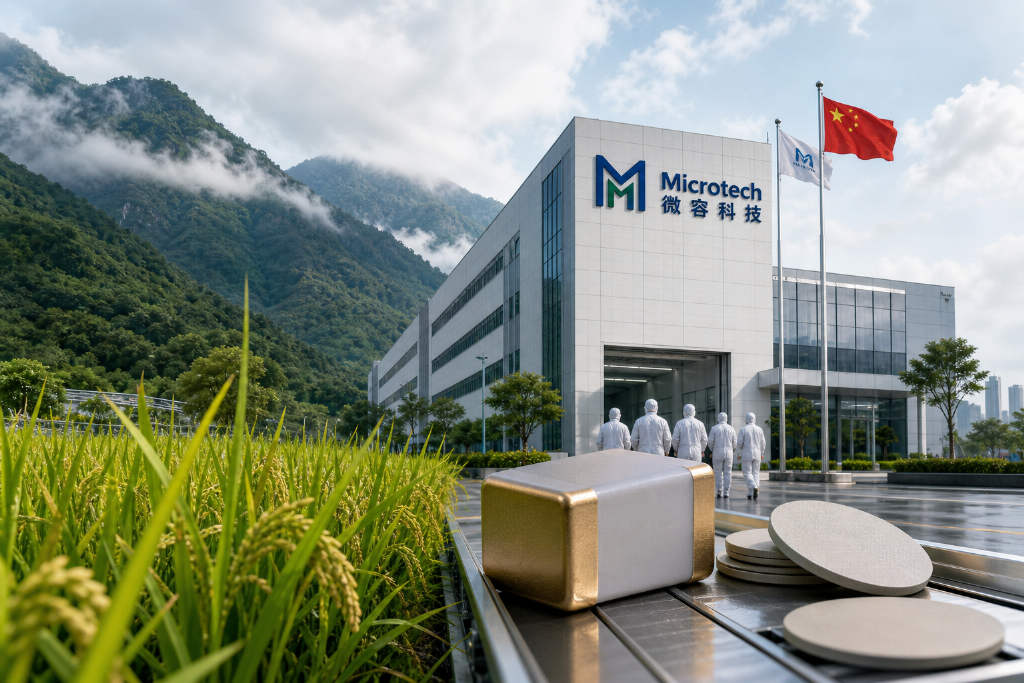
Weirong Technology, an MLCC maker based in Luoding in western Guangdong, landed in the spotlight after the Shenzhen Stock Exchange accepted its ChiNext IPO application in late April.
The company stands out for more than its listing push. It also stands out because of where it was built. Luoding, under Yunfu's administration, is better known for rice than for electronics. The source article says Yunfu has long sat at the bottom of Guangdong's 21 prefecture-level cities in GDP, and Luoding itself is a basin city hemmed in by mountains. Even so, Weirong built an MLCC factory there. MLCCs, or multilayer ceramic capacitors, are often called the "rice of the electronics industry."
Founded by a veteran executive who returned home
Weirong's story is hard to separate from its founder, Chen Weirong, who was born in Luoding in 1959. At 18, he entered the radio engineering program at South China Institute of Technology, the predecessor of South China University of Technology. Two classmates later became heavyweight names in Chinese consumer electronics: TCL founder Li Dongsheng and Skyworth founder Huang Hongsheng. The source says the three were later known as the "South China University of Technology trio," and that at their peak, their companies accounted for 40% of China's television output.
After graduating in 1982, Chen joined Guangdong Guangming Overseas Chinese Electronic Industrial Co., later renamed Konka Group. He moved up from a technical post to plant manager, assistant general manager, board vice general manager, board general manager, and then president of Konka in 1994. He was 35 then and, according to the source, the youngest head of a RMB 10 billion industrial enterprise in Shenzhen.
Over the next seven years, Konka spread beyond televisions into mobile phones, VCD players, and refrigerators. Sales topped RMB 10 billion. Then in 1999, Konka's television output overtook Changhong, putting it at the top of the industry. Chen left Konka in 2001 after the company took heavy losses tied to misjudgments about the macro economy and market demand, plus an expansion plan that went too far.
That stretch shaped what he did next. While still at Konka, Chen had spotted a change in electronic components: the older leaded capacitors and resistors used in televisions were being replaced by imported MLCC chip components in mobile phones, VCD players, and computers. He later founded Yuyang Technology and entered the MLCC business.
Why MLCC mattered
The source describes MLCC as a tiny "layer cake." Each one can be as small as a grain of rice, even as fine as sand. But inside, it packs dozens, hundreds, or even thousands of staggered layers of ceramic and metal film that are sintered together. The thinnest film layer is less than 1 micron thick, about 1% to 2% of the diameter of a human hair.
These parts handle key jobs on circuit boards: filtering, decoupling, energy storage, and oscillation. They help keep voltage and signals steady. The article gives a few scale examples. One NVIDIA NVL72 AI rack uses 440,000 MLCCs. A smartphone uses more than 1,000. A new energy vehicle uses 18,000. Simple point: wherever there's a circuit board, there's MLCC demand.
It was also a hard business to break into. Back then, much of China's electronics industry barely knew MLCC, while Japan's Murata and TDK dominated the market. Chen poured several hundred million yuan into research and development and led Yuyang Technology's parent company to a Hong Kong listing in 2007, his first IPO.
By 2015, Yuyang could make most low- and mid-end MLCC products. But high-capacitance MLCC technology was still tightly held by Japanese manufacturers. The source says the business runs on a brutal rule: 20% of high-capacitance products generate 80% of sales. Chen had previously explained that one automotive-grade MLCC could sell for more than RMB 1, while 1,000 ordinary low- or mid-capacitance MLCCs used in phones might together bring in only a little more than RMB 1. He said, "The value gap is more than a thousandfold, so the product is difficult to make and requires higher reliability and more layers."
The article also says MLCC, like DRAM, is a standardized high-volume product. If a company cannot crack the high-capacitance segment, it will have a hard time reaching the industry's top tier.
Leaving Yuyang and building Weirong in Luoding
In 2017, at 58, Chen left Yuyang Technology and went back to Luoding to start again with a high-end MLCC business. That choice led to Weirong Technology.
The return home was not sold as pure sentiment. The source says MLCC is tiny and high in added value, so logistics costs do not change much whether production sits in mountainous areas or the Pearl River Delta. Luoding, though, had two edges. First, electroplating. MLCC needs specific solderability standards, and Luoding already had at least some industrial base in electroplating parks. Second, labor stability. In manufacturing, stable skilled workers directly affect yield. Luoding is a populous county-level area, and letting workers stay close to home can avoid the high turnover common in the Pearl River Delta.
Chen also found support for that thinking during overseas factory visits. When he visited Murata in Japan, he saw that the global MLCC leader's headquarters was not in Tokyo or Osaka, but in Nagaokakyo, Kyoto Prefecture, a city of just 20 square kilometers. He later toured a number of factories in Japan and Germany and found many famous plants sitting right beside farmland. That convinced him that county-level locations could host high-tech industry too. So Luoding became his first choice.
Growth, valuation, and the listing test
After Weirong was founded, Chen pushed hard on expansion. The source says the company built semiconductor-grade cleanrooms in its industrial park, brought in advanced equipment, and kept R&D spending at no less than 10% of revenue, well above the 3% to 5% level cited for peers.
Weirong officially started MLCC production in 2019. Just two years later, according to the source article, it had become No. 1 in domestic market share. Then in 2022, its valuation moved past RMB 10 billion, putting it in unicorn territory.
The prospectus cited in the report shows that Weirong posted revenue of RMB 1.041 billion, RMB 1.512 billion, and RMB 1.845 billion in 2023, 2024, and 2025. Its compound annual growth rate over that stretch was 33.17%. Net profit surged from RMB 57.41 million to RMB 269 million, while gross margin climbed from 19.52% to 27.58%.
After a Pre-IPO financing round in December 2025, the company's post-money valuation stood at about RMB 11.5 billion. Its shareholder list includes OPPO, Xiaomi Industry Fund, Lenovo Capital, SAIC Motor, Hefei Industrial Investment, Guotai Junan, the investment arm of Guangdong Technology Financial Group, Jianyin Investment, Guangzhou State-owned Assets Industrial Investment, Guangzhou State-owned Assets Venture Capital, Hefei Construction Investment, and GF Securities.
Patent losses, investor terms, and control questions
Weirong's rise has not come without dispute. The biggest flashpoint is its patent fight with Yuyang Technology.
The source says several of Weirong's core executives once worked at Yuyang, including president Li Jing, vice president and board secretary Luo Jun, CTO Xiang Yong, and product center general manager Jiang Mengda. In November 2020, Yuyang sued, accusing Chen of using his position to transfer assets, employees, and intellectual property. The case covered 20 patents tied to core MLCC manufacturing processes. The reported result: Weirong lost all 16 patent ownership lawsuits, and the patents were awarded to Yuyang.
Another issue under the microscope is the company's betting-style investor agreement. At the end of last year, Weirong signed a Pre-IPO shareholder agreement with 48 investor shareholders, covering special rights including redemption rights and liquidation preferences. One key clause says these rights automatically terminate once a qualified listing application is formally accepted. But if the application is returned, rejected, or withdrawn by the company, those rights come back.
So if the IPO does not go through, Chen Weirong and his daughter Chen Qihui would face redemption obligations.
The prospectus also lays out the control structure. Chen Qihui holds 42.13% of the company and is the legal controlling shareholder. But after a shareholding reform in October 2024, father and daughter signed a concerted action agreement stating that if they disagree, Chen Weirong's view prevails. The agreement runs through the end of 2030, which makes him the real decision-maker in practice.
There is one more issue critics have seized on: Weirong held RMB 2.264 billion in term deposits, large-denomination certificates of deposit, and wealth management products, yet of its planned RMB 1.675 billion IPO fundraising, RMB 200 million is still earmarked for working capital supplementation.
What Weirong changed in Luoding
The source places Weirong's rise inside Luoding's long-running industrial ambitions. A local joke says that traveling from Guangzhou to Luoding means "one trip, three tire repairs," a line that captures the transport headaches of a city surrounded by mountains on three sides.
From the late 1970s through the 1990s, Luoding chased industry and foreign investment with unusual intensity and was once described as "a banner for using foreign capital in Guangdong's mountainous areas." In 1991, it funded and built an airport on its own, becoming the first mountainous county-level general aviation airport in China constructed with self-raised funds. Later it financed a local railway, built a port at the Nanjiang entrance, and added 50 local roads totaling more than 200 kilometers.
Those efforts did not fully deliver. Location and debt held the city back, and it struggled for years. After 1996, the airport saw few civil aviation flights, the railway ran into operational trouble, and the port sat idle. The article says the "empty airport, empty dock, empty railway station" became a painful symbol of Luoding.
But the search for industry never stopped. In recent years, bringing local business leaders back to start companies has become one of Luoding's main strategies. Chen looks like the clearest success story. After local officials learned of his expansion plans, investment promotion teams reportedly held repeated overnight talks and offered support on land, electricity, and talent. The city provided more than 100 mu of land in the first phase and set aside more than 300 additional mu for later expansion phases.
One detail from the source says a lot: after Weirong started production, a thunderstorm-related power outage caused one batch of products to be scrapped. Local power authorities then added a dual-circuit backup power supply.
On labor, about 80% to 90% of Weirong's nearly 1,800 employees are local residents. MLCC is described as a capital-intensive industry whose production process depends heavily on accumulated experience and stable yields. Constant worker turnover makes it harder for know-how to take root. Before this, young people in the area often had only two choices: leave for factory work in the Pearl River Delta or stay home and farm. Weirong created a third option by offering wages that the article says are not lower than those in the Pearl River Delta. Because of that, worker attrition is several times lower than in that region.
Starting in 2023, Weirong and Yunfu Longzhou Vocational School launched a "Weirong class." Company technicians teach on campus and provide equipment and internship sites, turning former garment workers and restaurant staff into technical operators who can tune production lines. In the same year, Weirong's output value exceeded RMB 1 billion and contributed more than RMB 10 million in tax revenue to Luoding.
The company has also started drawing in suppliers. According to the source, Weirong has already attracted upstream suppliers to Luoding, with the local government building factory space so they can move in with minimal setup. Over the next three to five years, dozens of upstream and downstream companies are expected to cluster there.
Today, with Weirong as the lead company, Luoding's number of industrial enterprises above designated size has risen from zero to 97, while high-tech enterprises have reached 37. Electronics, daily-use light industry, biopharmaceuticals, and new building materials are all moving ahead together, and what the source calls a map of "six 10-billion-yuan industrial clusters" is taking shape.
The article argues that Luoding did not back Weirong with huge capital injections and is not one of its key shareholders. Its support came through practical fixes instead: reliable power, land supply, and focused talent training. For that reason, Weirong is framed not as a flawless template, but as a real-world case worth watching for underdeveloped regions trying to build high-end manufacturing capacity.
The original article was published by the WeChat account Touzhongwang and written by Zhang Xue.