
Winbond says DRAM shortages will last through 2027
Winbond Electronics (2344) held an earnings conference call this week. CEO Chen Pei-ming said the DRAM supply-demand imbalance will continue through 2027 and may become even tighter next year.
He said AI server procurement keeps expanding, while Samsung, SK Hynix and Micron are redirecting more capacity into HBM, DDR5 and LPDDR5. That shift has sharply reduced supply of mature-node DRAM. Suppliers of legacy standards such as DDR3 are also leaving the market, widening the gap further.
Chen expects 2027 to be tighter than 2026. Some customers have already started discussing long-term supply agreements for 2029 to 2030, suggesting downstream buyers are extending their expectations for scarcity. He also said DRAM prices should keep rising this quarter, with flash products also set for price increases, and he is upbeat on revenue in the second half.
Capital spending and Kaohsiung expansion
To capture the pricing and market-share opportunity created by the shortage, Winbond’s board approved a NT$13.074 billion capital expenditure plan. Starting in August, the company will gradually deploy spending on manufacturing equipment, R&D equipment, plant engineering and capitalized lease assets.
Kaohsiung will be the company’s main growth engine over the next several years.
Chen said monthly capacity at the Kaohsiung fab is about 15,000 wafers now and is planned to reach 24,000 wafers by year-end. Winbond is also accelerating its move to 16nm process technology. Wafer starts will rise by about 60%, but higher bit density from 16nm could push DRAM bit output to nearly double by 2027.
The company later plans to launch a new B-building project to prepare for demand beyond 2030.
Flash revenue jumped 65% quarter on quarter
Flash is another major growth driver. Winbond said second-quarter Flash revenue rose 65% from the first quarter, and SLC NAND accounted for nearly 40% of Flash revenue.
The company is moving its Flash line from 46nm and 32nm toward 24nm. The shift should improve cost structure and expand supply capability. Winbond’s goal is to become the world’s largest SLC NAND supplier before 2027, with 24nm products expected to start contributing meaningfully to revenue in the second half.
SLC NAND stores 1 bit per cell and offers the fastest speed and highest durability. It is used in automotive electronics, industrial control, robotics, drones and low-Earth-orbit satellites.
Chen also said next-generation AI server racks are using significantly more NOR Flash. He estimated each AI rack needs 500 to 600 NOR Flash chips, covering 512Mb, 1Gb and 2Gb devices, and said Winbond could capture 40% to 50% of that supply.
Analyst says the market is underpricing hidden SLC demand from CMX
Citrini analyst Zephyr said Kioxia’s XL-Flash storage-class memory uses both SLC and MLC NAND at the base architecture level, and the product is set to be integrated into CMX memory expansion modules built around the CXL interface.
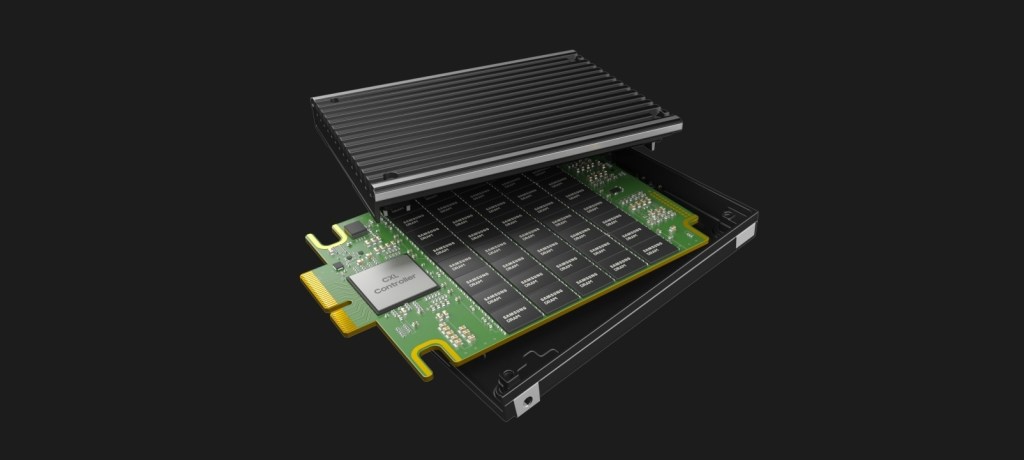
CXL is an open interconnect standard that is being rapidly adopted in AI servers. It allows CPUs to attach extra memory pools directly over PCIe, bypassing the physical limits of traditional DIMM slots. The setup is especially useful for large KV caches in LLM inference workloads.
Zephyr said the market is currently pricing in SLC demand mainly from established uses such as automotive electronics, but is not reflecting the extra SLC NAND consumption that could come from the XL-Flash to CMX to CXL AI server chain.