
Top 10 stories of the week
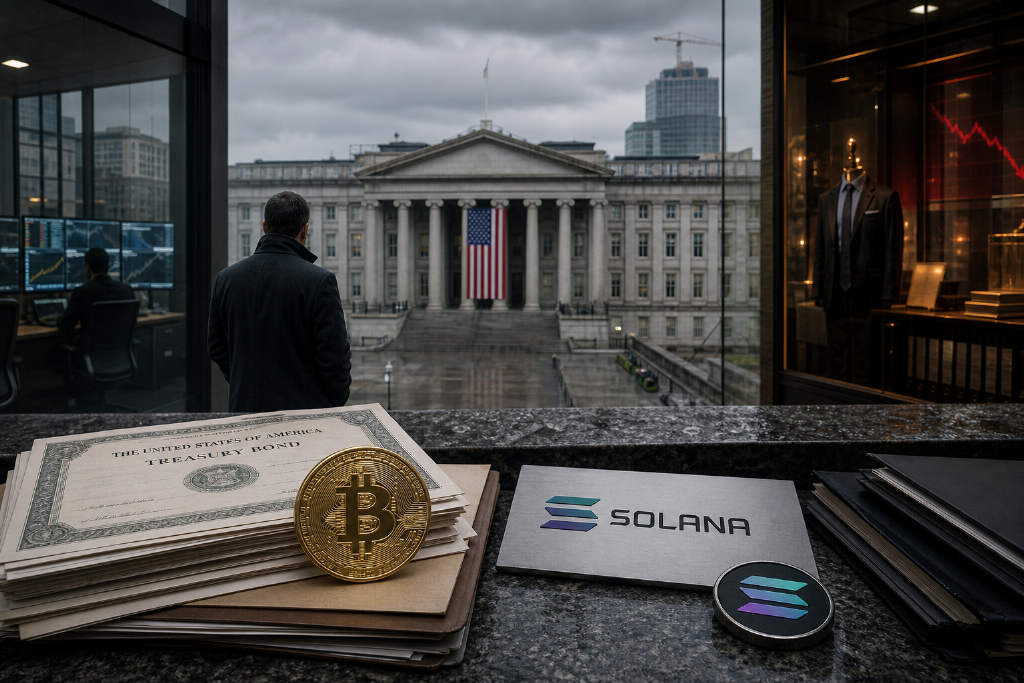
WuBlockchain’s weekly selection of 10 stories centered on US fiscal liquidity, Bitcoin’s breakout, Solana governance proposals, losses tied to Trump-linked crypto ventures, and continued growth in real-world asset tokenization.
1. Arthur Hayes says the US Treasury is still adding liquidity and that a new Bitcoin bull market has started
Arthur Hayes, in a new essay titled Same Drink, New Bottle, said Treasury Secretary Scott Bessent is pushing down yields through steps such as expanded long-dated Treasury buybacks. Hayes argued that the practical effect is more dollar liquidity for markets, with Bitcoin positioned to benefit first.
Hayes said the most aggressive scenario could involve something close to yield curve control if the 10-year Treasury yield rises above 5%. He described a more likely path as a gradual expansion of buybacks combined with the use of about $1 trillion from the Treasury General Account, or TGA. He said Bitcoin has already entered a new bull cycle, though volatility is likely to increase sharply. He also said Maelstrom is now at its “maximum risk exposure,” concentrated mainly in BTC, ETH, ENA, and ETHFI.
GSR’s latest weekly report said Bitcoin broke out of the $60,000 to $70,000 range that had held for seven weeks, briefly reaching about $79,000. The token rose about 25% on the week, its strongest weekly performance this year. From Wednesday through Friday, total short liquidations across the market came to about $4.6 billion.
GSR said the rally looked more like fresh outside capital coming back into crypto than a rotation within the crypto market itself. Flows were concentrated in BTC and ETH, and only 33% of the top 100 altcoins outperformed BTC during the same period, suggesting the move has not turned into a broad altcoin season. The firm said traders will be watching US PCE data, Nvidia earnings, and Jackson Hole. If policy action keeps pressure on long-end Treasury yields and ETF and stablecoin inflows remain intact, GSR said BTC and ETH could keep their relative strength.
Wintermute said in a market update that it has turned more constructive after BTC broke out of a six-week trading range and spot ETFs for BTC and ETH posted net inflows of about $1.92 billion and $693 million, respectively, over the past week. At the same time, the move higher came with about $2.7 billion in short liquidations, making the durability of ETF inflows a key variable from here.
Wintermute said it would turn cautious again if BTC ETFs record net outflows over a week and Bitcoin closes back below the old range under $67,000. The firm also pointed to a US Treasury announcement that, starting Sept. 9, the size of each 10-year to 30-year Treasury buyback will increase from a maximum of $2 billion to at least $4 billion, calling that an important backdrop for changing liquidity expectations.
2. BlackRock says the case for Bitcoin as a fiscal-risk hedge is getting stronger as US debt tops $40 trillion
Robbie Mitchnick, head of digital assets at BlackRock, said US debt and fiscal deficits are again becoming core market risks and are pushing some investors toward alternative stores of value such as Bitcoin and gold. As of Aug. 18, US federal debt had risen to about $40.05 trillion.
Mitchnick said fiscal sustainability matters more to Bitcoin’s long-term pricing than the CLARITY Act, which is still moving forward. He added that regulatory clarity has greater significance for other parts of crypto, including DeFi. BlackRock has also previously said that rising government debt and persistent fiscal deficits could strengthen the long-term portfolio case for Bitcoin as a hedge against fiat currency debasement.
3. US Treasury is considering using about $950 billion in TGA funds to support long-term Treasury buybacks
CNBC, citing two senior US Treasury officials, reported that the department is considering using about $950 billion from the Treasury General Account to support expanded long-term Treasury buybacks.
The US Treasury has already raised the size of each 10-year to 30-year Treasury buyback from $2 billion to at least $4 billion. Treasury Secretary Scott Bessent has also said the actual scale could increase further. If TGA funds are used, the Treasury would have a larger source of capital for repurchases, though officials did not disclose a specific amount to be deployed or a timetable.
4. Coinbase lays out its “AiFi” strategy
Coinbase used a new post to describe its strategy for “agentic finance,” or AiFi. The company said traditional finance is constrained by business hours, legal identity checks, and manual intervention, which makes it a poor fit for AI agents that need to operate autonomously around the clock. Crypto and stablecoins, Coinbase said, offer the always-on, programmable, low-cost micropayment rails that AiFi needs.
Coinbase said its current AiFi product stack includes Coinbase Advisor, an SEC-registered investment adviser tool for agent trading; Coinbase for Agents, which supports sandbox operations and integrations with Claude, ChatGPT, and Cursor; the x402 open micropayments protocol; and Coinbase Business, which allows companies to charge AI agents directly in USDC.
5. Solana proposals aim to cut issuance, with staking yields potentially cut roughly in half over two years
Solana is advancing two governance proposals, SIMD-550 and SIMD-553.
SIMD-550 would raise the annual deflation rate from -15% to -30%, moving the timeline for Solana to reach its 1.5% terminal inflation rate forward from around 2032 to the first half of 2029. Under that framework, nominal staking yields are projected to fall to about 2.25% in the third year.
SIMD-553 was approved and merged on July 20. It would introduce burn fees on compute units for financial activity requests. Based on current network activity, daily SOL burned is estimated to rise from about 600 to 800 tokens to about 7,500 to 9,000 tokens.
Taken together, the two proposals are expected to reduce issuance by about $1.4 billion to $1.5 billion over six years. The exact outcome still depends on the SIMD-550 vote and the validator fee design under SIMD-553.
Separately, Ellipsis Labs CEO Eugene Chen criticized Solana’s SGP-0003 fee reform proposal, saying it could have a material impact on applications that depend on market microstructure on Solana. He said changing the on-chain cost model without sufficient participation from application developers would weaken confidence in building on the chain.
Solana co-founder Anatoly Yakovenko later suggested that signature fees could instead be changed to a model based on compute units, while keeping average fees roughly unchanged. Chen said he supports the idea in principle but believes the mechanism still needs more evaluation.
6. Uniswap founder Hayden Adams says AMMs now have a clear route to leading global financial markets
Uniswap founder Hayden Adams said the wave of real-world asset tokenization is giving automated market makers, or AMMs, a clear route to becoming dominant infrastructure in global finance.
Adams said traditional market makers use vertical integration to capture high-margin business and rely on costly delta-neutral hedging. Blockchains, by contrast, separate execution, custody, and settlement, which lowers the barrier to market making.
He added that on-chain liquidity naturally concentrates in correlated pairs, with only a small number of highly liquid bridge pairs, such as SPY/USD and ETH/USDC, needed to connect to dollar rails. Because market makers holding correlated assets face lower inventory risk, he said passive AMMs can replace traditional high-cost market-making strategies with a much lower cost of capital.
7. Guren Zhou, the largest disclosed backer of Trump family token purchases, has been listed as a defaulter in China
UAE-based investment firm Aqua 1 Foundation previously spent $100 million buying tokens in World Liberty Financial, or WLFI, the Trump family’s crypto project. That amount exceeded the previously reported cumulative $75 million investment by Justin Sun, making Aqua 1 the largest mystery buyer of WLFI.
An investigation cited in the roundup said the long-obscure beneficial controller behind Aqua 1 is Guren Zhou, who was born in Shanghai in 1984, and that questions have been raised about the source of his funds.
The report said Zhou remains listed on China’s public enforcement information network as a defaulter subject to enforcement, tied to six cases involving debts totaling tens of millions of yuan. It also said an indictment disclosed by the UK Crown Prosecution Service, or CPS, shows Zhou is implicated in a money laundering case in the UK.
8. US adds digital assets to a new round of Iran sanctions and warns of sanction risk for related business
The US Treasury said it is expanding sanctions on Iran and will impose secondary sanctions across five areas: digital assets, technology, aviation, gold, and shipping. The stated goal is to cut off Iran’s overseas revenue sources, and the Treasury warned that foreign institutions continuing to do business with Iran-linked entities could face US sanctions.
Scott Bessent said the new measures will raise the sanction risk tied to such business dealings. The US had already sanctioned Nobitex, described as Iran’s largest crypto exchange, saying it was involved in sanctions evasion, terror financing, and transactions linked to Iran’s Islamic Revolutionary Guard Corps.
US authorities said that by May this year they had seized nearly $1 billion in crypto assets tied to Iran. The latest sanctions also cover multiple digital asset addresses, including a Bitcoin wallet that the US Treasury said is controlled by Arman Kahzadian.
9. Trump-linked crypto businesses caused at least $4.7 billion in investor losses
Public Citizen, a US consumer protection group, said in a report published on Aug. 27 that crypto businesses tied to Donald Trump and his family have caused at least $4.7 billion in investor losses since 2022. Most of those losses, the report said, remain unrealized.
The report covered NFT trading cards, WLFI, TRUMP, USD1, and Trump Media’s crypto asset holding strategy. Public Citizen said TRUMP accounted for the largest share of losses, estimated at $3.2 billion.
According to Nansen data, about 1 million of the roughly 1.6 million Solana wallets that bought TRUMP are sitting on unrealized losses. Public Citizen also estimated that WLFI alone has produced at least $1 billion in losses, while Trump Media’s holdings of 9,477 BTC were showing about $450 million in unrealized losses as of the end of June 2026.
The roundup added that Trump reported at least $1.4 billion in income from related crypto businesses in his 2025 asset disclosure.
10. On-chain RWA market cap reaches a record $44.9 billion
On-chain market capitalization for real-world assets, excluding stablecoins, has climbed to a record $44.9 billion.
Tokenized US Treasuries are the largest asset category at $15.3 billion. Yield or active strategies rank next at $8.8 billion, followed by credit funds at $6.3 billion.
Notable fundraising deals
WuBlockchain also listed several notable financing events from the week:
- Crypto tax and accounting infrastructure provider FinTax completed a seed round led by YZi Labs at a $40 million valuation.
- Havenex, a compliant exchange platform being built with participation from Sui co-founder Kostas Kryptos, is nearing the completion of its Series A round.
- City Protocol said it completed seed and pre-Series A financing totaling $11 million.
- Hivemind closed a $17 million strategic financing round led by M&G Investments.
For more industry financing events, the source said readers can check crypto-fundraising.info.