
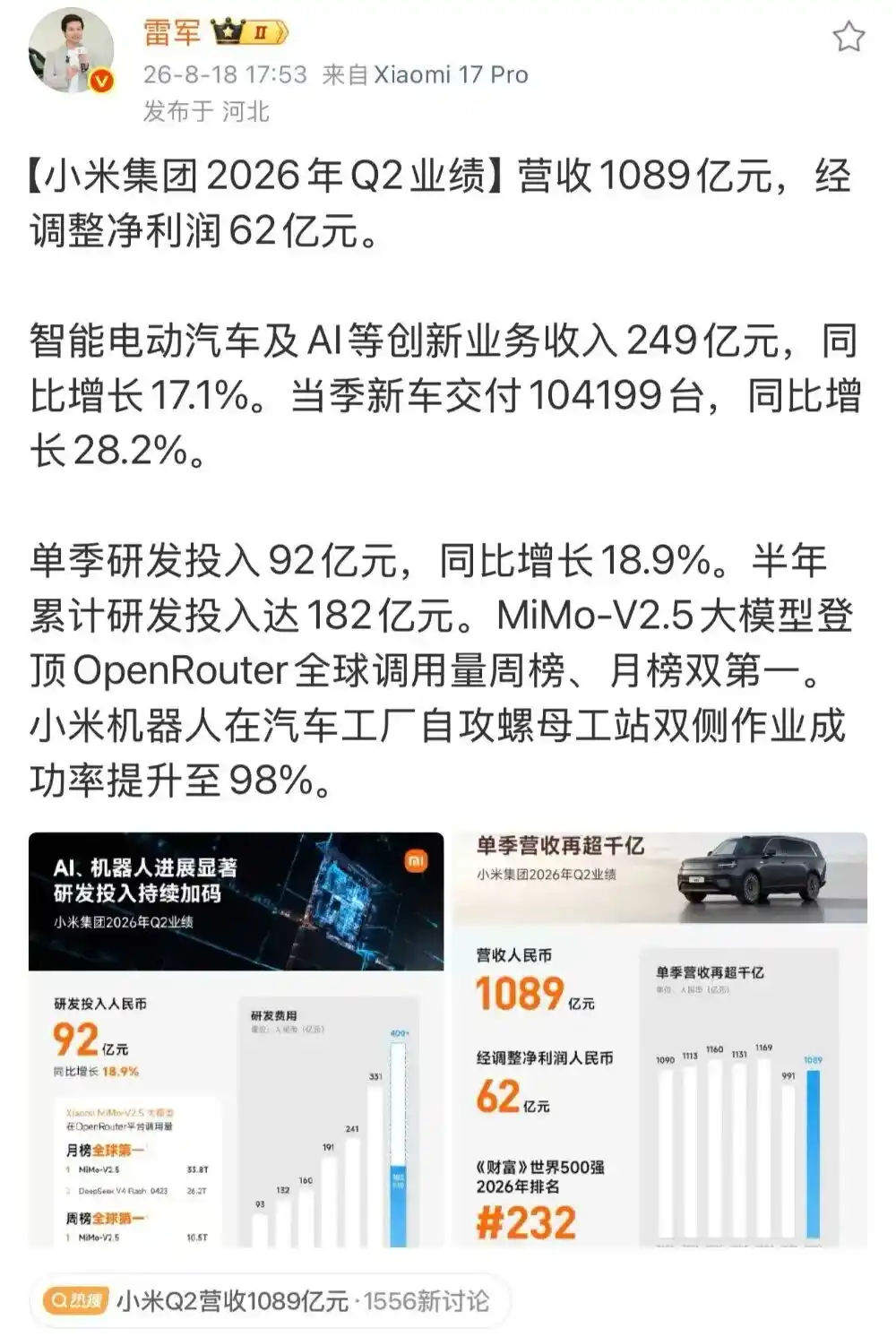
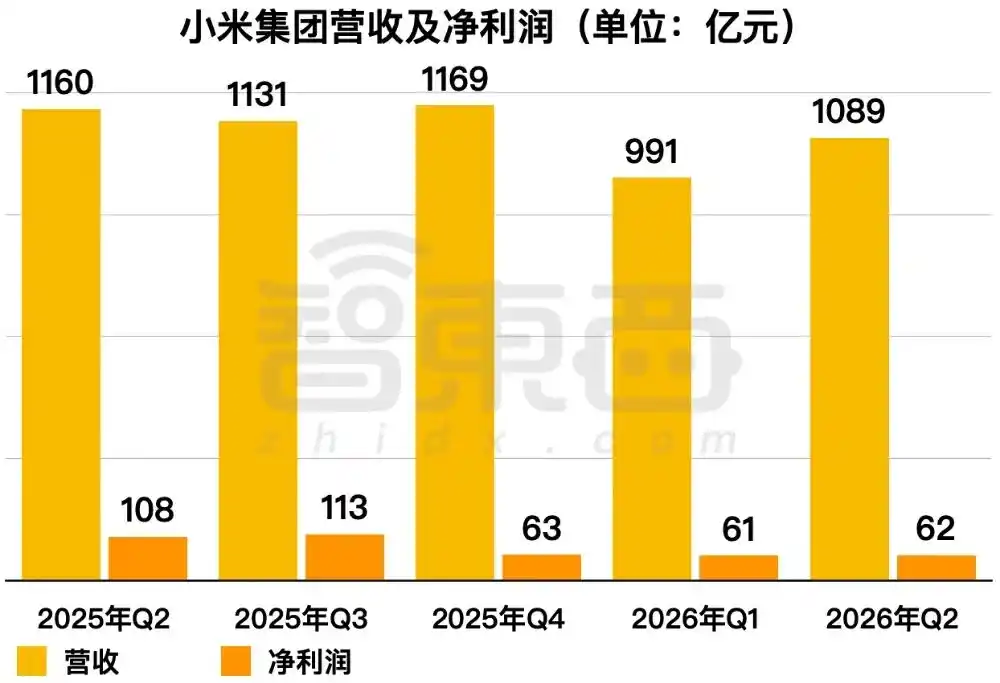
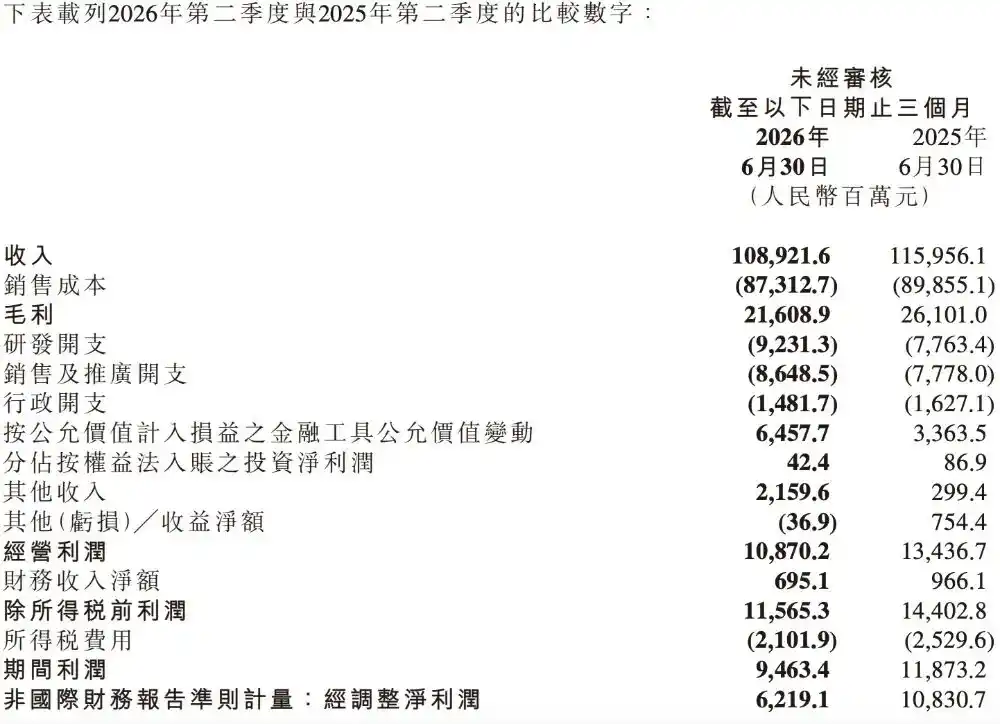
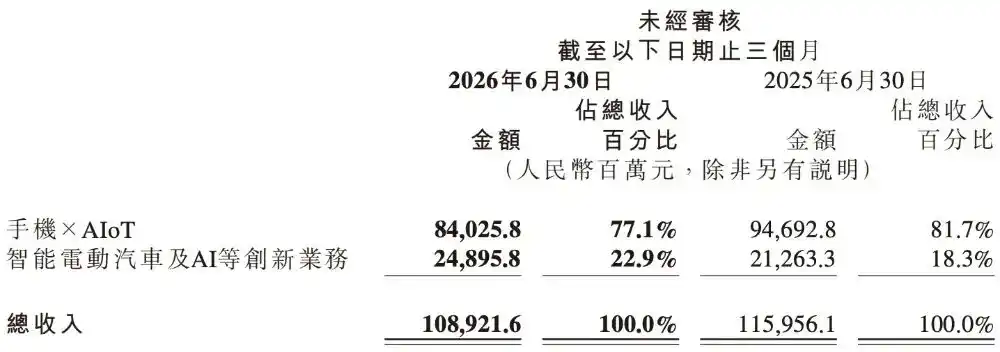
Xiaomi reported 2026 second-quarter revenue of about RMB 108.9 billion, down 6.1% year over year, while adjusted net profit came in at roughly RMB 6.2 billion, down 42.6%. After the earnings release, Lei Jun shared the headline figures on Weibo. On the earnings call, Xiaomi partner and president Lu Weibing said the Xring O1 chip launched last year has shipped more than 1 million units across three end devices, and a new-generation Xring chip is set to be released soon.
Xiaomi said capital expenditure in the quarter was about RMB 3.6 billion. Of that total, RMB 2.4 billion went to its smart electric vehicle and AI and other innovation businesses, equal to around 67% of total capex. Research and development spending reached about RMB 9.2 billion, up nearly 19% from a year earlier, bringing first-half R&D investment to RMB 18.2 billion.
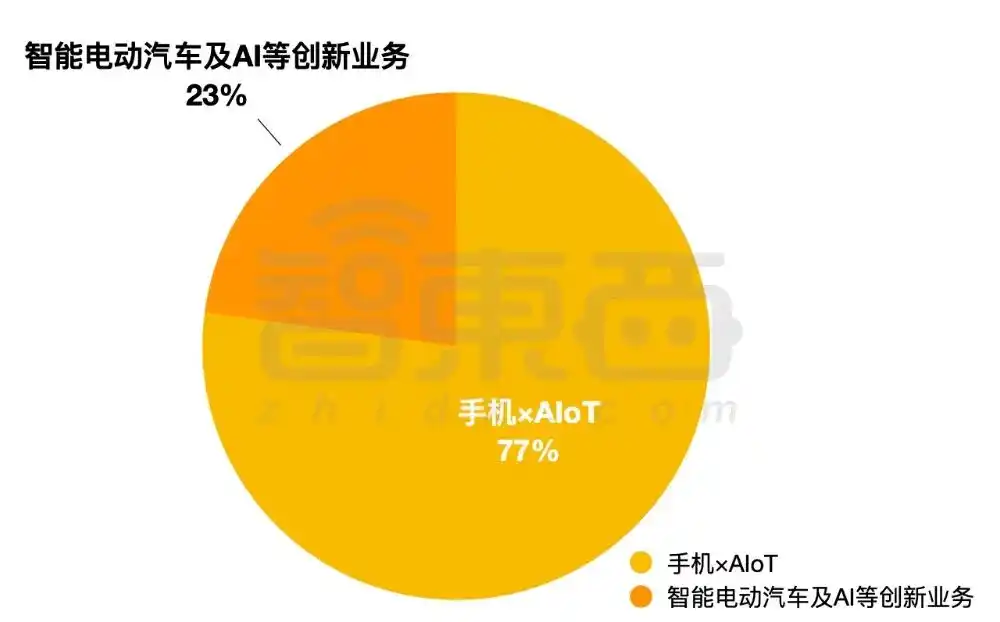
The company’s "smartphone x AIoT" business posted RMB 84 billion in revenue in the second quarter, with gross margin holding at 20%. Xiaomi’s newer businesses, including smart EV and AI, generated RMB 24.9 billion in revenue, up 17.1% year over year. Smart EVs contributed RMB 23.9 billion, while AI and other emerging businesses added about RMB 1 billion, including revenue tied to the commercial rollout of the Xiaomi MiMo large model.
Those newer operations are still in an investment stage. The segment posted an operating loss of RMB 2.6 billion in the quarter. Xiaomi CFO Alain Lam said on the earnings call that the company’s AI business remains in a phase of large-scale investment and that Xiaomi will keep pushing AI-led restructuring across its businesses. He added that the previously launched Token Plan has already brought in some revenue, but monetization is not the main objective.
Xring chips, HyperOS 4 and Super XiaoAI 2.0 move ahead
Lu Weibing said Xiaomi’s Xring O1 chip, launched last year, has now surpassed 1 million cumulative shipments across three terminal devices. He also said a new-generation Xring chip is nearing release.
On June 9, Xiaomi’s MiMo team and inference systems team TileRT said the UltraSpeed mode of Xiaomi MiMo-V2.5-Pro, the flagship large model released in April, became the first 1T-parameter flagship model to push output speed past 1,000 tokens per second.
In the same month, the MiMo team released and open-sourced MiMoCode V0.1.0, an AI coding assistant built on a secondary development of the open-source OpenCode project. Xiaomi said its core design uses "model-Agent collaboration plus engineering memory" to address issues seen in traditional coding agents, including forgetfulness, drifting off task and repeated rework.
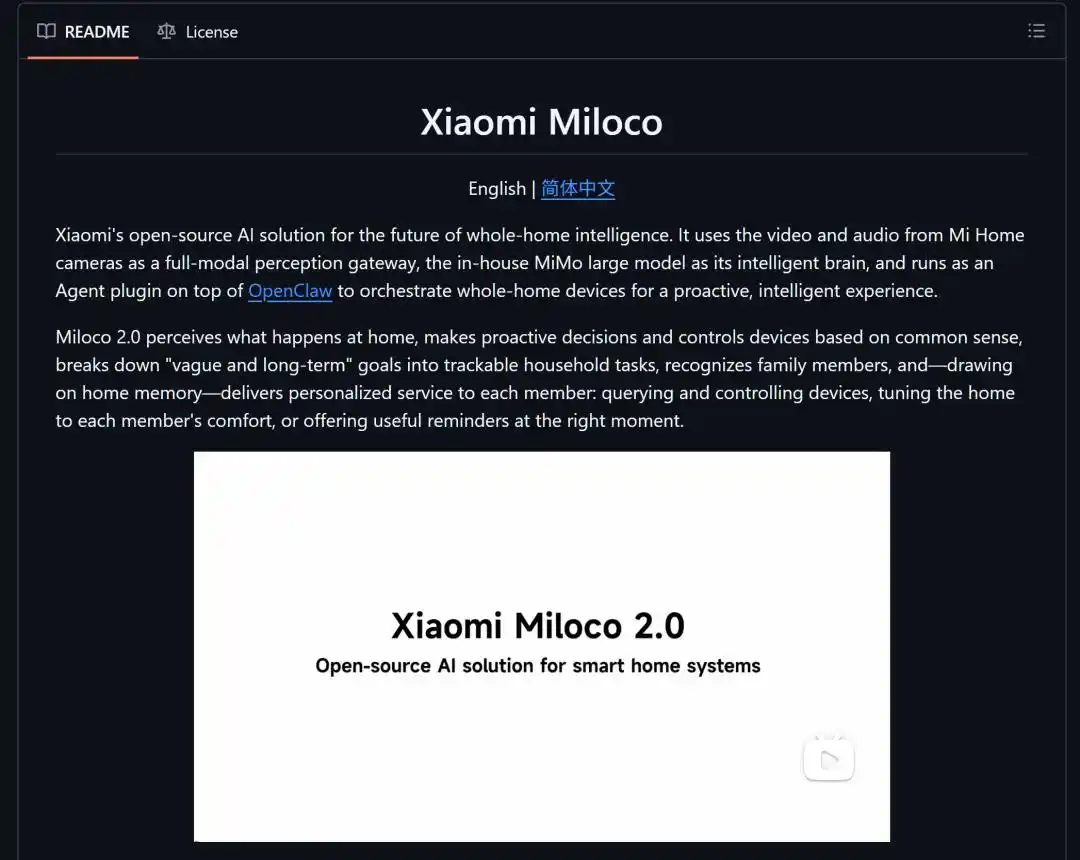
Xiaomi MiMo Claw also launched in an official version in June. The product is positioned as a cloud-hosted personal agent that requires no local deployment and is ready to use out of the box. It runs on the MiMo-V2.5-Pro model and links with the Kingsoft Office ecosystem. On June 18, Xiaomi also released and open-sourced Xiaomi Miloco 2.0, a whole-home smart AI open-source solution that it described as the first smart-home solution in the industry capable of proactive AI service with household memory.
In August, Xiaomi formally introduced HyperOS 4 Beta. The company said the release adds load calculation and memory preloading technology to the self-developed Xiaomi HyperCore kernel and builds an application runtime environment for HyperOS.
Xiaomi also unveiled Super XiaoAI 2.0. According to the company, improvements to the AI architecture and integration with the Xiaomi MiMo large model have strengthened its task orchestration and content generation capabilities, with targeted optimization for cross-app and cross-device scenarios.
Robotics remains focused on internal deployment first
In embodied intelligence, Xiaomi introduced Xiaomi-Robotics-U0 on July 15. The company described it as a 38B-parameter autoregressive world foundation model and the first unified embodied generative model to combine an image-generation base model with embodied world modeling.
On July 14, Xiaomi also disclosed new progress in robotics. Earlier this year, Xiaomi robots were deployed at a self-tapping nut loading station in the Xiaomi EV factory, where task success rates on both sides of the station rose to 98%. The robots also reached 90% success rates in center-console side-cover sorting and foldable bin recovery tasks.
Asked how Xiaomi views its robotics business internally, Lu Weibing said humanoid robots still face a long road before large-scale commercialization. For now, Xiaomi plans to first make the technology work inside its own operations, especially in smart factories and smart-home scenarios. He said many of Xiaomi’s core capabilities are expected to work together with robotics over time, while progress in robotics can also feed back into existing businesses.
Handset shipments weakened, but ASP hit RMB 1,351
Xiaomi’s smartphone revenue totaled RMB 42.1 billion in the second quarter, down 7.5% from a year earlier. The company said the decline mainly reflected lower smartphone shipments, partly offset by a higher average selling price.
Citing Omdia data, Xiaomi said global smartphone shipments fell 6% year over year in the second quarter of 2026 under the impact of memory pricing. During the same period, Xiaomi shipped 31.2 million smartphones globally, generated RMB 42.1 billion in smartphone revenue, and posted smartphone gross margin of 8.5%.
To deal with rising storage costs, Xiaomi pushed an upmarket handset strategy, lifted pricing, and continued to optimize product mix. Smartphone ASP rose 25.9% year over year to RMB 1,351 in the quarter.
Third-party data cited in the report showed that in mainland China, smartphones priced at RMB 3,000 and above made up 32.1% of Xiaomi’s overall smartphone sales in the second quarter, a record high and an increase of 4.5% from a year earlier. In the RMB 3,000 to RMB 4,000 price band, Xiaomi’s smartphone sales market share in mainland China reached 16.2%, up 3.3% year over year.
Omdia data showed Xiaomi ranked third globally by smartphone shipments in the second quarter, extending its run in the global top three to 24 consecutive quarters.
Xiaomi also said its smartphone shipments ranked in the top three in 53 countries and regions worldwide and in the top five in 67 countries and regions. By region, Xiaomi ranked second in Southeast Asia, Latin America and the Middle East, with market shares of 19.3%, 16.2% and 13.5%, respectively. It ranked third in Europe and Africa, where market shares stood at 16.5% and 10.9%.
Tablets, wearables and AIoT ecosystem kept expanding
Omdia data cited by Xiaomi showed its global tablet shipment ranking rose to fourth in the second quarter of 2026, while its mainland China tablet ranking was also fourth. In TWS earbuds, Xiaomi ranked second globally and second in mainland China. In wearable wristband devices, it ranked second both globally and in mainland China.
In its ecosystem business, Xiaomi said that as of June 30, 2026, the number of IoT devices connected to the Xiaomi AIoT platform, excluding smartphones and tablets, reached 1.16 billion, up 17.4% year over year. The number of users with five or more devices connected to the Xiaomi AIoT platform, again excluding smartphones and tablets, rose to 24.6 million, up 20.2%.
In June 2026, monthly active users of the Mi Home app increased 9.7% from a year earlier to 124 million. Monthly active users of XiaoAI rose 14.2% to 175 million.
EV revenue reached RMB 23.9 billion as SU7 deliveries passed 500,000
Xiaomi’s smart EV and AI and other new businesses generated RMB 24.9 billion in second-quarter revenue, including RMB 23.9 billion from smart electric vehicles.
The company delivered 104,199 new vehicles in the quarter, up 28.2% year over year. In the first half of 2026, the Xiaomi SU7 series ranked first among battery electric sedans priced above RMB 200,000 in mainland China. As of Aug. 17, 2026, cumulative deliveries of the Xiaomi SU7 series had surpassed 500,000 units.
Memory prices rose faster than expected, Xiaomi says
On the earnings call, Lu Weibing said memory price increases came in above Xiaomi’s expectations. From a sales perspective, he said higher memory prices had the clearest impact on low-end and entry-level models.
Lu said he expects the pace of memory price increases to ease around the middle of the third quarter, with prices likely to keep rising more slowly in the fourth quarter and the overall trend gradually becoming more manageable.
The quarter’s results show Xiaomi balancing pressure in its established businesses with continued spending on newer ones. Its smartphone operation maintained global scale and improved pricing through premiumization, while its EV and AI operations kept expanding but stayed loss-making. Xiaomi also accelerated product releases across AI agents, operating systems and embodied AI in the first half of the year, with broader market validation still ahead.
This report is based on information published by the WeChat public account Zhidxcom. The article was written by Wang Han and edited by Bing Qian, and later republished by MarsBit.