
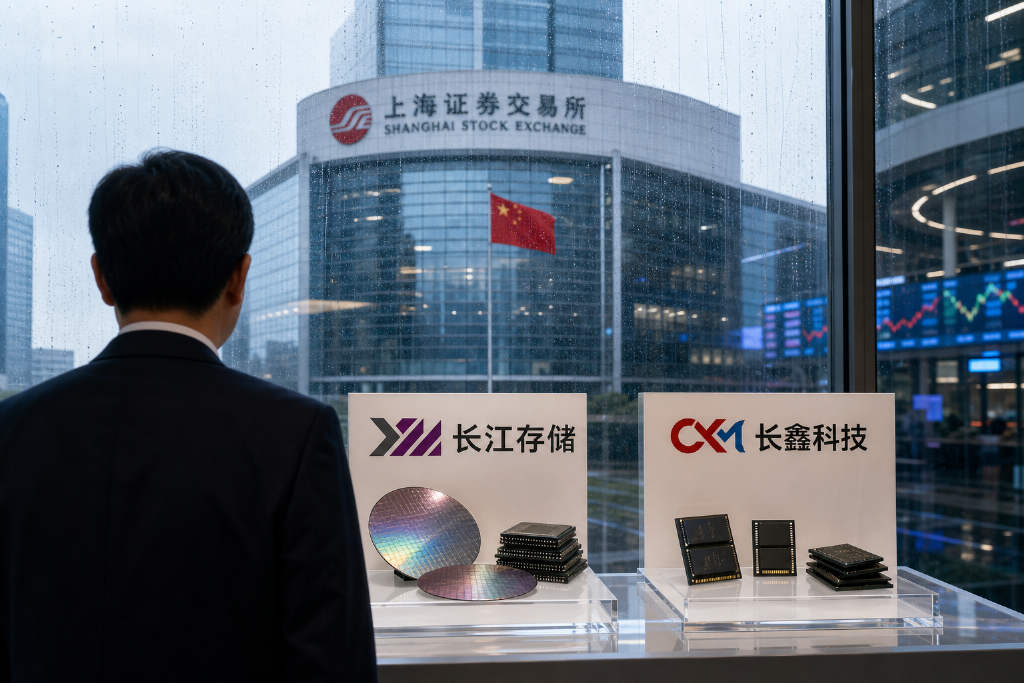
Yangtze Memory Technologies Co. (YMTC) has had its STAR Market IPO application accepted by the Shanghai Stock Exchange, with a planned fundraising amount of 33 billion yuan. That would exceed the 29.5 billion yuan targeted by CXMT and set a new record for proposed fundraising size on the STAR Market.
The filing comes about a month after CXMT went public. The company was priced at 8.66 yuan per share, implying an issuance valuation of about 579.2 billion yuan. It closed its first trading day at 49 yuan per share, lifting its market capitalization to 3.28 trillion yuan and putting it at the top of the A-share market by value. With YMTC also seen as a leading domestic memory maker, investors are now asking whether it could become another CXMT.
Similar labels, different memory tracks
YMTC and CXMT were both founded in 2016. Both use the IDM, or integrated device manufacturer, model, and neither has a controlling shareholder or an actual controller. Even so, their core businesses diverge in ways that shape how the market may value them.
According to the two prospectuses, CXMT is focused on DRAM, or dynamic random-access memory. DRAM must be refreshed periodically to retain data, and the data is lost immediately once power is cut. It is mainly used as working memory in electronic devices and handles temporary system data reads and writes. YMTC, by contrast, is focused on NAND Flash, which can retain data after power is removed, supports repeated erase and write cycles, and is widely used in large-capacity scenarios such as solid-state drives, embedded storage, and mobile storage.
Tian Lihui, a finance professor at Nankai University, told Zhongxin Jingwei that the two companies differ not only in market narrative but also, more fundamentally, in technology route and industrial positioning.
DRAM remains far larger than NAND Flash
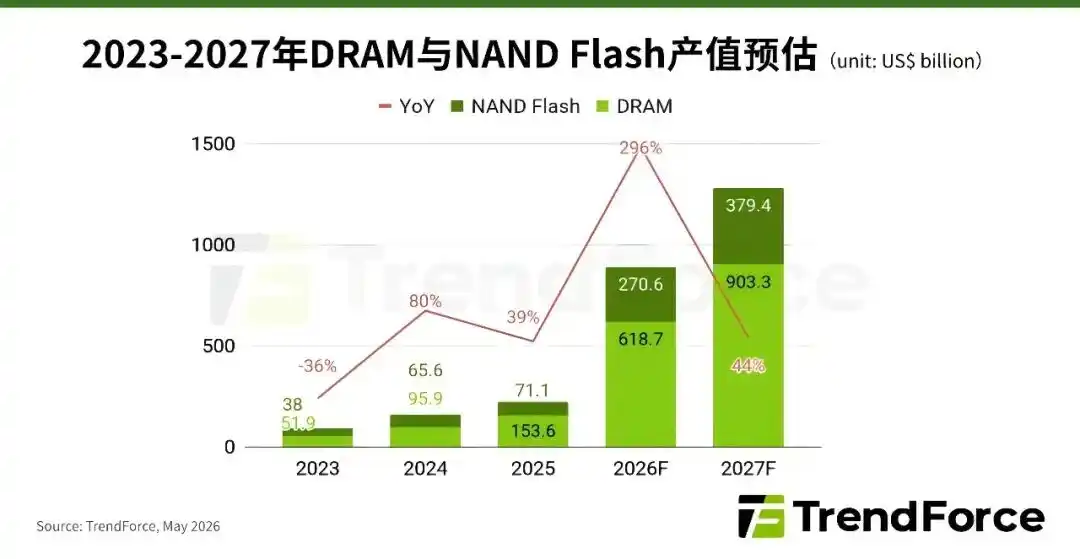
The gap between the two segments is substantial. TrendForce, a semiconductor and memory research firm, projected in May 2026 that global DRAM output value would reach about $618.7 billion in 2026, compared with about $270.6 billion for NAND Flash. That puts DRAM at roughly 2.3 times the size of NAND. For 2027, TrendForce forecast DRAM at $903.3 billion and NAND Flash at about $379.4 billion, with the gap widening further.
In terms of market structure, CXMT’s prospectus cited Omdia data showing that, based on sales revenue, Samsung Electronics, SK hynix, and Micron Technology held 33.96%, 34.48%, and 23.41% of the global DRAM market in 2025, respectively. Their combined share exceeded 90%, while CXMT ranked fourth with 7.67%. The prospectus described CXMT as China’s largest, most advanced, and most comprehensively positioned DRAM company with integrated R&D, design, and manufacturing capabilities.
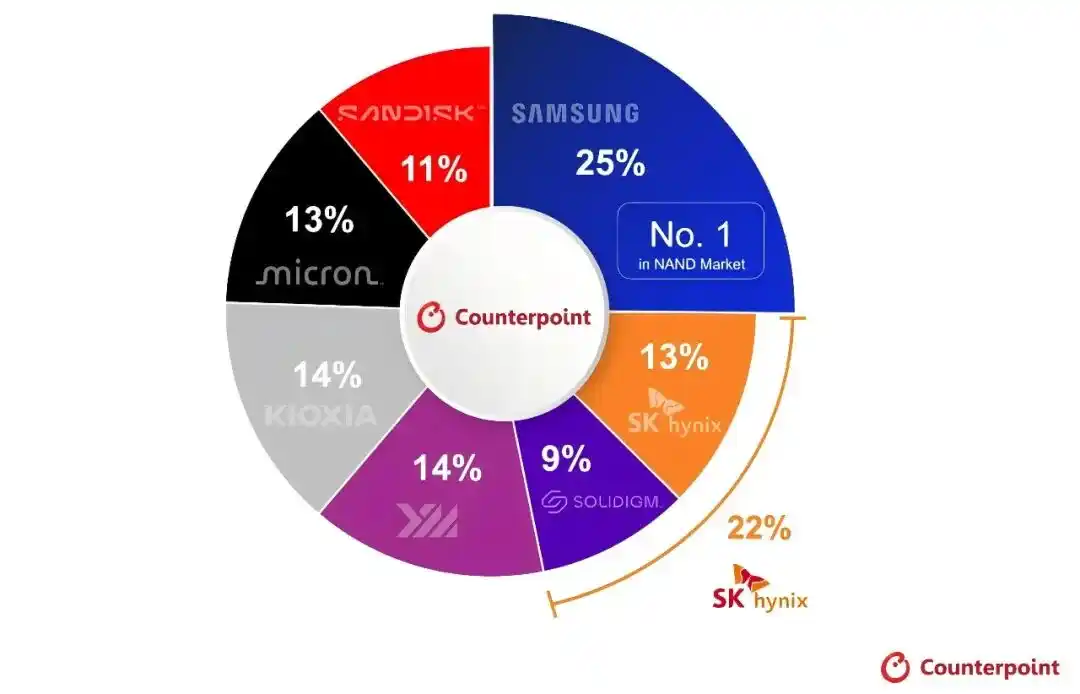
YMTC’s global peer group includes Samsung Electronics, SK hynix, Kioxia, Micron Technology, and SanDisk. In the latest memory and storage market tracker for the second quarter of 2026 from Counterpoint Research, Samsung led NAND shipments with a 25% share, followed by SK hynix at 22%. YMTC rose to third with 14%, slightly ahead of Kioxia, while Micron ranked fifth.
Counterpoint Research also said shipment volume does not directly translate into revenue. Even though YMTC ranked third in shipments during the quarter, it was fifth in revenue, behind Micron and Kioxia, because its product mix remained concentrated in consumer applications and its share of higher-priced enterprise SSD products for data centers was relatively low.
Tian said the DRAM market targeted by CXMT is tightly controlled by Samsung, SK hynix, and Micron. As the world’s fourth-largest supplier and China’s only DRAM IDM company, CXMT has been assigned a scarcity premium tied to the idea of breaking that concentration. YMTC’s main business, NAND Flash, is oriented toward long-term data storage, has relatively lower technology barriers, a lower margin ceiling, and a more dispersed global competitive structure, he said.
Can YMTC repeat CXMT’s first-day surge?
On July 27, CXMT’s market capitalization climbed from 579.2 billion yuan at issuance to 3.28 trillion yuan by the close of its debut session, a rise of more than fivefold. Whether YMTC can deliver anything similar is now central to the IPO discussion.
According to its prospectus, the shares to be issued in the IPO will account for 10% to 12% of YMTC’s total share capital after the offering. Based on the planned fundraising amount, that implies a company valuation of roughly 275 billion yuan to 330 billion yuan.
In Tian’s view, the odds of YMTC replicating CXMT’s first-day rally are very low, and the IPO could face what he described as structural cooling. He said CXMT came to market when the AI memory theme was still at full strength and overseas capital was aggressively buying, while the storage sector has since pulled back by nearly 30% from its high and market risk appetite has fallen sharply.
Strong quarterly profit, but different demand outlooks
YMTC posted strong first-quarter 2026 results. Revenue came in at 47.042 billion yuan, and net profit attributable to shareholders reached 33.379 billion yuan, above CXMT’s single-quarter profit of 24.762 billion yuan. The prospectus said YMTC’s average selling price for NAND Flash products in the first quarter rose 172.72% from the full-year 2025 level, while gross margin on those products increased from 36.66% in 2025 to 78.73%.
Still, a July 30 report from TrendForce said memory demand in 2027 will continue to be led by AI applications. In DRAM, HBM, or high-bandwidth memory, continues to crowd out capacity, AI server demand remains strong, and procurement momentum for CPU-related memory and HBM is still rising. The market is expected to stay tight on supply, with pricing biased upward. For NAND Flash, however, concentrated new capacity additions and continued weakness in end-market consumer demand could push supply toward a looser balance in the second half of 2027, bringing possible price correction pressure.
Tian said that, from a fundamentals perspective, YMTC’s first-quarter profitability was on par with or even slightly better than CXMT’s. But he added that YMTC does not match DRAM and HBM in scarcity or strategic value within the AI supply chain. The key contest, in his view, will be whether the bookbuilding process produces a reasonable valuation. If pricing is too aggressive, he said, the stock could face a break below issue price at some point after listing. If the offer leaves a margin of safety, it may still win recognition from more rational capital during a calmer market phase.
Another academic takes a less cautious view
Li Guoping, a professor at the Central University of Finance and Economics, told Zhongxin Jingwei that sentiment affects company value mainly in the short term, while fundamentals remain the decisive factor over the long run. Whether YMTC’s market capitalization can exceed CXMT’s, he said, will ultimately depend on its later earnings performance and on whether it can make progress in HBM.
Li also said YMTC and CXMT hold broadly similar positions in China’s domestic market. Their products differ, but he sees their long-term investment value as comparable. Although the storage sector has already pulled back, market sentiment remains relatively elevated, which in his view means the risk of YMTC’s IPO turning cold should be limited.
The source article was published by the WeChat account Zhongxin Jingwei (ID: jwview), written by Xie Jingwen and edited by Li Xiaoxuan.