


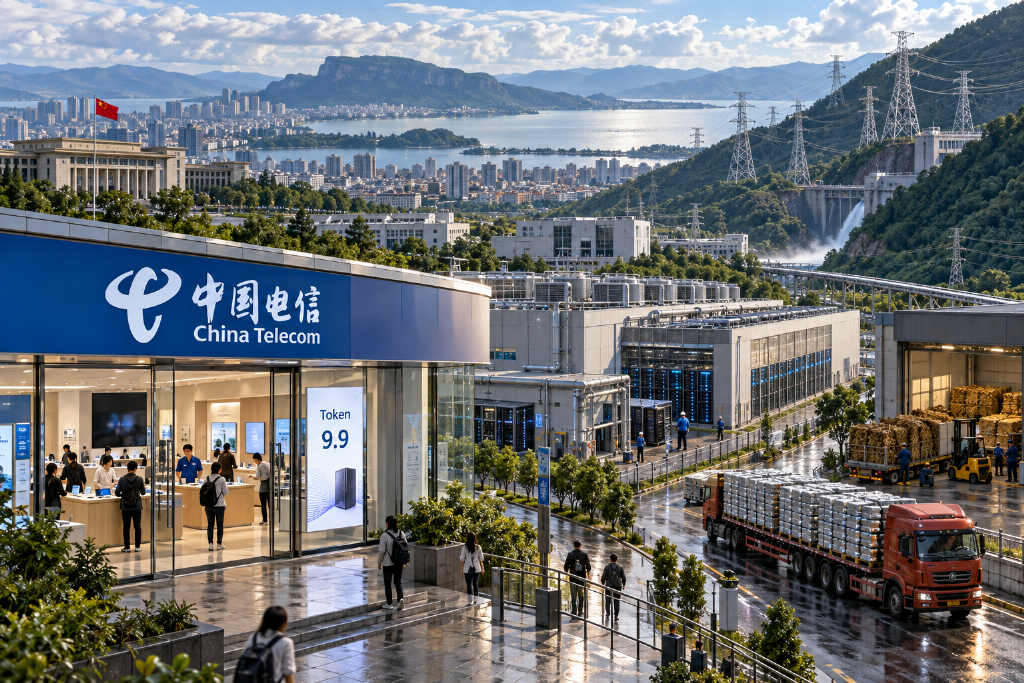
AI is starting to carry a posted price, much like mobile data once did.
At a telecom service hall in Kunming, customers can buy 10 million Tokens for 9.9 yuan a month.
At the same time, Yunnan’s green aluminum industry is expanding quickly. In the first half of 2026, the province’s value-added industrial output above designated size rose 0.7%, while value added in green aluminum climbed 10.2%, contributing 70.8% of the growth in above-scale industry.
One business sells compute. The other sells aluminum. They look unrelated, but the underlying logic is similar: convert local resources into tradable goods.
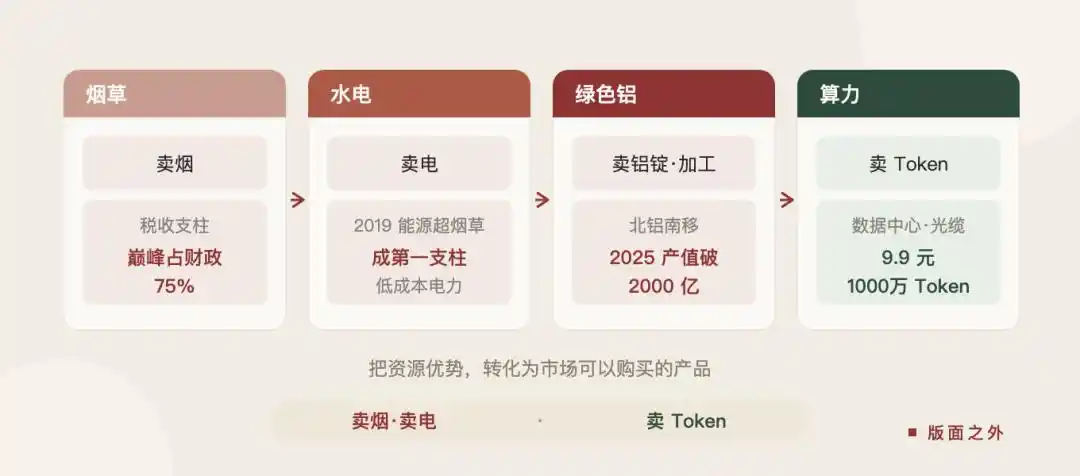
Viewed over several decades, Yunnan’s industrial shifts have largely followed that path. From tobacco to hydropower, then from green aluminum to compute, the province has kept looking for new outlets for its resource base and new ways to turn those advantages into industrial scale.
From tobacco to compute
For a long period, tobacco defined Yunnan’s industrial economy.
The sector brought stable tax revenue, jobs, and supply chains, and it shaped the province’s industrial fundamentals. At its peak in the 1990s, tobacco taxes and profits accounted for more than 75% of Yunnan’s fiscal revenue. As the energy sector developed, another pillar began to emerge.
In 2019, value added in the power-based energy industry surpassed tobacco for the first time, becoming the province’s largest industrial pillar.
Hydropower sat at the center of that change. Yunnan has abundant water resources, a high share of clean electricity, and a clear cost advantage in industrial power use. In 2021, total installed power capacity in the province exceeded 100 million kilowatts. Green energy then became an important condition for attracting manufacturing. Yunnan has said it aims to bring total installed capacity to around 180 million kilowatts by 2027.
Hydropower, by itself, does not automatically become higher industrial income. Lower electricity costs first reshape manufacturing cost structures. Only then can they attract supply-chain relocation.
Around 2018, as the electrolytic aluminum industry adjusted its geographic layout, the shift of aluminum capacity from north to south accelerated. Yunnan’s appeal was straightforward: abundant hydropower and competitive electricity prices made it suitable for energy-intensive electrolytic aluminum production.
In 2017, Yunnan’s operating electrolytic aluminum capacity was about 1.68 million tons. By 2025, that figure had grown to about 6.5 million tons. In 2025, output value across Yunnan’s green aluminum supply chain exceeded 200 billion yuan for the first time.
The industry has also moved downstream. Products such as lightweight automotive materials and aluminum foil for new-energy batteries mean Yunnan’s green aluminum is no longer limited to primary raw materials. Some companies have entered supply systems tied to automakers including BMW and Tesla.
Hydropower did not turn directly into revenue. It first became low-cost electricity, then aluminum ingots, processed products, and supply-chain output value.
Compute is following a similar route.
The Wanxichong intelligent computing industrial park in Kunming has already built multiple data centers, and compute infrastructure continues to expand. The China-Laos and China-Myanmar international communications cables, along with the Kunming international communications gateway bureau, provide the network conditions needed for cross-border data transmission. Power, server rooms, and communications networks together form the base layer of the compute industry.
Once those pieces are in place, electricity powers servers, servers provide computing services, and those services can be priced in Tokens.
From selling tobacco to selling electricity and then selling Tokens, the form of the commodity has changed, but the basic method has not. Yunnan identifies resources where it holds a comparative advantage, then uses industrial investment and infrastructure buildout to turn that advantage into products the market can buy.
That approach has created one wave of industrial growth after another.
But it also leaves a harder question. Resource advantages can attract companies, and investment can expand industrial scale quickly. Whether a company can build long-term operations and sustained innovation locally is a different matter.
Projects can be moved in. Capabilities are harder to keep.
Yunnan’s rise in green aluminum has depended heavily on large companies and major projects.
Electrolytic aluminum requires heavy capital spending, stable power supply, mature production management, and a complete supply chain. For Yunnan, bringing in capable companies is easier than building an entire chain from scratch if the goal is to reach scale quickly.
Aluminum clusters in places such as Wenshan have continued to expand. Companies including Chinalco and Yunnan Aluminium have kept investing, driving growth in smelting, processing, and supporting industries.
The compute sector shows similar traits. Telecom operators build data centers, cloud service providers supply compute, and communications infrastructure supports data flows. Huawei and Yuntianhua have worked together on gasification operations, using automation and intelligent tools to optimize production. Yunnan Jiaotou has explored the use of large models in transport operations to improve handling of specific tasks. Yunnan Baiyao and companies in the aluminum sector are also pushing cloud platforms and industry-model applications.
These projects share a common pattern: external technical capabilities are paired with local industrial scenarios to solve specific problems. Xiong Yunbiao, dean of the School of Economics and Management at Yunnan Minzu University, described this model as exchanging resources for industry, resources for markets, and resources for technology.
That path has a practical basis. Resources can serve as bargaining chips, markets can attract companies, and industrial scenarios can give new technologies room to land. For regions with relatively weak industrial foundations, importing mature companies and technologies can shorten the development cycle.
Still, project delivery is only one point in industrial development.
Once a production system is built, who maintains it? After an outside technical team leaves, can local staff keep optimizing it? If a technology works in one scenario, can it be transferred to another? Investment totals and output figures do not answer those questions very well.
Technology can be purchased. Equipment can be installed. Systems can be delivered. Internal business experience, process understanding, and the ability to keep improving do not arrive automatically with the project.
AI is pushing that issue into view for more companies.
On production lines, intelligent systems often target clear objects: temperature control, equipment monitoring, energy optimization. Results can be measured through output, yield, and fault rates. In procurement, finance, contracts, and day-to-day management, the boundaries are much less clear. Data sits across different systems, workflows depend on manual handoffs, and decision standards are often embedded in employee experience.
That work consumes a great deal of time, yet it rarely appears on the investment list for major projects.
Chen Peng, director of the procurement and bidding center at Yunnan Hengtong Coal Industry Co., Ltd., under Yunnan Energy Group, found another possible use for AI in exactly this kind of work.
The man with the calculator
In 2017, Chen saw an employee using a calculator to check inventory data.
The data had already been entered into a computer, but the employee still had to calculate item by item and compare results repeatedly before confirming accuracy. Chen realized the issue was not the absence of spreadsheets. It was that staff had not found a more efficient way to work.
Years later, similar scenes were still common.
Hengtong Coal uses an ERP system to manage operations. For security reasons, system interfaces cannot be opened freely, so employees export data and then check and organize it manually. A routine task can take one employee four hours. During inspections or concentrated processing periods, the work often runs late into the night.
The data is digital. The work is still not fully free of manual handling.
In July 2026, Chen discussed AI applications with the Kingsoft Office team. In August, WPS Comate began to go live at Hengtong Coal. That same month, Kingsoft Office launched its "WPS Comate 100-City AI Agent Enablement Plan." At the time, Kingsoft Office Vice President Wu Qingyun said the industry had spent the past few years talking about compute, algorithms, and data, and that this year applications could finally move to the front.
What sits behind that statement is the deeper problem of moving AI from demos to scaled deployment.
As an early pilot company, Hengtong Coal had business staff work with Kingsoft Office pre-sales consultants to map workflows and try handing repetitive tasks once done by people to digital employees.
The effort did not begin with replacing the ERP system, and the company did not rebuild its existing infrastructure. The team started by looking inside current workflows for tasks that could be broken down and verified.
That was also the product logic behind the tool. As the core AI component of WPS 365, WPS Comate does not replace a company’s existing ERP or OA systems. It adds a connection layer on top of current business systems, opens data interfaces, unifies data standards, and provides an agent platform so business staff can define tasks in natural language. At Hengtong Coal, multidimensional spreadsheets first addressed data standardization, and Comate then built auto-executing skills on top of that base.
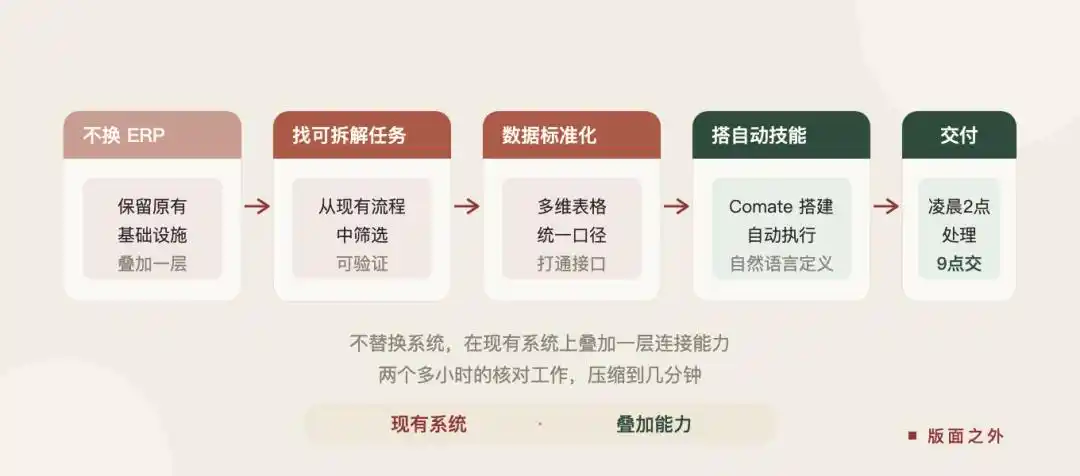
In actual use, the digital employee extracts data from different sources, validates it according to rules, and writes the results back to designated locations. It starts processing at 2 a.m. each day. By 9 a.m., the relevant report is ready for staff.
A task that once took more than two hours now takes only minutes.
The change happened inside the existing workflow. Employees no longer spend their time moving and checking data repeatedly, and can focus on the parts that require judgment.
Chen also wrote a user manual and an operations manual for the digital employee. He found, for the first time, that writing a job description for a non-human colleague had something in common with assigning work to staff: the task has to be clearly stated, execution rules have to be explicit, and the conditions for stopping also need to be agreed in advance.
He even gave the digital employee weekends off.
Even so, the digital employee did not take over the entire procurement process.
Hengtong Coal’s procurement work involves importing demand data, bid-award data, and performance-fulfillment data, as well as collecting outside market information. The first batch of skills focused mainly on data processing and steps with clear rules. Procurement intent, target judgment, procurement disputes, and exceptional cases still require people.
That boundary matters. Repetitive work can be handed to AI. Matters involving trade-offs, accountability, and complex judgment still need business staff to make the call.
A more revealing test came soon after.
During one run, the digital employee hit a 1 million-Token context limit in a single conversation. The task stopped, and the business could not proceed normally for nearly 10 days. The issue was not something that could be fixed simply by adding more compute. The task packed into one conversation was too complex, and the process had moved beyond what a single work unit should handle.
Chen and his team broke the workflow apart again. They split the original work into four independent skills, then added one coordinating conversation. In total, five conversations worked together to complete the task.
The process ran again.
The lesson from that failure went beyond tool usage. Business staff needed to understand which parts of a workflow were relatively independent, which tasks could be separated, how data moved between stages, and who should take over when exceptions appeared. In the past, that kind of work might have been handled by product managers, process designers, or technical teams. In AI deployment, business staff are now entering that process too.
Chen’s role gained another layer. He had to understand procurement work, translate it into tasks AI could execute, and keep adjusting based on actual performance. Whether a digital employee can work reliably increasingly depends on whether a company can explain its own work clearly.
That also helps explain why the same AI tool can produce very different results across companies. The model provides general capability. The company has to provide the specific data, rules, workflows, and decision standards.
Hengtong Coal’s experiment is not large in scale, but it touches a key threshold in enterprise AI adoption: moving from employees using AI to AI participating in the workflow itself.
Yunnan’s next step
Hengtong Coal is not the only case.
Yunnan Normal University, facing the need to evaluate thousands of teaching-design assignments each semester in public courses, also tried using WPS Comate for part of the work. The university used a teaching-design evaluation agent for preliminary scoring, then had teachers conduct sample reviews. The system runs twice a day on schedule, allowing students to submit work and receive feedback the same day.
Results from teacher spot checks are continuously fed back into the evaluation model to help improve its judgment.
A coal company and a university have very different businesses, but the working method is similar: find a task with relatively clear boundaries and high repetition, define evaluation rules and a human review mechanism, then let AI adjust gradually in real operation.
Applications like this are difficult to complete by software procurement alone. As Wu Qingyun, vice president of Kingsoft Office, put it, large models have general capabilities, but they do not understand each company’s own data, experience, and rules. If AI is to participate in business work, companies need to turn knowledge scattered across daily employee activity into content that systems can use.
That means AI deployment is no longer only a technical project for the IT department.
Finance staff need to know which standards budget analysis depends on. Procurement staff need to know which data can be checked automatically. Teachers need to know how evaluation standards should be applied. Technical teams build the tools, while business teams define tasks, test results, handle exceptions, and revise workflows through repeated use.
The work is more granular. It also determines whether AI can move from pilot projects into day-to-day operations.
For Yunnan, this question sits inside a larger industrial backdrop.
The province has said that by 2027, the share of value added from non-tobacco and non-energy industries in above-scale industrial value added should rise by about 3 percentage points. Green aluminum and new-energy batteries are among the sectors expected to help reshape the industrial structure.
At the same time, Yunnan’s development and reform authorities have said in responses to related proposals that the energy value of green electricity has not yet been fully converted into higher industrial value added.
Lower electricity costs can attract energy-intensive industries, and data centers can expand compute supply. But the economic value of resources is ultimately realized through companies’ production, management, and innovation activities.
Under the same power conditions, can companies make products with higher added value? With compute infrastructure in place, can local companies use AI to improve R&D, procurement, finance, and operating decisions? Those capabilities will affect how much industrial value resource advantages can ultimately produce.
Assessment data cited from the China Academy of Information and Communications Technology points to the same deployment gap. About 40% of application software has already integrated specialized agents, but the share of organizations that have actually deployed agents internally is about 17%.
The two figures use different objects and statistical definitions, so they cannot be directly subtracted. They still point to a practical reality: software having the capability is not the same as companies using that capability in routine work.
A company may already have bought AI products. Employees may already use AI in their personal work. That does not mean AI has entered a stable business workflow.
The real test is whether a company can find the right first task, maintain and improve it over time, and turn one person’s experiment into a method that a wider group can reuse.
Yunnan’s industrial transition is now extending from competition over resources and infrastructure to capability building inside companies.
From tobacco to green power, then to green aluminum and compute, Yunnan has repeatedly turned resource advantages into industrial scale. The next step is for more local companies to gain the ability to turn new technology into productivity, so that resources, technology, and talent can connect more tightly inside the enterprise.
Projects can expand an industry quickly. Organizational capability has to be accumulated through repeated, concrete work.
Beyond the page
The article closes with a simple observation: the hardest thing to replicate inside a company is often the experience that nobody wrote down, even though everyone depends on it.
Veteran workers know where errors are likely to appear. Procurement staff know which data points need repeated verification. Legal teams know which contracts deserve a second look. Those judgments are scattered through daily work. They may never make it into an operating manual, but they shape how a company runs.
AI creates a chance to organize and reuse that experience. It also forces companies to face a basic question: how do we actually get work done?
The hard part is not only teaching machines to do tasks. It is also teaching a company to understand itself.
This article was originally published by the WeChat account "Bianmian Zhihou" and written by Huahua.