


MarsBit published a long essay by Zeneca arguing that crypto is no longer a market where broad exposure to a large number of tokens reliably produces outsized returns. His central claim is simple: the old "spray-and-pray" strategy is fading, and a framework closer to value investing is starting to matter more.
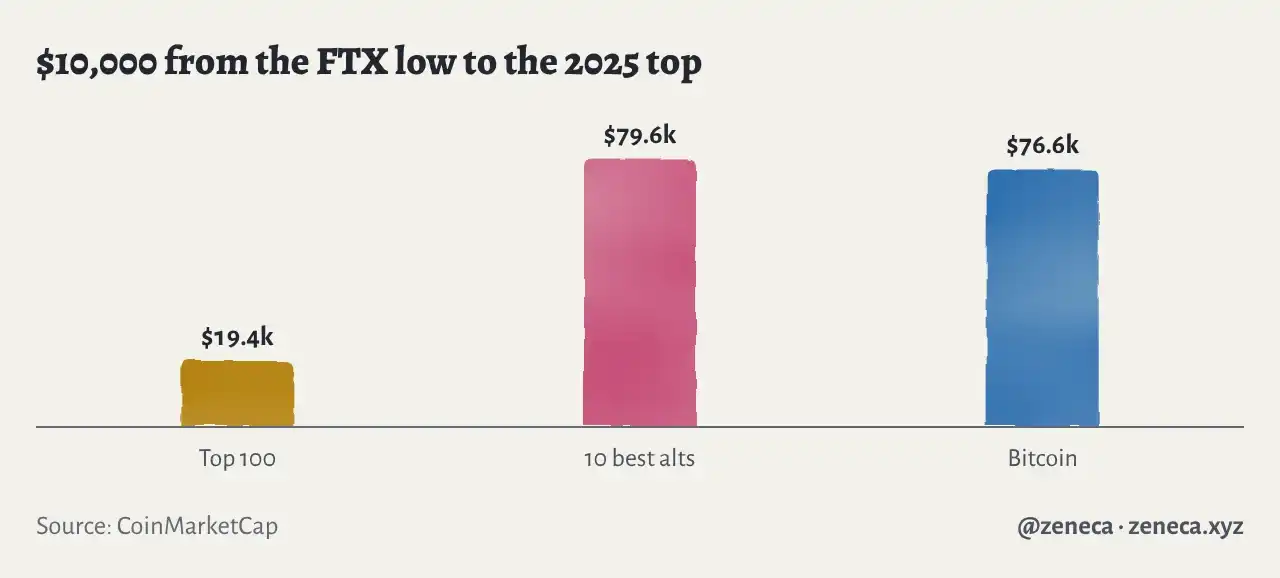
Zeneca opens with a thought experiment. If an investor had $10,000 on Nov. 20, 2022, roughly one week after the FTX collapse, and split it evenly across the top 100 tokens by market capitalization at $100 each, then held through the full cycle until total crypto market capitalization peaked on Oct. 6, 2025, that portfolio would be worth about $19,400. The same $10,000 placed only in Bitcoin would have grown to roughly $76,600.
He says three-quarters of the gains among the top 100 came from just 10 tokens, while the median token in that basket ended up worth $0.99 for every $1 invested. In other words, even buying near the bear-market bottom and holding to the cycle top still left more than half the basket underwater.
Cycle data shows a steady decline in broad altcoin payoff
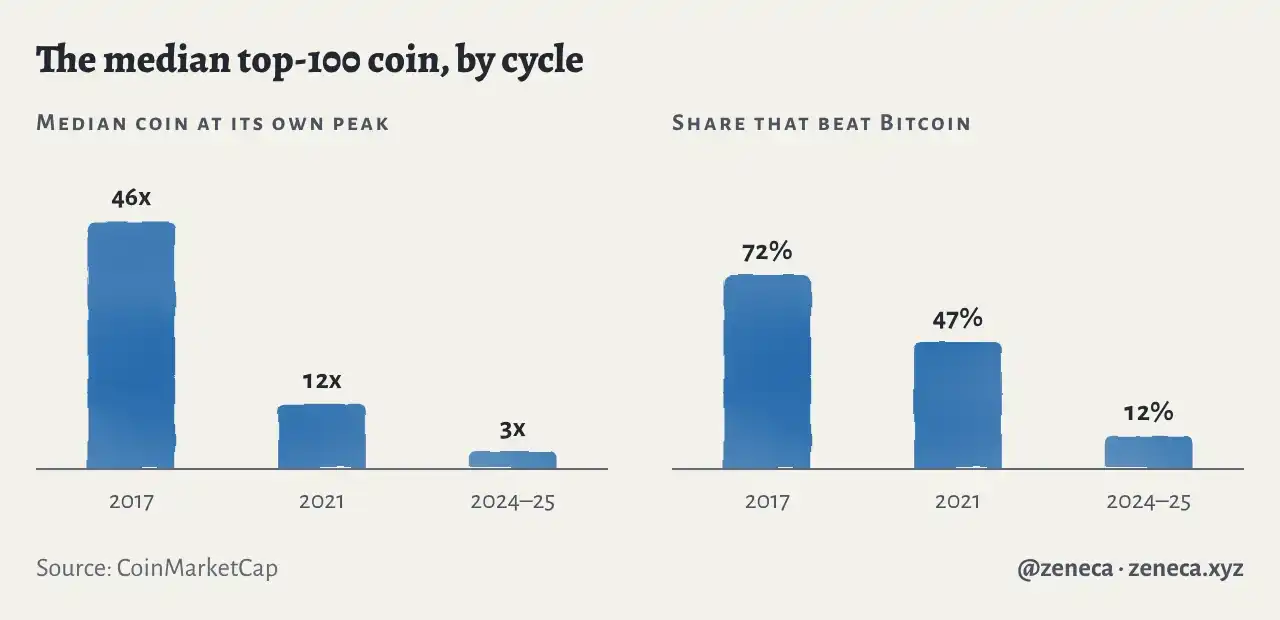
Zeneca argues that this was not always the case. In the 2017 cycle, he writes, the median top-100 token was up about 46x by the January 2018 peak, and most of those tokens outperformed Bitcoin. In that environment, buying a wide basket of coins from CoinMarketCap could work extremely well.
By 2021, the pattern was still visible but weaker. Median token performance was roughly in line with Bitcoin. By the 2024-2025 cycle, the median top-100 token had risen only about 3x even at its best point, only around one-eighth of the group beat Bitcoin, and most tokens had already topped in mid-2024, more than a year before the broader market peak.
That, in his view, explains why many investors felt their altcoin holdings had already peaked in early 2024 even while the wider market narrative still pointed to an ongoing bull run. He says most altcoins had in fact already topped, and the long-awaited "altseason" many were waiting for may never arrive in the same way again.
Chasing narratives has become harder too
Zeneca extends the same criticism to thematic rotation. He lists ICOs, DeFi summer, NFTs, alternative layer-1s, memecoins and AI agents as examples of sectors traders tried to enter early and exit before the crowd. That approach worked for a time, he says, but each wave produced fewer durable winners.
According to the article, only about one-tenth of the top 100 tokens from 2017 made new highs in the next cycle. The total memecoin market cap is now about one-fifth of its December 2024 peak, and he dismisses the NFT segment with a brief aside.
His broader point is that thousands of new tokens now launch every day, all competing for the same capital. That makes it harder for narrative-driven speculation alone to keep delivering the kind of returns traders once expected.
From the top looking down: a small group of tokens is separating from BTC
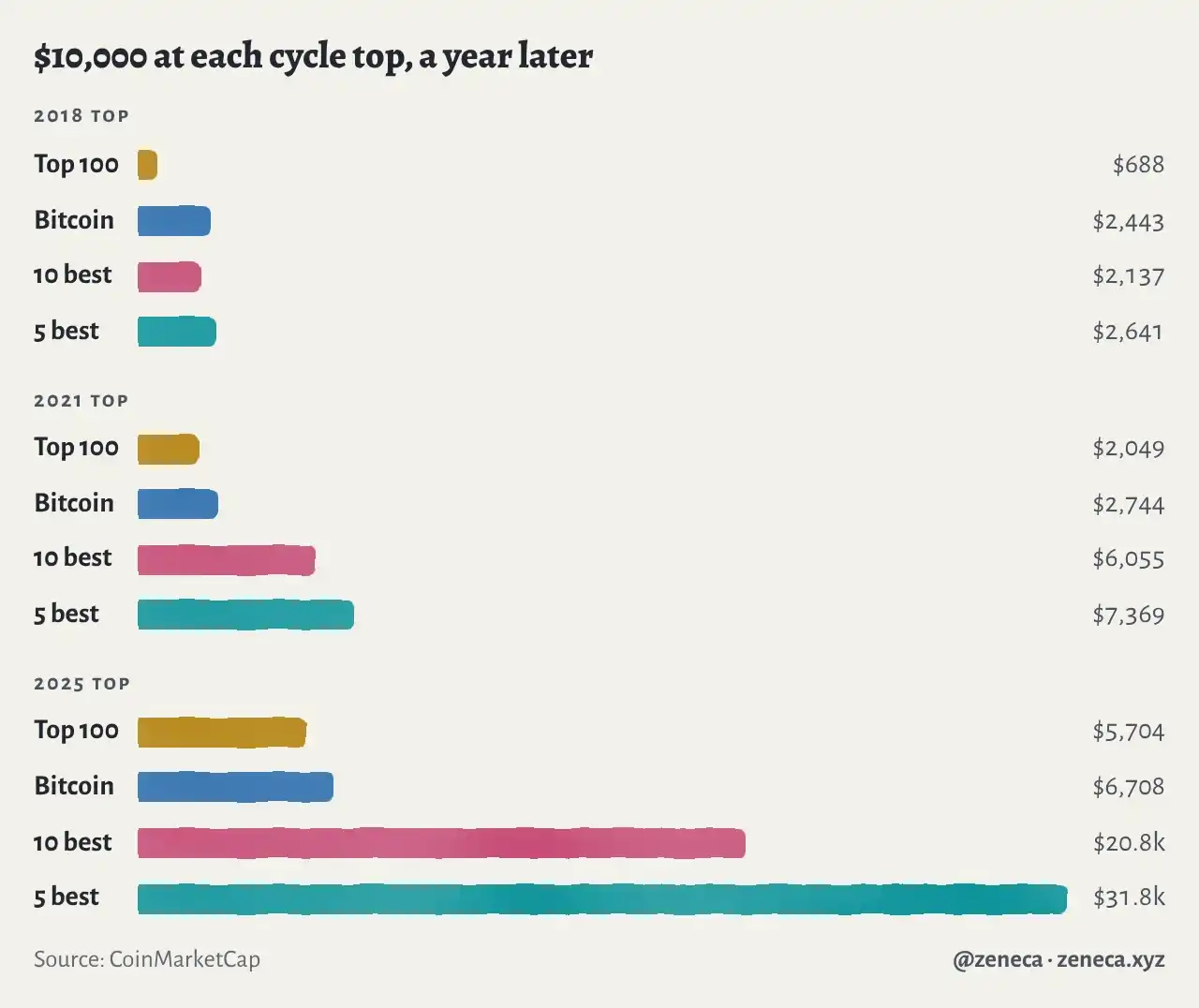
He also runs a reverse test from the last cycle top. If an investor had put $10,000 into an equal-weight basket of the top 100 tokens on Oct. 6, 2025, that portfolio would be worth about $5,700 at the time of writing, with only 6 of the 100 tokens in positive territory. A Bitcoin-only position from the same date would be worth about $6,700.
But the dispersion inside the basket was large. If an investor had somehow identified the 10 best performers and put $1,000 into them, the result would have been about $20,800. Putting $2,000 into the best five would have produced about $31,800.
Zeneca says he ran the same exercise for the previous two cycle tops, Jan. 7, 2018 and Nov. 8, 2021, using a one-year holding period. The trend, he writes, is clear: the best tokens are decoupling from BTC.
Why the broad-basket strategy is breaking down
His main explanation is token supply. There are simply too many assets competing for the same pool of money.
At the January 2018 peak, fewer than 1,400 tokens were listed on CoinMarketCap, he says. By the end of August 2026, Pump.fun alone was launching about 44,000 new tokens per day. Token count has expanded by orders of magnitude, while the number of buyers and the amount of capital have not kept pace.
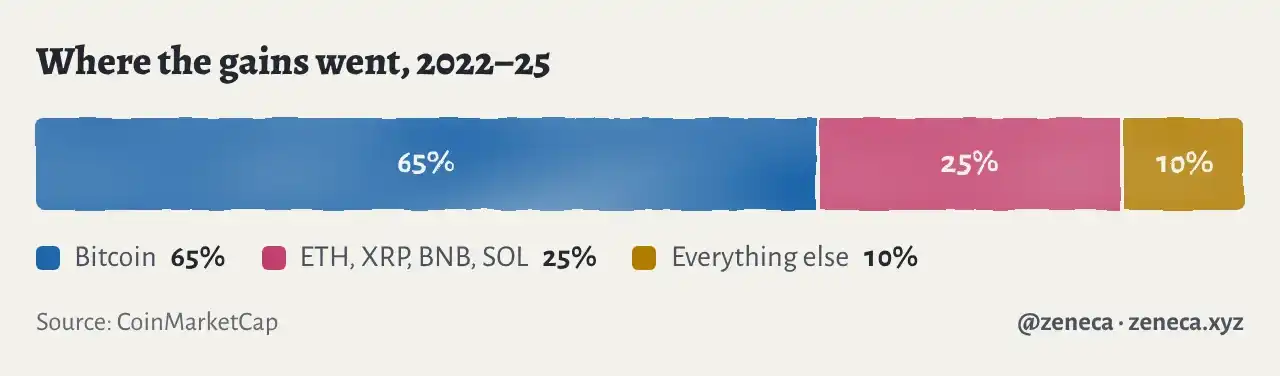
At the same time, most of the large inflows have gone to the biggest names. From the FTX low to the October 2025 peak, Bitcoin absorbed about two-thirds of new market capital, while ETH, XRP, BNB and SOL took about one-quarter. Everything else combined got only about one-tenth.
He argues that ETFs, treasury companies and funds do not buy crypto with a spray-and-pray mindset. They buy a small number of assets they can explain to their own investors, then hold them.
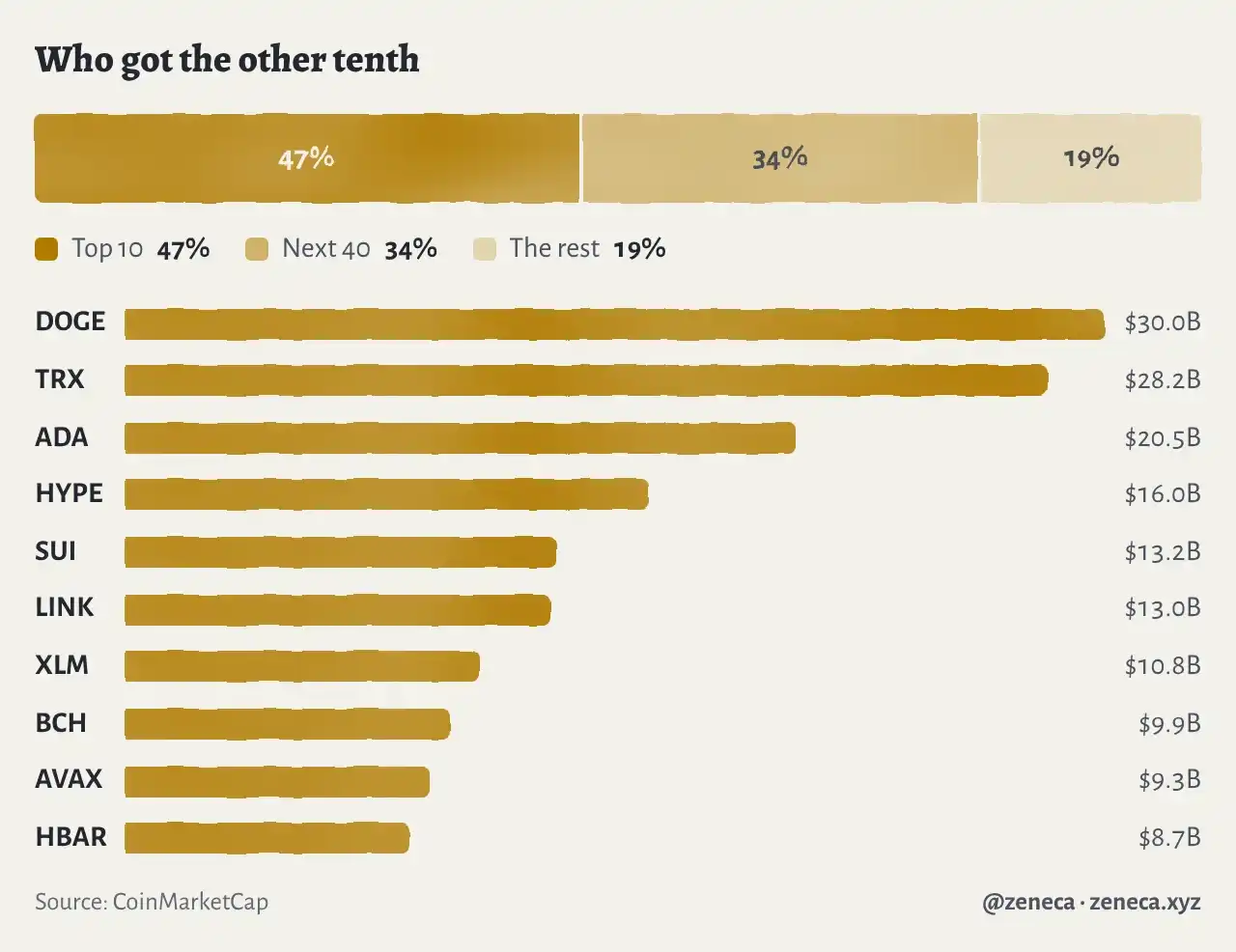
Even that final slice of gains outside the majors was concentrated. Ten tokens captured nearly half of it, mostly older names such as DOGE, TRX, ADA, LINK and XLM, with HYPE and SUI as the only notable newer entrants. Over the same period, the number of tokens listed on CoinMarketCap rose from about 21,800 to about 36,200, while Pump.fun issued millions more. In his telling, most new tokens got almost nothing.
The implication is blunt: if the next cycle looks anything like the last one, holding too many coins may simply guarantee exposure to a large pile of assets that go nowhere.
What is replacing it: real revenue, buybacks and burns
Zeneca says the market is starting to reward a different class of token: projects willing to spend real cash on their own token. In practice, that means buybacks and burns, plus a smaller set of models such as Aerodrome, which routes fees to locked-token holders.
These tokens have existed for years, he writes, but there are now many more of them, and the market response has been strong. Investors like owning tokens tied to protocols with real revenue, and they like them even more when part of that revenue is used to support the token and its holders.
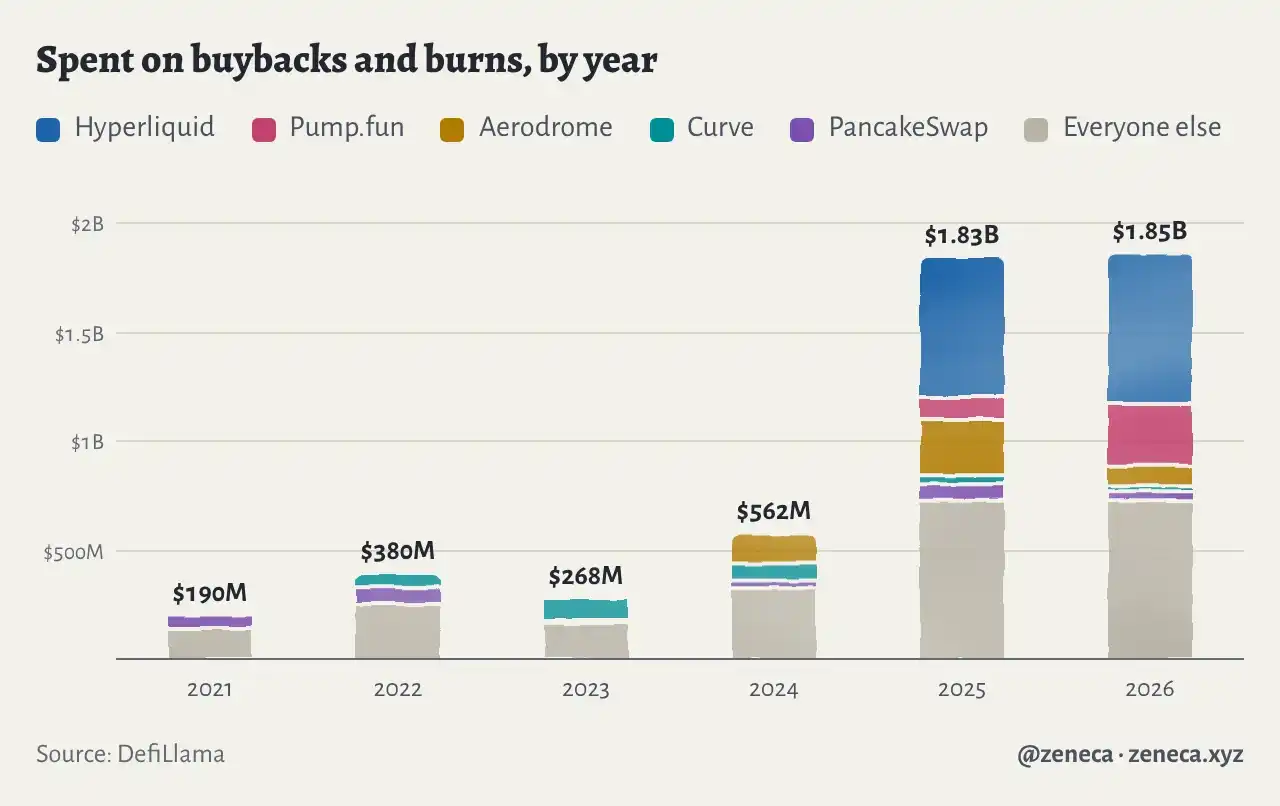
He cites figures showing annual token buybacks rising from about $190 million in the year through October 2021 to about $1.85 billion in the year through October 2026. The number of projects spending more than $1 million a year on buybacks rose from 10 to more than 70. He notes that DefiLlama has expanded protocol coverage over time, so part of the increase reflects better data collection, but he still sees the shift as substantial.
One detail stands out to him. Over the past year, total crypto market capitalization fell by more than one-third, yet the amount spent on buybacks and burns still edged higher. Prices fell sharply, cash kept coming in. For Zeneca, that is the core setup value investors look for.
He invokes Benjamin Graham’s line, often repeated by Warren Buffett, that in the short run the market is a voting machine and in the long run a weighing machine. For most of crypto’s history, he argues, there was little to weigh, so the market was dominated by memes, narratives and social-media strength. Now, for the first time, a meaningful part of the market can actually be weighed.
Applying Graham and Buffett to crypto
Zeneca frames his own approach in those terms: buy a small number of good projects that put real money into their own token, buy when they are cheap or when growth is not yet reflected in price, and hold for years.
He revisits Graham’s concept of Mr. Market, the emotional business partner who shows up every day with a different price. Investors do not need to transact with him every day; they only need to act when his quote becomes absurd. In crypto, Zeneca says, Mr. Market is especially emotional. From October 2025 to June 2026, the market fell by more than half, and those are the periods when good businesses can become attractive buys.
He also adapts Graham’s margin-of-safety idea. The closest thing he can find in crypto to a price-to-earnings ratio is market capitalization divided by the amount a project spends in a year buying back or burning its token. If a token is worth $1 billion and spends $50 million a year on buybacks, that implies a 20x multiple.
At the time of writing, he says, some of the best-run and largest projects, including HYPE, JUP, PENDLE and SKY, were trading at roughly 30x on that rough measure. He treats that as a useful benchmark rather than a precise rule.
He also cites Buffett’s refinement of Graham: it is better to buy a wonderful company at a fair price than a fair company at a wonderful price. The related lesson for crypto, in his view, is concentration with understanding. Own only a few tokens, and know each one well.
Which tokens actually beat Bitcoin
To test the framework, Zeneca compared all 100 tokens with market capitalizations above $300 million as of Oct. 11, 2026 against Bitcoin. He looked at one-year performance and also at performance since the FTX low, using the point when a newer token first crossed a $100 million market cap where needed.
Over the year through Oct. 11, 2026, Bitcoin was down by about one-quarter. Of the 93 tokens that already existed a year earlier, 37 outperformed BTC. The biggest outperformers were a mixed group: VVV rose about 16x, DRV about 14x, ZEC and XMR benefited from the privacy trade, HYPE more than doubled, and QNT, NEAR, JST and MORPHO also made the list, along with several newer small-cap names.
But the split becomes much clearer when he separates tokens with real buyback support from everything else. About 60% of buyback-backed tokens beat Bitcoin over one year, versus only about one-quarter of other tokens. Over the longer period, roughly half of the buyback group beat BTC, compared with about one-quarter of the rest.
He gives several examples. PUMP delivered about 2x Bitcoin’s one-year performance. SKY, UNI and RAY each came in at roughly 1.7x to 1.9x Bitcoin.
Still, buybacks are not a cure-all. CAKE and CRV have been buying back tokens for years, yet since the FTX low they still trailed Bitcoin by about 85% to 90%. BONK’s launchpad spent heavily on buybacks, but the token still lagged. The winners, he says, were usually growing, cheap relative to buyback spending, or both. Some of the biggest winners had no buyback at all, with ZEC as the clearest example.
The low-point examples he finds most telling
Zeneca highlights several moments when market pricing and business fundamentals diverged sharply.
- At PUMP’s low on June 25, 2026, the token’s entire market cap was about three times Pump.fun’s annualized buyback amount at the time. It later rose nearly 5x from that level.
- At AERO’s low in February 2026, market cap was less than three times one year of fees flowing to lockers. It later rose more than 3x.
- At HYPE’s low in January 2026, the token traded at about 11x annual buybacks. By October 2026 it was around 27x, and the token had risen about 4x.
- VVV bottomed near $0.95 on Dec. 1, 2025, when the token’s market cap was about $40 million and Venice was reportedly generating about $10 million in annual revenue. It later rose about 26x.
- RAY and UNI each climbed more than 3x from their lows, while SKY nearly doubled.
He stresses that these did not look like obvious opportunities at the time. PUMP’s best entry, for example, came while memecoins were fading, the market was in a bear phase and the founder was being sued. That is exactly the point of Mr. Market in his framework: the worst sentiment often produces the worst price, even when the business itself keeps operating.
How he separates a good business from a weak one
Zeneca then lays out the questions he asks, roughly in order.
Does it actually make money?
He means money from customers. Many networks issue new tokens worth far more than the revenue they generate. As of October 2026, he writes, Bittensor subnets were bringing in about $30 million a year from customers, while newly issued TAO was worth more than 10 times that amount. On his test, that does not pass.
How much of that money actually reaches the token and stays there?
This is where most tokens fail, he says. Fees are what users pay. Revenue is what the protocol keeps. Profit is what remains after team expenses, incentives and any new token issuance used to retain users. Only then can an investor see how much value really flows into the token.
Hyperliquid, he says, sends essentially all revenue to HYPE buybacks. Pump.fun uses about half its revenue to buy back and burn PUMP. Collector Crypt is, in his words, a very good business: in the year through October 2026, its gacha card packs generated about $94 million in revenue, but only about 1% of that went to buying back and burning CARDS.
He says he likes CARDS and sees it as a good business and a strong token, but revenue by itself is not enough. Investors need to know how much of that revenue becomes profit and how much of the revenue or profit is returned to the token ecosystem.
Where do the bought-back tokens go?
He says this point is often missed. Burned tokens are gone permanently. Tokens sitting in a treasury may come back later. Tokens distributed as rewards or cashback are often sold straight back into the market, which means buy pressure and sell pressure can offset each other.
Brave’s BAT buybacks, he writes, were used to pay ad viewers, most of whom sold, so he does not count that as a true buyback. Since September 2026, ether.fi has been sending one out of every two repurchased ETHFI directly to cardholders as cashback, and many of them may sell as well.
He still says he likes BAT and ETHFI, but when a project tells investors how much it spent on buybacks, he argues the next question should always be where those tokens ended up.
Will unlocks overwhelm the buybacks?
If teams and early investors are selling more tokens than buybacks remove from the market, the buyback loses much of its force. Pump.fun, he notes, will unlock nearly $40 million of PUMP per month for the team and early investors until mid-2029. That means a large share of its buyback program is effectively absorbing insider supply. Even so, he says, PUMP may still be a strong token, but the unlock schedule has to be part of the analysis.
Will it still be around in 2029?
If he plans to hold something for years, it has to survive bad years too. He repeats a line he often uses: the only requirement for doing well in this industry is surviving first. Not every survivor becomes a winner, but if a protocol survives, keeps growing, generates revenue and uses part of that revenue to support its token, the odds improve materially.
What about growth?
He argues that value investing is not just about buying cheap and dull assets. Buffett wrote in 1992 that growth is always a component in the calculation of value. In 1972, Buffett paid about three times book value for See’s Candies after Charlie Munger convinced him that a good business deserved a premium.
Zeneca applies the same logic to crypto. He is willing to pay a higher multiple for growth if the growth is real and not already fully priced in. His example is Derive, which he says handles most onchain options activity. Open interest in early October 2026 was more than 10x the level a year earlier, and after a vote in October 2026, half of protocol fees began buying DRV every week.
Even so, at around $0.48, DRV was valued at more than 100x trailing annual revenue, far above the roughly 30x level he associates with the best-run tokens. His way to test whether growth is already priced in is to work backward from the valuation. For DRV to trade at around 30x while still using half of fees for buybacks, Derive would need to grow fees to roughly four to six times recent levels. If that happens within a few years, DRV may still look cheap in hindsight. If not, investors are paying a growth-stock multiple for something that has already stopped growing.
ZEC is his exception
ZEC is the clear exception in the essay. By his own framework, Zcash breaks almost every rule he has laid out. Zcash generates less than $1 million a year in fees, none of which flows to the token, while newly issued ZEC is worth hundreds of millions of dollars per year.
He acknowledges that Buffett would dislike that setup. The article cites Buffett’s 2011 letter on gold producing nothing and his 2018 remark calling Bitcoin "probably rat poison squared."
Still, Zeneca says Bitcoin is the obvious store-of-value asset, and if the goal is simply to park money somewhere for the long term and sleep well, BTC is a sensible choice. His own goal, though, is to outperform Bitcoin. For the store-of-value sleeve of that plan, he chooses ZEC.
His reasoning is that Zcash largely shares Bitcoin’s monetary rules, including a 21 million cap and four-year halvings, while adding an optional privacy mode. As more money moves onto public blockchains, he believes privacy will become more valuable.
He does not hide the risk. With no cash flow, the price is based entirely on belief. But he adds that Bitcoin has also long relied on belief, and he sees the meme strength around ZEC as strong enough to justify holding it.
Where the thesis could fail
Zeneca lists several ways the strategy could go wrong.
The market’s voting-machine behavior could keep winning for a long time. If the next cycle looks like the memecoin frenzy of 2021, a small group of boring buyback tokens could underperform while assets with no revenue at all go up 50x. He says he can live with that, but it is part of the trade-off.
Paying up for growth can also fail if growth stalls, which is why he would size those positions smaller than positions in tokens already buying back large amounts of their own supply.
Buybacks themselves can stop. If a team or DAO decides to start a buyback, it can also decide to end one, as he says happened with Aave and Sky. Investors usually have no legal claim on protocol revenue either.
His plan for the next bull market
He closes with a practical outline:
- Hold a small number of tokens backed by real businesses, plus a bag of ZEC as a store-of-value position.
- Only buy when he can explain in one sentence how money moves from customers into the token, and when he can track where bought-back tokens go afterward.
- Check unlock schedules against buyback amounts before buying.
- Compare price with buyback spending.
- Pay a premium for growth only when growth is visible in fees and the assumptions embedded in price are clear.
- Write down the conditions that would trigger a sale before entering the position, then keep holding as long as those conditions do not occur.
- Build positions slowly and let Mr. Market’s bad days do the work.
- Measure the portfolio against simply holding Bitcoin, because that is the benchmark he is trying to beat.
Final note: accept the missed opportunities
Zeneca ends by saying investors will never catch every opportunity, and should not try to. Many good projects and good tokens will never make it into his portfolio. Some of them will go up 10x while he sits in a handful of duller names. He says that is fine.
He would rather own a few things he truly understands and believes in, put real money behind them and give them time, than own a little bit of everything without knowing why. His advice is to find the few positions one can hold through a 60% drawdown because the underlying project still makes sense, and accept that many other opportunities will be missed.
He adds that his next letter will go into his actual portfolio and allocation, then break down the tokens he likes most and why, using business fundamentals as the lens.
The article ends with a disclaimer that the newsletter should not be treated as investment advice, that the author is not a financial adviser, and that readers should consult a professional or licensed adviser before trading or investing in crypto-related products. Some links, he says, may be referral links.