

After Zhipu AI's stock revaluation, the market has been attempting to infer Anthropic's valuation from Zhipu's sharp rise. Zhipu CEO Zhang Peng explicitly stated that the company's commercialization path is fully benchmarked against Anthropic. A few months ago, Anthropic completed a $65 billion funding round, with a post-money valuation of approximately $965 billion. Now, as Zhipu's market cap surpasses one trillion, the market is looking for a valuation link between the two.
The Valuation Anchor of Zhipu's Surge: Revenue Base and Scarcity Premium
According to SCMP, Zhipu's 2025 revenue was 724.33 million yuan, up 131.9% year-on-year, with total losses of 4.72 billion yuan and adjusted net losses of 3.18 billion yuan. Its revenue base is low and losses remain large. The significant market cap revaluation in 2026 trades not only on the current income statement but also on progress in domestic large model capabilities, the substitution imagination brought by access restrictions to overseas models like Claude Fable and Mythos, the scarcity of AI targets on the Hong Kong stock market, and the amplification effect of public market liquidity on hot assets.

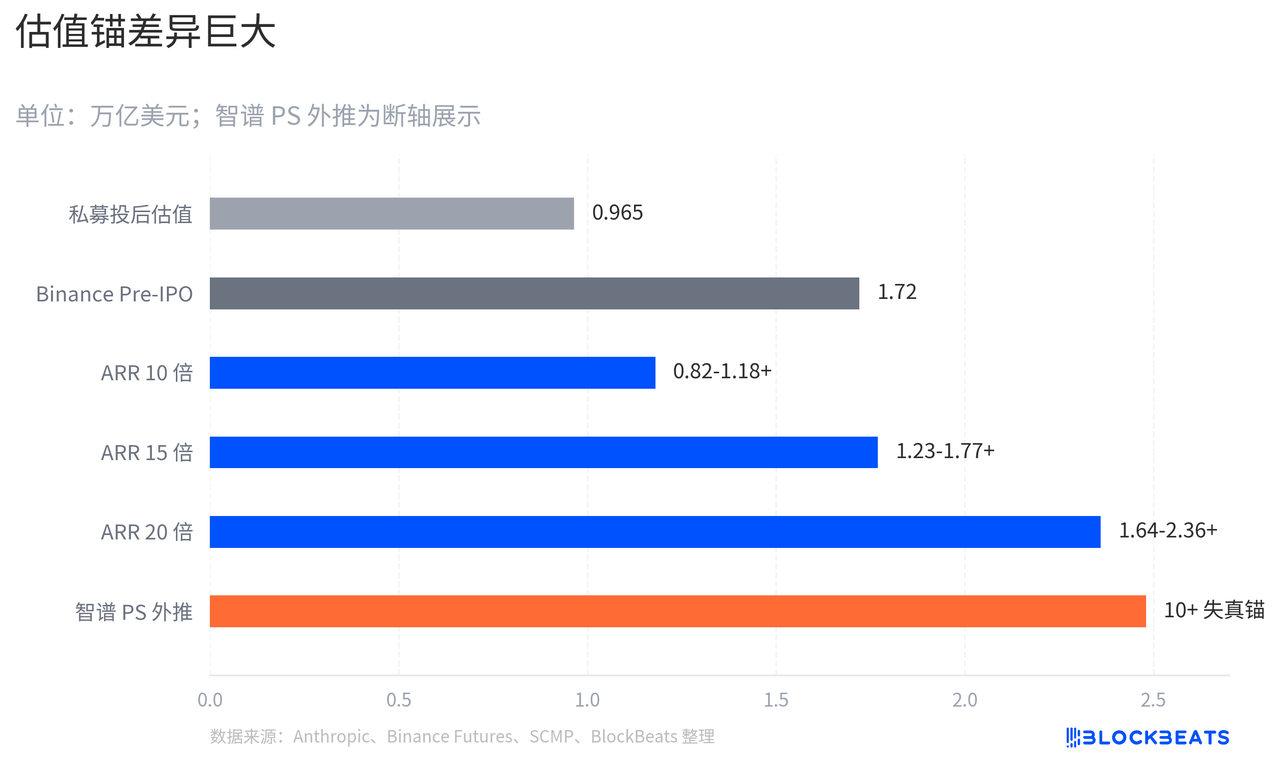
Based on Zhipu's roughly $100 million revenue, its market cap once corresponded to hundreds of times PS, far exceeding traditional high-growth software companies. Applying this multiple to Anthropic: if its annualized revenue exceeds $30 billion to $47 billion, the theoretical valuation would enter the tens of trillions, far beyond the current private market price.

On-Chain Pre-IPO: A Thinly Traded Price
Anthropic's pre-IPO assets trade on Binance Futures. The ANTHROPICUSDT contract launched on June 2 uses 1 billion shares as an estimated share count, with a clear disclaimer that it is for reference only and does not endorse a real share count. As of June 22, the contract price was approximately 1,718 USDT, implying a total market cap of about $1.72 trillion. However, the contract's 24-hour volume was only $1 million, indicating extremely poor liquidity.
While this price is closer to reality than the $10 trillion figure, it does not represent the true clearing price of common stock.
ARR Multiple Framework: More Plausible but Conditional
The key variables for AI companies are sustained high revenue growth and declining costs. For large model companies, if inference costs (computing power, electricity, chip depreciation, and cloud resources per call) do not drop quickly, higher revenue may mean higher cash burn. Therefore, ARR (annualized recurring revenue) and gross margin are more important than revenue alone.

A simple formula: Anthropic's ARR multiplied by a revenue multiple, adjusted for gross margin and cloud costs. Offshore buyers' consensus for the combined ARR of Anthropic + OpenAI by end of 2026 is $140 billion to over $200 billion. If Anthropic maintains its roughly 59% revenue share, its ARR would be approximately $82 billion to over $118 billion. At 10x ARR, that implies $820 billion to $1.18 trillion; at 15x, $1.23 trillion to $1.77 trillion; at 20x, $1.64 trillion to $2.36 trillion.
The market's willingness to give a near-trillion private valuation essentially bets on three things: continued growth in enterprise and developer demand for Claude, high-quality revenue from agent and code assistant scenarios, and sufficiently fast declines in inference costs to bring gross margins closer to software company levels.

No Single Method Provides the Answer
Returning to the original question: all three methods—the Zhipu benchmark, the pre-IPO contract, and the ARR multiple—can produce numbers, but none can stand alone. Zhipu provides an emotional ceiling—$10 trillion is clearly distorted; Binance gives a transaction price—$1.72 trillion is closer to reality but lacks liquidity; the ARR multiple is relatively more reliable but still just a framework.

Whether Anthropic's post-IPO valuation can hold depends on several conditions aligning simultaneously: continued high revenue growth, stable recurring demand from enterprises and developers, high-quality revenue from agents and code assistants, and sufficiently fast declines in inference and cloud costs. If all these conditions hold, a valuation near or exceeding $1 trillion has support; if any one falters, the market will reprice Anthropic rather than cling to a single attractive valuation anchor.