

HashKey Global
14 hours agoNews Editor

HashKey Global to revise trading fee schedule on Dec. 2, 2026

HashKey Global said it will adjust its trading fee schedule starting at 8:00 a.m. Beijing time on Dec. 2, 2026. Under the update, new standards will apply to the trading volume requirements for each VIP tier as well as the corresponding fee rates. The exchange said order fees will be calculated based on the actual fee rate in effect at the time of execution. It also noted that the latest fee schedule should be checked on the official Fees page. The notice did not include the revised fee table in the brief announcement provided by Techub News.

10
HashKey Global to revise trading fee schedule on Dec. 2, 2026
South Korea
14 hours agoNews Editor

South Korea industry minister outlines KRW 1,600 trillion plan spanning semiconductors, AI data centers and physical AI

South Korea’s Minister of Trade, Industry and Energy, Kim Jeong-gwan, said on Nov. 2 in Seoul that the government plans to link three major projects — semiconductors, AI data centers and physical AI — into what he described as a national growth platform, according to Yonhap News Agency. The combined investment plan for the three projects totals about KRW 1,600 trillion, which he said is roughly 60% of South Korea’s GDP in the year the projects begin. Kim also said the government will push to shorten the time needed for semiconductor factories to begin operations by at least two years through one-stop permit approvals and by drafting a "Special Act on Ultra-Wide Special Zones." In the same remarks, he presented four implementation strategies under the acronym M·E·G·A: concentrating national capabilities, encouraging participation from all economic actors, creating new growth drivers and expanding the impact of the results.

00
South Korea industry minister outlines KRW 1,600 trillion plan spanning semiconductors, AI data centers and physical AI
Supreme People's Procuratorate
14 hours agoNews Editor

China’s top prosecutors cite two crypto-linked personal data trafficking cases

China’s Supreme People’s Procuratorate has released a set of typical cases on the lawful protection of citizens’ personal information, including two cases tied to the crypto sector. In the first case, 11 defendants led by a man surnamed Wang built a chain that linked domestic buyers, overseas data sources, and domestic resale channels. They used virtual currency to pay overseas suppliers for personal data, then resold information including household registration details, property status, and location traces inside China. The amount involved exceeded 1.98 million yuan. The court sentenced the defendants to prison terms ranging from three years and six months to eight months, along with fines. In the seventh case, 21 defendants led by Lin Moufeng illegally obtained more than 870,000 job applicants’ personal records through online recruitment platforms and by bribing corporate human resources staff, then sold the data overseas. Illegal proceeds were settled in virtual currency and later converted into renminbi. The amount involved exceeded 7.46 million yuan. The court handed down prison terms ranging from five years and three months to six months and ordered the defendants to bear civil liability including compensation for public interest damage.

00
China’s top prosecutors cite two crypto-linked personal data trafficking cases
Market Analysis
14 hours agoNews Editor

Charlie Bilello data shows wide drawdown gaps across major assets

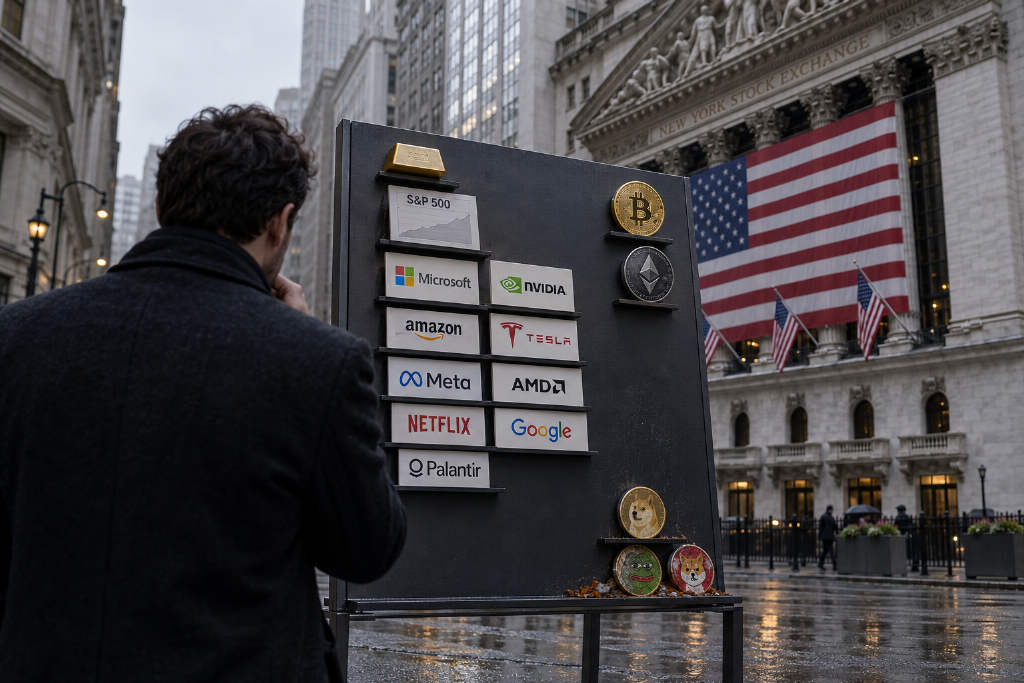
Data cited by ChainCatcher and published by Creative Planning Chief Market Strategist Charlie Bilello showed a sharp split in how far major assets have fallen from their all-time highs. The S&P 500 was down 3%, while Microsoft had fallen 6%. Palantir, Nvidia, Amazon, Tesla, Meta and AMD were each down between 14% and 24% from their peaks. The list also showed deeper pullbacks in several other assets. Gold was down 31%, Alphabet was down 32%, SpaceX had fallen 41%, and Netflix was down 54%. In crypto, Bitcoin was down 39% from its high and Ether had dropped 55%. Meme coins posted the steepest declines in the dataset, with Dogecoin down 90%, Fartcoin down 95%, TrumpCoin down 98%, and MelaniaCoin down 99%.

10
Charlie Bilello data shows wide drawdown gaps across major assets
Hyperliquid
14 hours agoNews Editor

Hyperliquid Sends 2.5247 USDC to Assistance Fund as Market Watches for Second Reserve Yield Settlement

On-chain data shows that an address tied to reserve yield for Hyperliquid’s AQAv2 transferred 2.5247 USDC to the Assistance Fund at 00:00 UTC on Nov. 2, according to ChainCatcher. The small transfer resembles a pattern seen last month before a larger reserve-yield payment arrived, drawing attention to the possibility that a second USDC reserve-yield settlement may be near. Market estimates cited in the report suggest the current round of reserve yield could exceed $15 million. Based on an HYPE price of about $83, that would translate into potential buyback capacity of roughly 180,000 HYPE. The report also noted that Hyperliquid’s first USDC reserve-yield payment, worth about $14.58 million, arrived in early October and was used to support HYPE buybacks. For now, the second large transfer has not yet arrived. The final amount of funds and the eventual scale of any buyback remain unconfirmed.

40
Hyperliquid Sends 2.5247 USDC to Assistance Fund as Market Watches for Second Reserve Yield Settlement
SK hynix
15 hours agoNews Editor

KB Securities sees SK hynix topping 100 trillion won in Q4 operating profit

KB Securities said in a Nov. 2 report that it expects SK hynix to post 104 trillion won in operating profit for the fourth quarter of 2026, up 441% from a year earlier, which would mark the company’s first time above the 100 trillion won threshold in a single quarter. The brokerage kept its Buy rating and a target price of 3.5 million won. The report said profit growth would be driven by a 24% quarter-on-quarter increase in DRAM bit shipments, a 5% rise in NAND bit shipments, continued gains in average selling prices, and a product mix shift in which HBM4 sales are expected to overtake HBM3E. KB also forecast full-year operating profit of 285 trillion won in 2026 and 470 trillion won in 2027. SK hynix’s third-quarter results, released on Oct. 28, underpinned that view. The company reported revenue of 104.6 trillion won, operating profit of 83.3 trillion won, and an operating margin of 80%, all at record levels. Management also said it had signed long-term supply agreements with 14 customers, including major global cloud service providers, covering more than 50% of total capacity for 2027 and 2028.

00
KB Securities sees SK hynix topping 100 trillion won in Q4 operating profit
Hyperliquid
15 hours agoNews Editor

Hyperliquid, Fragment and Stripe deals point to a revenue-first turn in crypto

A long-form article translated by TechFlowPost from The Token Dispatch argues that crypto startups are moving away from the old playbook of venture funding, token launches and user subsidies, and toward businesses built on real revenue. The piece points to Hyperliquid generating nearly $1 billion in trading fees over the past 12 months without raising money from venture capital firms, and Telegram-owned Fragment posting more than $350 million in net revenue from auctions for anonymous numbers and usernames without issuing a token or selling equity to VCs. It also cites Stripe’s $1.1 billion cash-and-stock acquisition of stablecoin platform Bridge as a sign that fintech and crypto are converging around cash-flow businesses rather than token speculation. Drawing on 1kx’s 2026 blockchain revenue report, which tracked more than 2,600 crypto protocols and 100 public companies, the article says investors are increasingly valuing tokens based on actual distributions, buybacks and fee-sharing. It also argues that distribution has become the new center of value capture, with platforms such as Coinbase, Robinhood Chain and Hyperliquid’s HIP-3 ecosystem taking a larger share of economics tied to user access.

10
Hyperliquid, Fragment and Stripe deals point to a revenue-first turn in crypto
Kalshi
14 hours agoNews Editor

Kalshi raises another $1 billion at a $40 billion valuation as growth collides with legal pressure

Kalshi has closed a $1 billion Series G round at a $40 billion post-money valuation, less than six months after its previous billion-dollar financing. The round was led by Sequoia Capital and Wellington Management, with Baillie Gifford, Morgan Stanley Investment Management, Coatue Management and Andreessen Horowitz also participating. Founder Tarek Mansour said the valuation was tied to roughly $4 billion in annualized gross revenue, implying about a 10x price-to-sales multiple, and said the new capital will be directed toward leveraged event contracts, single-stock perpetuals and compute-price markets. The company also released fresh operating metrics, saying annualized trading volume has surpassed $1 trillion and registered accounts have topped 30 million. Kalshi reported $140 billion in annualized crypto volume, more than $8 billion in annualized political volume, and $83 billion in cumulative perpetuals volume since launch, with more than 500,000 traders. At the same time, the company faces scrutiny over some of its reported crypto trading data, intensifying competition with Polymarket, and a widening legal fight over whether its sports event contracts fall under federal commodities law or state gambling rules. In Utah, state prosecutors have brought criminal charges and a civil recovery action, while the CFTC has sued in federal court to block the state from acting against prediction markets.

40
Kalshi raises another $1 billion at a $40 billion valuation as growth collides with legal pressure
Total 233 items
Go topage