0DTE

Bitcoin
2026-08-19 00:39:46

Bitcoin Volatility Nears Record Low as Trading Flows Shift to AI Stocks, Prediction Markets

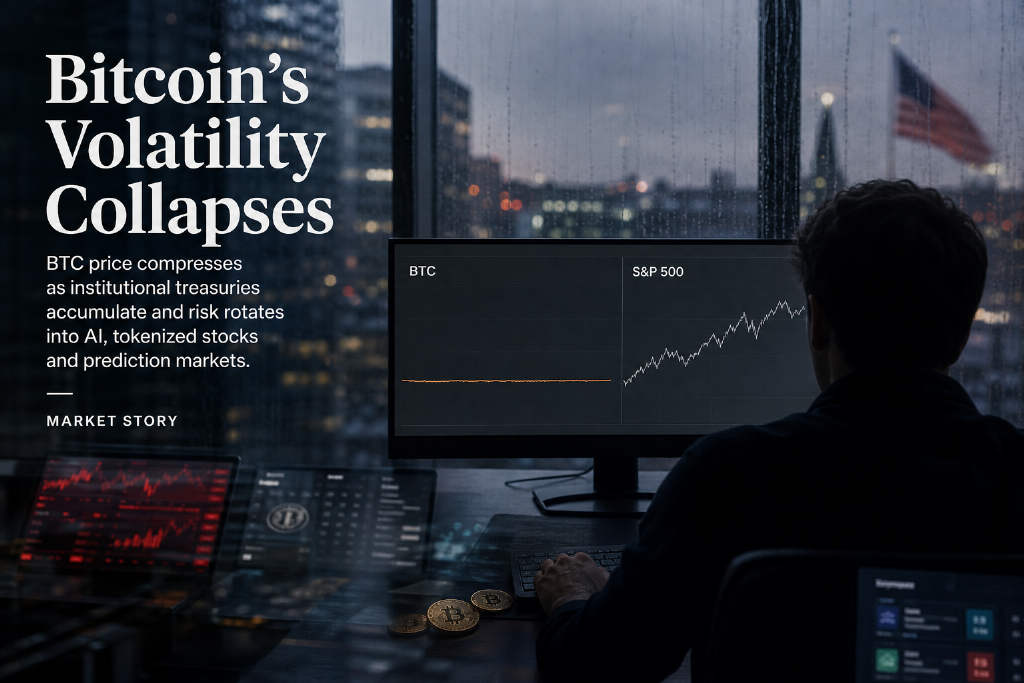
According to CoinDesk, Bitcoin’s 30-day realized volatility has fallen to an annualized 42%, narrowing the gap with the S&P 500’s 18% to the smallest level on record. Traders interviewed in the report point to retail rotation into AI stocks, tokenized equities and prediction markets, while institutional ETF and DAT activity, low open interest, and pending U.S. regulatory clarity continue to shape the market. Monarq’s Shiliang Tang said Bitcoin is stuck in a price standoff, with corporate treasury selling limiting the upside and long-term accumulation helping cap the downside. B2C2’s Edmond Goh and Wincent’s Paul Howard both described a market that is quieter, more mature and less volatile than before. NYDIG’s Greg Cipolaro said the search for 5x or 10x returns has broadened well beyond crypto. The report also notes sharp drops in Korean retail trading on Upbit and Bithumb, alongside rising volume in prediction markets and perpetuals tied to traditional assets.

550
Bitcoin Volatility Nears Record Low as Trading Flows Shift to AI Stocks, Prediction Markets
Bitcoin
2026-08-05 09:21:00

Bitcoin Holds Near $64,000 as Kalshi Bets Tilt Below $60,000 and Burry Warns on U.S. Stocks

Bitcoin traded in a tight range around $64,000 after briefly touching about $64,500, with traders watching U.S. nonfarm payrolls, progress on the Clarity Act, and developments tied to a temporary Hormuz Strait agreement. On-chain data cited in the report showed roughly 155,000 BTC changed hands between $62,000 and $65,000, while Glassnode said about 515,000 BTC last moved near $63,000 and another 362,000 BTC near $61,000. The report also noted that spot price is sitting close to the 200-week moving average around $63,700, pointing to a key support area. Options markets remain calm for now. Bitcoin’s 30-day implied volatility has dropped to 36%, the lowest level since late May, even as traders on Kalshi increased bets on a move below $60,000 this month, with more users also positioning for $57,500 and $55,000. CryptoQuant analyst Axel Adler Jr. said Bitcoin has a 55% probability of trading between $58,000 and $67,000 in August, versus a 30% bearish scenario and a 15% bullish one. The report also reviewed U.S. equity futures, crypto-related stocks, Michael Burry’s renewed warning that the stock market may be near a major top, and a series of upcoming earnings and token unlocks that traders are tracking.

1340
Bitcoin Holds Near $64,000 as Kalshi Bets Tilt Below $60,000 and Burry Warns on U.S. Stocks
Microsoft
2026-07-31 04:28:00

Microsoft earnings lift Wall Street as AI spending fears ease, chips and memory stocks jump

Wall Street rebounded sharply after the prior session’s sell-off, with Microsoft’s earnings report becoming the session’s main catalyst. The company’s Azure cloud business grew 43% at constant currency, ahead of expectations, while lower-than-expected capital spending and a commitment to positive cash flow in fiscal 2027 helped calm concerns that AI investment was becoming too costly. Microsoft shares surged 15.51%, adding about $450 billion in market value in a single day. The move helped drive the Dow up 1.19%, the S&P 500 up 1.66%, the Nasdaq up 2.78%, and the Nasdaq 100 up 3.36%, while the VIX fell 17.33% to 17.08. Semiconductors and memory names led the rally, with the Philadelphia Semiconductor Index rising 8.19% and the Roundhill Memory ETF climbing nearly 17%. At the same time, traders continued to monitor Middle East developments, a possible OPEC+ output increase of 188,000 barrels per day in September, and sharp currency moves in Japan and South Korea. Market participants are also watching several near-term events, including the Trump administration’s AI regulatory framework deadline on Aug. 1, South Korea’s July export data, and the Aug. 2 OPEC+ meeting.

1250
Microsoft earnings lift Wall Street as AI spending fears ease, chips and memory stocks jump
On-chain opti
2026-07-26 09:50:55

On-chain options revive as market structure shifts from complexity to specific user demand

On-chain options are re-emerging after several cycles of failed experiments, but the new wave looks very different from the first DeFi options push. The report cited in the article argues that the sector is moving away from passive liquidity pools, generalized AMMs and overly complex retail-facing products, and toward market structures built around central limit order books, request-for-quote systems, cross-margining and clearer user segmentation. Platforms such as Derive, Rysk and Aevo illustrate that shift in different ways: Derive is positioning itself as a professional venue for sophisticated volatility traders, Rysk is packaging options into yield-oriented products such as covered calls and cash-secured puts, and Aevo is offering options inside a broader unified-margin derivatives exchange. Beyond vanilla venues, the piece also maps out adjacent categories including perpetual options, AMM-native options, short-dated touch options and binary-style markets that overlap with prediction markets. The broader argument is that infrastructure alone does not create demand. For on-chain options to grow, teams need products that solve concrete problems for asset holders and traders in ways that perpetual futures or prediction markets cannot easily replicate.

1590
On-chain options revive as market structure shifts from complexity to specific user demand
Pantera Capit
2026-07-11 11:04:10

Pantera Capital says Hyperliquid sits at the center of a shift as perpetuals move into mainstream finance

Pantera Capital argues that perpetual futures are moving well beyond their crypto-native roots and into the core of global market structure, with Hyperliquid emerging as one of the clearest on-chain expressions of that trend. In a lengthy note, the firm says recent moves by the U.S. Commodity Futures Trading Commission mark an important change in Washington’s stance, opening a path for regulated crypto perpetuals under the existing futures framework rather than requiring a brand-new rulebook. The report traces the appeal of perpetuals to their simpler design: no expiry, funding-based price anchoring, easier position management, and round-the-clock trading. Pantera says those traits made digital assets the natural proving ground, citing 2025 centralized exchange perpetual volume of $62 trillion versus roughly $19 trillion in spot volume and $86 trillion in total derivatives volume. Hyperliquid is presented as the main on-chain winner so far. Pantera says the protocol accounts for about 40% of decentralized perpetual volume, with monthly volume above $250 billion and annualized revenue of $800 million. The firm also points to Hyperliquid’s expansion beyond crypto into equities, commodities, indexes, and private companies, alongside growing attention from hedge funds, exchange operators, and public-market vehicles tied to HYPE. At the same time, Pantera flags regulation as the biggest unresolved risk, especially for a permissionless venue without KYC. Its broader argument is that the market has already answered whether perpetuals matter outside crypto; the open question is whether blockchain-based infrastructure can become a major venue for pricing risk across other parts of finance.

1180
Pantera Capital says Hyperliquid sits at the center of a shift as perpetuals move into mainstream finance