SpaceX2026-08-05 06:07:28SpaceX posts stronger-than-expected Q2 revenue, takes $540 million paper loss on Bitcoin holdingsSpaceX reported its first quarterly earnings since going public, with second-quarter 2026 revenue reaching $7.8 billion, ahead of Wall Street estimates of $6.9 billion. The company said net loss narrowed to $541 million from $1 billion a year earlier, while adjusted EBITDA climbed to $3.5 billion, nearly triple the prior-year period. SEC filings showed SpaceX did not sell any Bitcoin during the quarter and still held 18,712 BTC as of June 30. But the value of those holdings fell with the broader crypto market. The carrying value of its Bitcoin position dropped from $1.64 billion at the end of 2025 to $1.1 billion, leaving the company with an unrealized loss of about $540 million. Capital expenditure reached $18.4 billion, above analyst expectations of $13 billion, which the company attributed mainly to heavier investment in artificial intelligence infrastructure. After the earnings release, SpaceX shares fell about 6% in after-hours trading to $118, after gaining nearly 10% during the regular session.1730
S&P 5002026-08-04 10:10:34S&P 500 earnings rise 14% above long-term trend, giving valuations firmer supportA market earnings revision report compiling data from several institutions says S&P 500 earnings per share are running about 14% above a trend channel built from more than 90 years of history, the first such deviation since 1955. The report argues that unusually strong profit growth, a high share of earnings beats, stronger-than-expected sales, and continued upward analyst revisions are helping justify elevated U.S. equity valuations. Public data points cited in the article show some variation in second-quarter growth estimates. FactSet on July 2 projected S&P 500 earnings growth of 23.3% year over year, Axios cited a FactSet figure of 22.5%, and Bloomberg put the number at about 25%. The article says the most accurate public-range description is therefore roughly 23% to 25%, while the report’s 33.2% figure may reflect a different cut of the data. The piece also says earnings strength is no longer confined entirely to mega-cap technology names. FactSet data dated July 20 showed Q2 blended earnings growth of 24.7% for the S&P 500 and 22.8% for the 493 companies outside the “Magnificent Seven.” Even so, large tech and semiconductor names remain major drivers. The report concludes that stronger earnings can support valuations, but they also raise the bar for companies heading into earnings season.1730
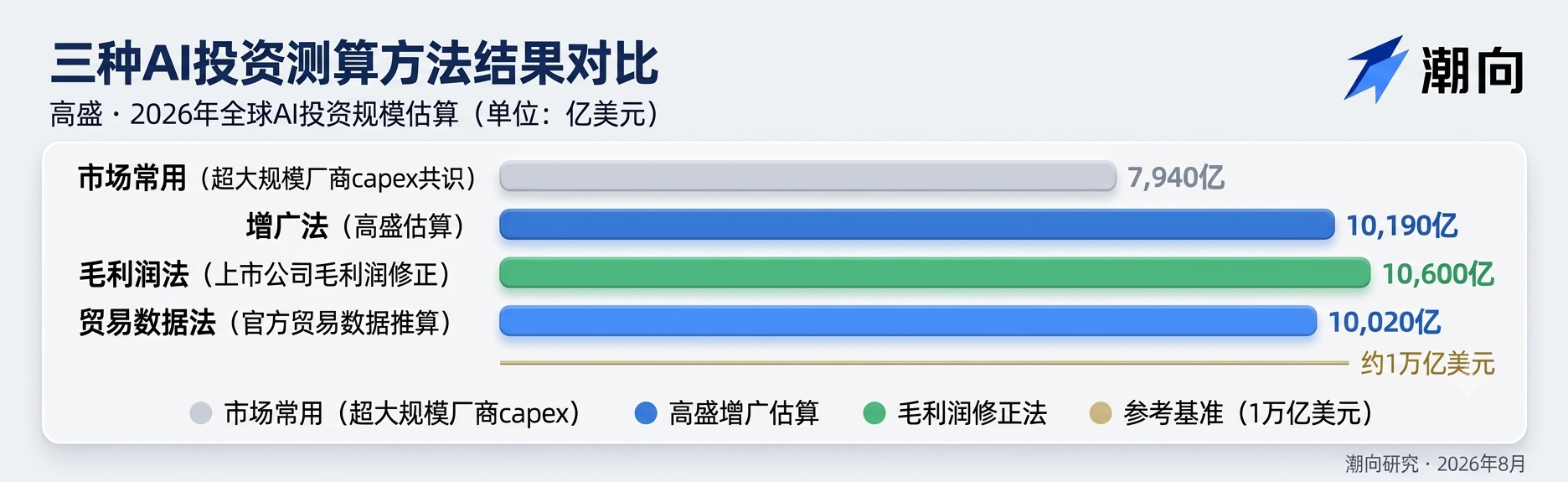
Goldman Sachs2026-08-04 02:32:35Goldman Sachs Puts 2026 Global AI Investment at $1.019 Trillion, Above the Market’s $800 Billion BenchmarkGoldman Sachs said in an Aug. 2 global economics report that the market’s commonly cited $800 billion figure for 2026 hyperscaler capital expenditure understates the scale of worldwide AI investment and overstates how much of that spending is actually taking place in the United States. After adjusting for private companies, non-U.S. firms, pre-existing spending and the geographic split of projects, the bank estimated 2026 global AI investment at roughly $1.019 trillion, including about $581 billion in the U.S. The report said the widely used benchmark misses around $200 billion of global AI investment while overstating U.S. domestic AI investment by roughly the same amount. Goldman also used two separate cross-checks — one based on forecast revisions to gross profits at AI-related listed companies, and another based on national accounts and trade data — and said the results converged around the same conclusion: global AI investment is nearing $1 trillion and U.S. AI investment is close to $600 billion. Looking ahead, Goldman expects AI investment to rise as a share of GDP. It projected the ratio for the U.S. at 1.8% in 2026, 2.5% in 2027 and 2.8% in 2028. For the world economy, it forecast 0.9%, 1.3% and 1.4% over the same period.1980
DeepMind2026-08-03 14:28:00DeepMind executive says RSI may become AI’s next big investment thesis after AGIA new investment narrative is taking shape in the artificial intelligence sector, according to comments cited by The Information. Jasjeet Sekhon, chief strategy officer at Google DeepMind, said one of the core assumptions behind the industry’s unprecedented capital spending is that future AI systems may achieve recursive self-improvement, or RSI. In his view, that idea is starting to emerge as a fresh thesis after AGI, or artificial general intelligence. Sekhon described RSI as a scenario in which AI systems analyze and improve their own capabilities, develop more efficient algorithms, refine model architectures, and help drive stronger next-generation systems. He said infrastructure spending on the current scale needs a higher-order technological breakthrough to justify its long-term value, and RSI is one of the directions now drawing attention. He also said the industry is moving beyond simply scaling models and compute, toward more autonomous AI agents and intelligent systems. At the same time, he noted that RSI remains exploratory. While current models can already generate code, use tools, and assist research and development, fully autonomous iteration with limited human involvement still faces technical, safety, and controllability challenges.1850
Federal Reser2026-08-03 11:04:18Williams says tariff-driven inflation is near its peak, sees no AI bubbleNew York Fed President John Williams said the Federal Reserve’s decision to leave interest rates unchanged in July was consistent with current economic conditions, citing a stable labor market and solid growth without signs of overheating. He said there is no immediate need to raise rates. Williams also said most of the inflation impact from tariffs has already passed through to U.S. prices, and that tariffs are unlikely to cause a meaningful additional increase in inflation over the coming months. In his baseline view, inflation pressure tied to tariffs and energy prices is close to a peak, while earlier drivers of price gains should gradually fade. He noted that the conflict in the Middle East pushed oil prices higher, though markets broadly expect tensions to ease eventually. If energy trade normalizes, prices could decline, he said, while adding that uncertainty in energy markets remains elevated. Williams reiterated that U.S. inflation is expected to return to the Fed’s 2% target before 2028. He pointed to lower housing costs, easing goods inflation, and softer core services inflation as factors that should continue to bring inflation down. On AI, he said he does not currently see signs of a bubble, though competition across companies and technology paths could still create market volatility.1880
Andersen Capi2026-08-02 05:40:18Andersen Capital founder says easy gains in the S&P 500 may be fadingPeter Andersen, founder of Andersen Capital Management, said investors are starting to reassess the returns on artificial intelligence capital spending, a shift he believes could make future market gains depend more on stock picking than on simply owning the S&P 500. In his view, the earlier trade of buying anything tied to AI is losing steam as investors ask whether heavy spending can actually produce revenue and cash flow. Andersen said the AI investment theme is not over, but large technology companies now face pressure to show that their massive outlays can turn into real business results. He added that capital may begin moving into areas that had received less attention, naming quantum computing, European defense, and equipment rental as examples. He also said he sees long-term potential in quantum computing and views the field as a possible direction for the next round of competition in computing technology, according to TheStreet.1690
China VC2026-08-02 03:56:41Chinese VC firms line up new dollar funds after three-year slump, targeting $35 billionChinese venture capital firms are stepping up fundraising after three years of record weakness, according to a Financial Times report cited by BlockBeats. Data from Asante Capital shows that at least 60 new U.S. dollar-denominated funds are collectively seeking about $35 billion, with roughly 40 of them focused on venture capital. Firms including HSG, IDG Capital, Matrix Partners China and Future Capital Discovery are marketing new funds or preparing launches, while ZhenFund and Qiming Venture Partners have recently closed fundraising. The renewed push is tied to stronger investor interest in China’s technology sector. The report said successful listings by companies such as Zhipu and MiniMax, along with progress by Moonshot AI, DeepSeek and robotics companies, have helped bring attention back to the market. Some investors are treating China AI exposure as a hedge against concentrated bets on the U.S., pointing to fierce cost competition among Chinese companies and lower-priced model services. Still, market participants said this does not mark a full return to boom conditions, but rather a selective reopening in dollar fundraising after three years at low levels.2780
Jump Capital2026-07-29 00:19:54Jump Capital raises $350 million fund for AI investmentsJump Capital has raised a $350 million fund dedicated to artificial intelligence investments, according to The Information. The report ties the fundraising update to the firm’s earlier crypto reorganization, noting that in 2021 Jump Capital spun out its cryptocurrency team into Jump Crypto. That unit operates as the digital asset arm of Jump Trading. The development points to a capital focus on AI while also situating the firm within the broader digital asset sector through its prior structural split. No additional deployment details, portfolio targets, or timeline for the new fund were disclosed in the source material provided here.1860