Goldman Sachs2026-08-13 06:32:31Goldman Sachs says US AI investment could hit $600 billion in 2026, with only a 0.1-point direct GDP boostGoldman Sachs said in an Aug. 10 US economic research report that AI investment in the United States could reach $600 billion in 2026, equal to nearly 2% of GDP and more than 10% of business fixed investment. The bank’s central question was what this spending is crowding out. Its answer: less than many investors assume. Goldman estimated total crowding-out effects at roughly $50 billion across three channels — substitution away from other tech investment, pressure on other construction activity, and slightly higher borrowing costs driven by AI-related bond issuance. On growth, the bank argued that the headline size of AI spending overstates its direct economic contribution. Under official national-account treatment, AI investment would add about 0.1 percentage point to 2026 GDP growth. If certain semiconductor spending and chip design service exports were counted differently, the effect would rise to about 0.3 point, with a net impact of around 0.2 point after factoring in wealth effects, higher electricity prices, and crowding out.1620
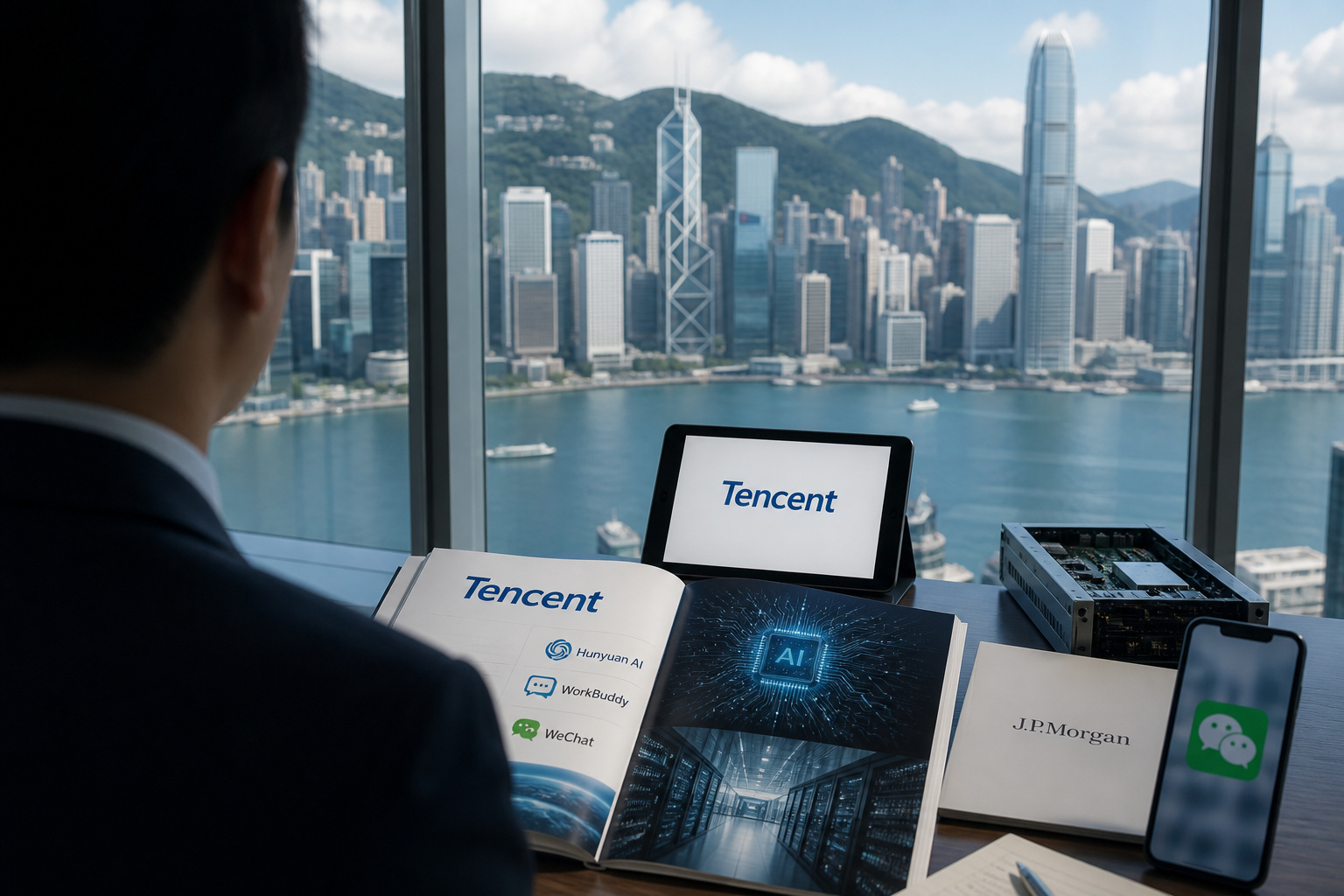
Tencent2026-08-13 05:22:41JPMorgan keeps Tencent at Overweight, says AI monetization will be the key testJPMorgan maintained its Overweight rating on Tencent Holdings (0700.HK) and kept its price target at HK$690 in a research note dated Aug. 13, framing the company as being in the middle of an AI investment cycle that runs through 2026 and 2027. The bank said 2026 could mark a low point for earnings growth, with adjusted EPS expected to rise about 2%, before growth recovers to a 10% to 15% range in 2027 as AI monetization starts to offset investment costs. The note pointed to Tencent’s second-quarter results, including revenue of 204.8 billion yuan, up 11% year over year, and non-IFRS net profit of 68.4 billion yuan, up 9%. It also highlighted 22% growth in marketing services revenue, 17% growth in domestic games, and 9% growth in fintech and business services. JPMorgan estimated quarterly spending on new AI products such as Hunyuan, Yuanbao, CodeBuddy, WorkBuddy and Xiaowei at about 10.5 billion yuan, above roughly 8.8 billion yuan in the first quarter. The bank said investors may read flat sequential profit and negative reported free cash flow as signs of stalled growth or cash burn, but argued Tencent’s core businesses still support the current AI push. It is now watching Hunyuan 4, deferred recognition of WorkBuddy paid-tier revenue, and testing and possible commercialization of WeChat agent Xiaowei.1620
AI investment2026-08-12 12:19:10Wall Street shifts its AI test from growth to cash flow as Big Tech spending comes under sharper scrutinyWall Street is no longer grading the AI trade on demand headlines alone. The focus has moved deeper into cash flow, capital intensity and the pace at which AI spending turns into revenue and returns. That shift was visible on Aug. 10, when NVIDIA unveiled a plan to work with Apollo, BlackRock, Blackstone, Brookfield, Goldman Sachs and KKR on an independent compute financing platform intended to mobilize more than $500 billion of third-party capital for AI infrastructure. The stock still fell 2.86% that day, with more than $70 billion in market value erased. Recent earnings reactions tell the same story. Alphabet reported 24% revenue growth and 82% growth in Google Cloud revenue, yet its shares fell 7.13% after results as free cash flow turned negative for the first time in a quarter since listing. Microsoft, by contrast, posted 18% revenue growth, stronger operating cash flow, $19.6 billion in free cash flow, 43% Azure revenue growth and a larger backlog, and its shares rose more than 15%. Meta, Apple, Micron, SanDisk and Western Digital added more evidence that investors are no longer rewarding AI spending automatically. They are asking which companies can fund the buildout, how quickly those investments convert into sales and cash, and whether future returns can justify the scale of capital being committed.1770
Temasek2026-08-12 03:38:42Temasek plans new investments in Samsung Electronics and SK Hynix in first move into South Korean stocksTemasek is preparing a new round of investment in Samsung Electronics and SK Hynix, marking the Singapore state-owned investor’s first entry into the South Korean stock market. According to government departments and institutions cited on Aug. 12, Temasek recently decided to invest in the two chipmakers and has already been in contact with the South Korean government to discuss the timing of execution. The firm is said to be handling the trades internally rather than hiring an external asset manager. A financial authority official said Temasek discussed market-entry timing after extreme volatility in the two stocks following approval of single-stock leveraged ETFs. The report said Temasek sees memory semiconductors as one of the most undervalued parts of the artificial intelligence value chain. The fund has been adding exposure across semiconductors, data centers, cloud services, AI model developers and software infrastructure, and plans to raise AI-related assets in its portfolio from 6% to as much as 15% over the next five years.2070
Taiwan stocks2026-08-12 00:38:22Foreign investors return to Taiwan stocks as gains edge past South Korea’s KospiForeign investors have turned back into net buyers of Taiwan equities after six straight weeks of selling, with August inflows reaching $1.7 billion so far, according to Bloomberg data cited by ABMedia. Over the same period, South Korean stocks saw net foreign outflows of $6.2 billion, marking a sharp divergence between the two major Asian technology markets following July’s global tech selloff. The shift has also altered the year-to-date performance rankings. Taiwan’s benchmark index is up 54% this year, overtaking South Korea’s Kospi at 52%. Fund managers and strategists cited in the report pointed to Taiwan’s broader technology supply chain exposure, stronger earnings revisions, and lower reliance on leveraged trading as reasons global capital has started favoring the market again. Bloomberg data showed analysts have raised 12-month earnings-per-share forecasts for Taiwan stocks by 9.5%, above the 7.4% increase for Korean shares. At the same time, some investors still see value in Korea after July’s pullback, with Aberdeen saying the Kospi’s valuation discount versus Taiwan has widened to a historic level. Societe Generale’s Frank Benzimra said the longer-term question remains whether global tech companies can turn heavy AI spending into real profits.1840
Goldman Sachs2026-08-10 05:36:10Goldman Sachs Sees Global AI Investment Topping $1 Trillion by End-2026Goldman Sachs analysts said in a recent report that global investment in artificial intelligence is set to exceed $1 trillion by the end of 2026, with US AI investment approaching $600 billion. In dollar terms, the projected US figure would account for roughly 60% of the global total. The bank's research unit, using its own estimate of AI investment preferences, calculated how much of US gross domestic product AI investment will account for by 2028. US AI capital expenditure as a share of GDP is expected to rise from 1.8% in 2026 to 2.5% in 2027 and 2.8% in 2028. Globally, AI investment as a share of world GDP is projected to climb from 0.9% in 2026 to 1.3% in 2027 and 1.4% in 2028. The US ratio is therefore roughly double the global ratio in each of those years, indicating the scale of AI spending expected in the American market. The figures come from Goldman Sachs Research and were reported by Odaily.1800
SoftBank2026-08-06 08:23:06SoftBank quarterly profit fell 18%, with Intel gains lifting resultsSoftBank Group reported quarterly net profit of 347.3 billion yen for the period ended June, down 18% from a year earlier but well ahead of the market consensus of 166 billion yen. The gap was largely explained by a sizable unrealized gain on Intel shares, which SoftBank bought last year at $23 apiece. Intel rose 216% during the quarter, producing roughly 1.3 trillion yen, or about $8.5 billion, in unrealized investment gains. Those gains helped offset losses in parts of the Vision Fund portfolio and softer growth in profits tied to SoftBank’s OpenAI investment. At the same time, investor attention has turned to the group’s balance sheet as Masayoshi Son steps up spending on generative AI. SoftBank is expected to complete about $65 billion in cumulative investment in OpenAI by October. To fund that push, the company signed a one-year $40 billion bridge loan and arranged a $20 billion margin loan backed by its Arm stake. The report also highlighted broader concerns around the AI sector, including rising competition, uncertainty over business models after heavy infrastructure spending, and the impact of any delay to OpenAI’s IPO timeline on SoftBank’s valuation.1810
quant funds2026-08-05 06:31:53Quant hedge funds post sharp July drawdowns as several products fall more than 20%China’s quant private fund sector suffered a broad pullback in July, according to a report cited by ChainCatcher from National Business Daily. Several firms saw monthly net-value declines of more than 20%, with some products’ year-to-date returns flipping from positive to negative. Among Huanfang Quant’s nine disclosed products, eight had fallen into negative territory for the year, and all posted losses of more than 20% in July. The largest drawdown reached 22.15%. Minghong Investment reported that nine of its 14 displayed products had posted negative returns for the year. Jiukun Investment showed better year-to-date resilience, with 14 of 15 products still in positive territory, though its monthly pullback was also described as notable. Yanfu Investment was cited as relatively steady by comparison. Several institutions said the sell-off reflected sentiment and trading structure rather than the end of the AI industry trend. Danshuiquan Investment said AI is still advancing rapidly in model capability, lower usage costs, and broader applications. Institutions added that AI investing is shifting from a first phase centered on computing infrastructure to a second phase of wider access to intelligence, which may benefit supply-chain companies serving top model developers and major cloud providers with cost-effective solutions.2020