BackBLAKE2

BLAKE2

WuBlockchain
2026-09-02 09:05:48

WuBlockchain August tech report: BIP-110 stalls, Glamsterdam goes public, Solana moves toward 350ms

WuBlockchain’s August technology report tracked a broad set of blockchain infrastructure updates across Bitcoin, Ethereum, Solana, major Layer 2 networks, and several other ecosystems. The report said Bitcoin’s long-debated BIP-110 entered real activation in August but failed to gain support, with miner signaling at only about 2.5% during the mandatory signaling phase. Nodes enforcing the rule began rejecting non-signaling blocks from height 961,632, effectively creating a minority chain that produced only around two blocks before largely stalling, while the main Bitcoin network continued as normal. On Ethereum, the Glamsterdam upgrade moved from internal DevNet testing into a public test phase, with DevNet 8/Platåberget launched on Aug. 13 and the Gloas fork activated on Aug. 20. Testing has shifted from basic functionality to edge cases and client compatibility, while tentative testnet activation targets of Sept. 28 for Sepolia and Oct. 26 for Hoodi have been proposed. Hegotá also advanced from open proposal intake into a narrower candidate-selection stage. The report also highlighted rising performance competition across scaling networks. OP Mainnet upgraded from 250ms Flashblocks to 200ms Subblocks, Base outlined a 200ms Native Blocks plan, and Solana is preparing to reduce mainnet slot time to 350ms starting from epoch 1020. In parallel, Arbitrum said real mainnet blocks can now be proven with SP1-generated ZK proofs, extending its path toward a multi-proving architecture.


220
WuBlockchain August tech report: BIP-110 stalls, Glamsterdam goes public, Solana moves toward 350ms
Bitcoin
2026-08-31 18:26:59

David Schwartz says post-vote BIP-110 chain amounts to an attack on Bitcoin

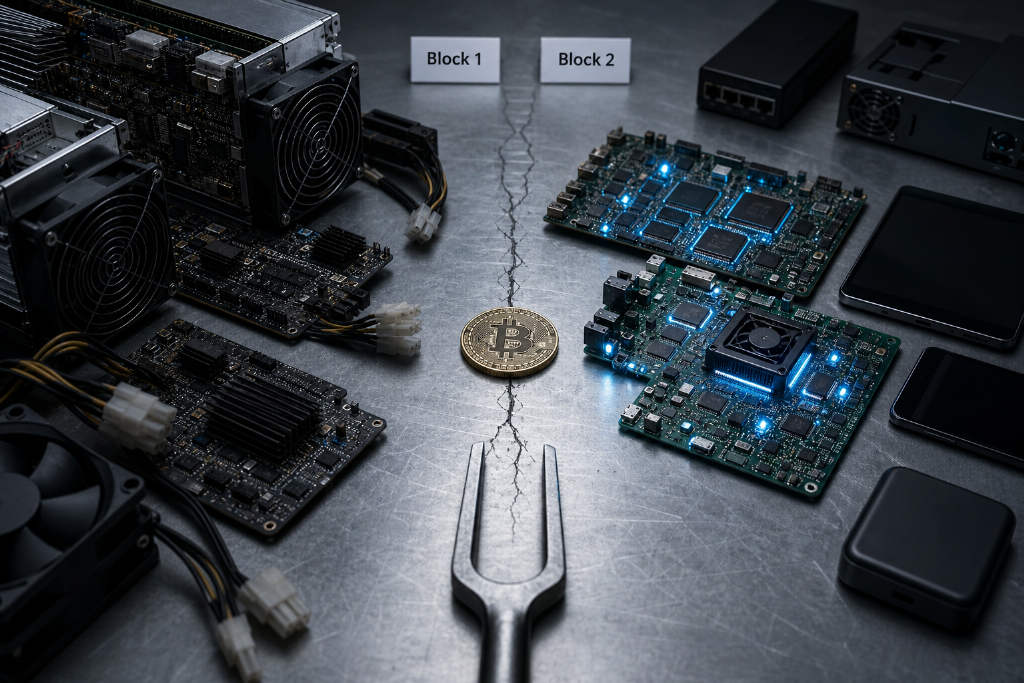
Ripple former chief technology officer David Schwartz said on Aug. 31 that backers of the Bitcoin BIP-110 fork crossed the line from governance into attacking the network after rejecting the soft-fork outcome and continuing to run an independent proof-of-work chain. In his view, losing a consensus dispute does not justify launching a separate Bitcoin chain, and doing so is itself an attack. The BIP-110 fork chain was activated at block height 961,640 through a flag-day hard fork. It replaced the SHA256d mining algorithm with BLAKE2b, introduced a new 164-byte block header, and added temporary rules that cap block size at about 300 KB until September 2027. Bitcoin Knots developer Luke Dashjr defended the changes, saying BLAKE2b lacks known weaknesses associated with SHA256d and that the redesigned block header closes a block-withholding flaw that previously required miner monitoring to detect. The fork grew out of Bitcoin Core removing old limits on OP_RETURN data, which opened more block space to non-monetary content including Ordinals and Runes. BIP-110 supporters wanted to preserve that space for payments. After the split, supporting mining pool Roughnecks produced only two blocks before the branch stalled, and the gap with the main chain widened to hundreds of blocks within weeks.

170
David Schwartz says post-vote BIP-110 chain amounts to an attack on Bitcoin
Bitcoin
2026-08-31 14:29:27

BIP-110 Backers Plan Sept. 1 Launch for BLAKE2b Fork Chain

Developers backing BIP-110 are planning to launch an independent proof-of-work chain on Sept. 1 that uses the BLAKE2b algorithm. The proposed chain would replace an earlier minority branch that produced only two blocks and failed to attract enough SHA-256 hashpower support. Under the hard fork plan, Bitcoin’s mining algorithm would shift from SHA-256d to BLAKE2b, which means existing Bitcoin mining machines would not be able to redirect hashpower to the new network directly. So far, no major exchange, wallet provider, or Lightning Network implementation has publicly committed to supporting the chain. Its launch still depends on whether the required technical conditions are met, according to Techub, citing crypto.news.

170
BIP-110 Backers Plan Sept. 1 Launch for BLAKE2b Fork Chain
BIP-110
2026-08-20 00:26:50

BIP-110 backers weigh a BLAKE2b fork to revive the minority chain as replay risks draw scrutiny

Supporters of BIP-110 are discussing another hard fork that would switch the stalled minority chain’s mining algorithm from SHA-256d to BLAKE2b. The issue drawing the most attention is replay risk: both chains still share transaction history from before the split, and if transaction and signature rules stay aligned, the same transaction could be copied and executed on the other chain. BIP-110’s miner support peaked at about 2.53%, and after the consensus rules took effect on Aug. 8, the minority chain produced only two consecutive blocks before stalling while the Bitcoin main chain continued and widened the block-height gap. The BIP-110 proposal was later marked closed, and discussion shifted to a BLAKE2b proof-of-work approach. Bitcoin Knots plans to add a new signature hash option, but RDTS is expected to keep compatibility with Bitcoin Core’s existing signature hash types. That means ordinary transactions may still remain valid on both chains, leaving users dependent on the new option and on wallets or hardware-signing firmware that support it in order to separate assets. Luke Dashjr said on Aug. 18 that Bitcoin should take responsibility for replay protection, calling it “Spamcoin.” If a BLAKE2b fork moves forward around Sept. 1, exchanges, wallets and holders would need to distinguish between cross-chain transactions and chain-specific ones.

420
BIP-110 backers weigh a BLAKE2b fork to revive the minority chain as replay risks draw scrutiny
Policy and Re
2026-08-16 11:43:02

Robinhood Chain leads NFT volume as ENS Foundation formalizes operations

A busy week across crypto projects brought updates in protocol design, governance, lending products, wallet security and payment infrastructure. Robinhood Chain posted $3.13 million in daily NFT volume, overtaking Ethereum, while its average daily transactions hit 11.6 million and TVL rose to $473 million. ENS token holders passed and executed the “Next Era of ENS DAO” proposal, turning ENS Foundation into a formal operating body with a full-time executive director, staff and a five-member board. On Solana, Jupiter rolled out Lend v2, a lending upgrade that lets deposited and borrowed assets also serve as trading liquidity. Other notable developments included Ethereum Foundation researcher Justin Drake saying Ethereum L1 will stop pursuing Poseidon and instead move toward SHA or BLAKE-based hashing options; Hyperliquid outlining a plan to route idle HLP USDC into its native lending pool; Uniswap redirecting creator fees tied to a test token into an automatic buyback-and-burn contract; UniSat raising the default seed phrase length for new wallets from 12 words to 24; a USENIX study finding security-rule violations across 15 x402 payment providers; MegaETH’s native stablecoin USDm dropping to roughly $18 million in supply from a peak near $600 million in May; and World Liberty Financial delaying a yield-token launch tied to a Trump-branded Maldives resort project.

630
Robinhood Chain leads NFT volume as ENS Foundation formalizes operations
Foresight
2026-08-15 02:00:54

Foresight’s weekly Web3 roundup tracks Bitcoin infighting, security breaches, Ethereum roadmap shifts and new corporate bets

Foresight News’ latest weekly Web3 roundup pulls together a dense mix of stories that shaped industry conversation over the past several days. At the center were the death of Quantum Fintech Group founder Harry Yeh in Paraguay, a fresh count showing that more than 300 Web3 projects have gone quiet over roughly 588 days, and renewed attention on Li Lin’s return through Avenir Group-backed UMX. Bitcoin also saw an old fault line reopen after BIP-110 triggered a chain split and cost Luke Dashjr his BIP editor role. The security section was just as busy. A DeFi whale lost roughly $25 million to $26 million in minutes, Trezor disclosed a ShipMonk-related data breach affecting close to 14,000 customers, Harmony was hit by an exploit that expanded ONE supply, and ZachXBT detailed a social-engineering scam tied to at least $5 million in losses. Foresight also reviewed Bybit’s effort to recover funds from the 2025 theft attributed to Lazarus Group, with recovered and frozen assets totaling about $78.9 million so far. On the project side, Vitalik Buterin’s updated Ethereum Strawmap elevated privacy and post-quantum security, Justin Drake said Ethereum would drop Poseidon at L1, Bitwise continued launching products while shutting eight ETFs and cutting staff, and Trump Media & Technology Group showed how far it has moved beyond a pure social-media business.

420
Foresight’s weekly Web3 roundup tracks Bitcoin infighting, security breaches, Ethereum roadmap shifts and new corporate bets
Ethereum
2026-08-14 03:53:48

Ethereum Drops Poseidon for SHA2 and BLAKE2 in Layer 1 Post-Quantum Shift

Ethereum is moving away from Poseidon at Layer 1, ending years of work around a hash function long favored in SNARK-based systems. On Aug. 13, Ethereum researcher Justin Drake said on X that the Ethereum Foundation had decided to abandon Poseidon in favor of traditional hash functions such as SHA2 or BLAKE2. The change comes after eight years of research, tens of millions of dollars in spending, and a broader reset of Ethereum’s post-quantum roadmap. The key technical driver is progress in binary-field SNARK design, which allows traditional hash functions to perform inside proving systems at speeds that were previously associated with SNARK-optimized designs. Drake said a laptop can now verify about 1 million conventional hash calls per second in a SNARK setting, while recent benchmarks from projects including Flock and SNARK.fast point to sharply improved throughput. The roadmap itself remains in place. Ethereum still expects a production-grade leanVM in 2027, followed by deployments across the consensus, execution, and data layers in 2028. The Foundation has also expanded its post-quantum work through pq.ethereum.org, weekly interoperability devnets involving more than 10 client teams, and two $1 million research prizes. The shift also comes as Solana and Starknet advance their own post-quantum plans using Falcon and BLAKE2-based transitions.

720
Ethereum Drops Poseidon for SHA2 and BLAKE2 in Layer 1 Post-Quantum Shift
ChainFeeds
2026-08-14 02:25:08

ChainFeeds research roundup tracks weak Bitcoin demand, Ethereum STARK debate and AI agent wallets

ChainFeeds published its Aug. 14 research roundup, pulling together five feature pieces selected from its Aug. 13 Web3 briefing. The package spans Bitcoin market structure, crypto venture and trading narratives, wallet design for AI agents, Ethereum’s long-term cryptography roadmap, and startup advice from Y Combinator CEO Garry Tan. The Bitcoin section, citing Glassnode, says BTC remains stuck between two key on-chain cost bases: the Median Realized Price near $63,000 and the Short-Term Holder Cost Basis near $68,700. Spot activity has fallen to one of the lowest levels in years, ETF demand has yet to show a convincing return, and leveraged longs in derivatives have built up ahead of a broader recovery. The report says a downside break would put focus on the June low around $58,500. Other pieces in the roundup argue that stablecoins and perpetuals remain crypto’s clearest native product-market fits, examine how products such as x402 and MetaMask Agent Wallet try to give AI agents controlled spending and execution power, and frame recursive STARK aggregation as a key tool for Ethereum’s post-quantum, privacy, and scaling agenda. The final feature highlights Garry Tan’s warning that chasing hot sectors can pull founders away from areas where they have genuine edge, while AI-driven coding is changing what counts as a durable moat.

900
ChainFeeds research roundup tracks weak Bitcoin demand, Ethereum STARK debate and AI agent wallets